
Rav Yisroel Meir HaKohen Kagan of Radin zt"l
הרב ישראל מאיר בן אריה לייב קאגאן זצ"ל
Elul 24 , 5693
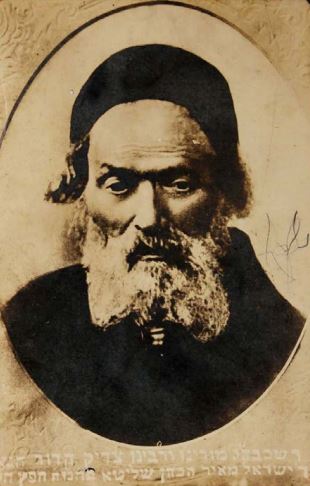
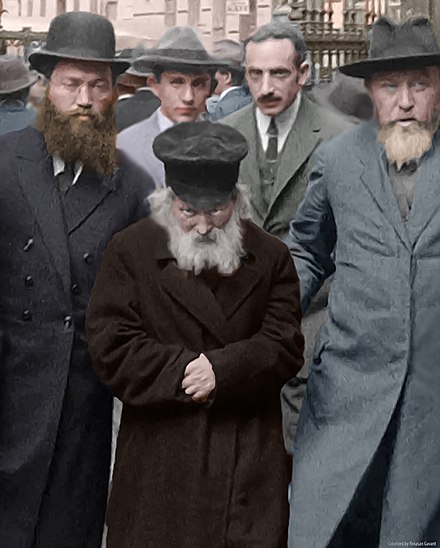

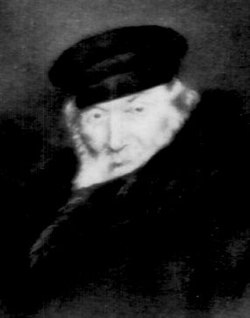
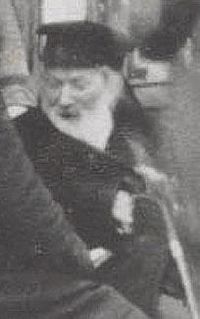
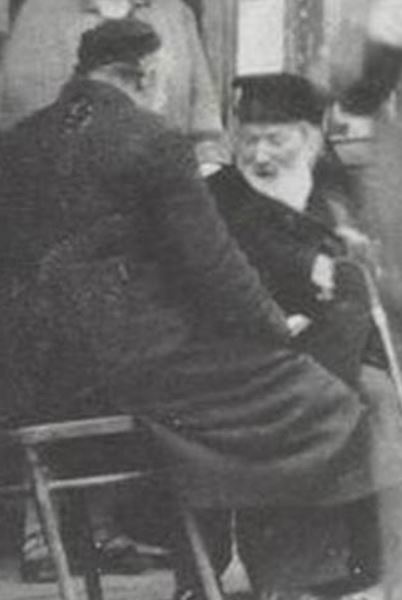
Rav Yisroel Meir HaKohen Kagan of Radin zt"l
Rabbi Yisroel Meir HaCohen Kagan is commonly known as the “Chofetz Chaim,” the name of his famous work on guarding one’s tongue. Born in Zhetel, Poland on February 6, 1838, he was taught untill age 10 by his parents and then moved to Vilna to further his Jewish studies. Refusing the pulpit rabbinate, the Chofetz Chaim settled in Radin (Poland) and subsisted on a small grocery store which his wife managed and he did the “bookkeeping”-watching every penny to make sure that no one was cheated. He spent his days learning Torah and disseminating his knowledge to the common people.
As his reputation grew, students from all over Europe flocked to him and by 1869 his house became known as the Radin Yeshiva. In addition to his Yeshiva, the Chofetz Chaim was very active in Jewish causes. He traveled extensively (even in his 90s!) to encourage the observance of Mitzvos amongst Jews. One of the founders of Agudas Yisrael, the religious Jewish organizaion of Europe and later the world, the Chofetz Chaim was very involved in Jewish affairs and helped many yeshivos survive the financial problems of the interwar period. Exemplifying the verses in Psalms 34:13-14, “Who is the man who desires life…? Guard your tongue from evil and your lips from speaking deceit,” the Chafetz Chaim passed away in 1933 at the ripe age of 95.
The Chofetz Chaim’s greatest legacy is the 21 sefarim (holy books) which he published. His first work, Sefer Chofetz Chaim (1873), is the first attempt to to organize and clarify the laws regrding evil talk and gossip. He later wrote other works, including Shmiras HaLashon, which emphasized the importance of guarding one’s tongue by quoting our Sages. The Mishnah Brurah (1894-1907), his commentary on the Daily Laws of a Jew (his first series in the Shulchan Aruch), is found in many Jewish homes and is accepted universally to decide Halacha.
Firmly believing that he was living right before the time of Moshiach and the rebuilding of the Holy Temple, the Chofetz Chaim wrote a work that stressed the learning of laws concerning sacrifices, the Holy Temple, and related topics. He also published seforim to strengthen certain aspects of Jewish life including kashrus, family purity, and Torah study.
https://torah.org/learning/halashon-ccbio/
By Rabbi Nosson Scherman
A little more than one hundred years ago, an unknown author was arranging for the publication of an anonymous work on a much-ignored topic. Reb Yisrael Meir Kagan of Radin, Lithuania, had spent two winters, 5630 and 5631 (1870 and 1871), writing Chofetz Chaim, a compilation of the laws regarding slander and defamation. During 5632, he was engaged in getting pre-publication orders from the general public and securing testimonials from outstanding rabbinic authorities. In those days, when he was a young man in his thirties, Reb Yisrael Meir still thought he could retain his anonymity. He introduced himself as the publisher, rather than the author, of the novel Shulchan Aruch. In this guise he succeeded in evading recognition by the masses, but the spiritual giants of the age – men like Rabbi Yisrael Lipkin (Salanter) – saw that they were dealing with one of those rare figures who would leave his imprint on a nation. More than sixty tireless years, twenty-four additional volumes, and countless public letters and appeals lay ahead of the young “publisher,” but the pattern of his long and busy life was already apparent when he was still unknown by circumstance as much as by choice.
A major reason for the enormous influence and acceptance won by the Chofetz Chaim was his utter and complete integrity. Statements and actions that would have seemed unctuously pretentious in ordinary humans were natural and unaffected coming from him. A case in point is the very topic of his “Chofetz Chaim” – gossip and witty character assassination are not twentieth century phenomena; human tongues have always been loose and hard to control. The Talmud says, “Most people are guilty of dishonesty, few of vice, but all of lashon hara”(Baba Basra 165). Anyone presenting a book codifying the sins of slander could expect to be greeted with much scorn – private if not public. Yet, when Reb Yisrael Meir mounted pulpits in town after town to discuss the forthcoming Chofetz Chaim, he was listened to with respect. The people sensed that he was no salesman hawking a product, but one of those rare finds – an honest man whose love for his fellow Jews was expressed by trying to bring them closer to Torah, and who truly believed in the ability and obligation of people to pursue perfection. They were convinced that he wrote Chofetz Chaim not for recognition and for library shelves, but – as advertised – because he expected working men as well as scholars to form study groups to learn and put into practice what he had gleaned and compiled, and what was forged into his personality.
Many of the rabbis whom he approached for endorsements were skeptical of the first person to so systematically attack a sin that the Talmud considers universal. To avoid bringing ridicule not only upon himself but upon his stated purpose – and thus, paradoxically, provide yet another topic for gossip mongering – the personal credentials of the author as one who “withholds his tongue from evil” had to be unimpeachable. Some went so far as to assign students or colleagues to engage Reb Yisrael Meir in conversation to try to trap him into lashon hara, thus revealing him as no less mortal than the next man. The ruses invariably revealed the greatness of the author, and the endorsements were forthcoming.
No one knows for sure what prompted Reb Yisrael Meir to write Chofetz Chaim, but it was certainly not his finding an unexplored, fertile field for research, for the Chofetz Chaim never took pen in hand, except in response to a concrete need. To reveal his reason for compiling his Shulchan Aruch on lashon hara would have involved dredging up sordid stories of the very type he was trying to still. His son, Reb Aryeh Leib, conjectured that his father’s first masterpiece grew out of a bitter controversy in the town of Radin during his youth. Acrimony had swirled about the town and all efforts to bring peace had failed. The town became divided into factions and its rabbi was forced to leave. He died after a few years in a new position and many blamed his early death on the anguish he suffered during Radin’s little war. Reb Yisrael Meir, then a young man, had seen his fellow townspeople turn their tongues into ugly lethal weapons. As long as he lived, he never discussed the dispute, saying simply, “I have a self-imposed restriction against speaking of it,” but it may very well be that the Chofetz Chaim was his response in the form of an appeal that there be no more such incidents in Radin – or elsewhere.
A New Need / A New Book
Whenever he wrote, it was to answer a need. Russia’s conscription policies forced many Jewish boys into the army for periods of at least six years, cutting them off from religious teaching and influence. They needed encouragement and answers to basic questions of halachah in layman’s language. The result was Machneh Yisrael, a book that became the link to Judaism for many a Jewish soldier.
o Heartbreaking tales of the breakdown of religion among Jewish immigrants to America led to his Nidchei Yisrael. In providing practical answers to the halachic problems peculiar to the immigrant, Reb Yisrael Meir often rendered lenient decisions that took into account the emergency conditions of the immigrants, but which were inappropriate to the thriving religious life of Eastern Europe. Because of this, he had hoped that Nidchei Yisrael would not be distributed in Eastern Europe, but inevitably some copies were seen. This led to criticism of the Chofetz Chaim – something he regretted, but considered unimportant in view of his primary goal of aiding the uprooted Jews in America.
o Reb Yisrael Meir felt that the practical laws of kindness and charity were too often ignored. His reaction was to do for gemilas chessed what he had done for shmiras halashon (guarding one’s tongue) – codify its laws, and actively campaign for Jews to join study groups to learn and to act upon them. As a result of his slim classic Ahavas Chessed, literally hundreds of free loan societies, shelters for the homeless, and bikur cholim societies sprang into being. Many of them sent requests to the Chofetz Chaim for letters of greeting and blessing that would be bound as the first page of a new organization’s ledger book.
o Weakening of adherence to the laws of family purity and of personal modesty led to pamphlets in both Hebrew and Yiddish addressed to Jewish women.
o There were booklets in both languages urging men to pursue Torah study in their homes . . . and the list goes on and on.
The personal attention Reb Yisrael Meir devoted to the publication of his ethical works did not end when the volumes were printed and distributed. He did not write his books to be purchased; he wrote them to be used. His frequent lecture tours in behalf of one or another of his sefarim were devoted primarily to encouraging people to set up groups for the study of the sefer. In later years, when he was too old or too busy to go on personal tours, he hired “field representatives” to carry on his work. But they were firmly instructed that they must sell the message of the books by personal example and persuasive lectures.
Fire-and-brimstone preaching was not his approach; he was a firm believer in the superior efficacy of a spoonful of honey to a gallon of vinegar. Once a traveling preacher complained to him that no matter how much he thundered and reprimanded his audiences, they seemed to ignore his calls to repent. The Chofetz Chaim replied, “Who told you that the way to perform the mitzvah of correcting sinners is by shouting and storming? Putting on tefillin is also a mitzvah – do you holler and shout when you perform that mitzvah?”
An Imminent Need / A New Syllabus
In addition to salvaging neglected mitzvos, the Chofetz Chaim assumed responsibility for reviving interest in a long neglected area of the Torah. For centuries, Kadoshim, the section of the Talmud dealing with the laws of the Sanctuary and sacrificial offerings, had been virtually excluded from the curricula of major Torah centers. Rare were the scholars who had more than a passing familiarity with its intricacies. Reb Yisrael Meir saw this as a far more serious matter than a lack of knowledge among Torah intelligentsia. With the deceptive simplicity that masked his penetrating insight, he would ask, “We believe that Mashiach can arrive today. If he does, are we ready to bring our offerings to the Bais Hamikdosh? Do the Kohanim know the laws of sacrifices? Do the scholars know enough to train the Kohanim?”
Obviously, the answer to all these questions was a shameful “No.”
“Then are we not somewhat lacking in our prayers, hopes, and beliefs in the imminent coming of Mashiach?” The solution was simple: organize groups to study Kadashim. Thus was born a trend that continues to this day. Far from being neglected, the study of Kadashim is now a mark of prestige; the endeavor of the most advanced group in nearly all yeshivos.
Typically, the Chofetz Chaim showed the way by practical example as well as by exhortation. He published Toras Kohanim, a compilation of the Tannaitic interpretations of Chumash Vayikra, with an amended, completely accurate text; and an original commentary that ranks as a model of conciseness and clarity. He also composed Likutei Halachos modeled after the Alfasi, which is a compilation of halachic sections of the Talmud dealing with Kadashim topics; and included an elucidating original commentary.
Magnum Opus: “Mishnah Berurah”
Of all his literary efforts, his acknowledged masterpiece and the one which continues to have the greatest influence is Mishnah Berurah, a work that was twenty-five years in the making.
The Chofetz Chaim was concerned by a serious gap in halachic literature. There was no modern commentary on Orach Chaim (the section of the Shulchan Aruch dealing with daily and festival rituals) that summed up the centuries of comment and responsa, and rendered authoritative decisions in areas of dispute. Clearly such a work was much needed, but it could be undertaken only by a giant in Torah scholarship. The mantle was not sought by the Chofetz Chaim. He urged it upon others, but finding no one willing to assume the responsibility, he finally accepted it upon himself. The breadth, conciseness, clarity, and genius of Mishnah Berurah speak for themselves, as does the almost universal acceptance it has attained. This is the supreme testimonial to its author’s stature as a sage.
He did not write the Mishnah Berurah simply because he wanted to, but because he saw it as a task that had to be done by someone, and his inability to find that someone left the responsibility at his doorstep. This is testimonial to his greatness as a person.
II. The Man of the Legends
The Chofetz Chaim was surely a scholar’s scholar. More than this, however, he was also a genuine folk-hero. Scholars respected him, but the common people loved him with a rare passion. The reasons are many and no doubt complex. But the most compelling one is simply that he considered himself as one with them and their problems. Even his books, despite the great scholarship they represent, were written to be used by ordinary men – and in many instances, by ordinary women, too. Sensing that he identified with them, people did not hesitate to seek his advice and assistance.
Although he never accepted the position of rabbi in Radin, he was in fact its spiritual and temporal leader. When some townspeople unfairly criticized and embarrassed their rabbi for the deficiencies of the town’s mikvah, it was the Chofetz Chaim who guaranteed the funding and supervised the building of a new one. When Radin was devastated by fires that, in successive years, destroyed first one half and then the other half of the Jewish section, it was he who organized emergency relief, fund-raising, and the rebuilding of the town.
A poor workingman was not ashamed to ask him, as author of Ahavas Chessed, how a laborer living hand-to-mouth could be expected to perform the mitzvah of lending money to others. And he did not feel patronized when he was told to save a few pennies a week, eventually building it up to a fund of several rubles, for loaning to fellow workers short of pocket money. That was down-to-earth advice that was followed by thousands, and it was typical of the pragmatic idealism of a man who never took a penny offered to him by people who had the notion that his greatness entitled him to gifts.
The Chofetz Chaim’s awesome care in maintaining the strictest possible standards in his financial dealings has become legendary. No doubt many of the stories attributed to him are apocryphal – but, for most of them, there is more than ample first-hand testimony … He insisted that his son reprint hundreds of sections of Mishnah Berurah to replace originals where pages had inadvertently been put in the wrong order. … The Chofetz Chaim himself once went dashing through the Jewish quarter of Warsaw shortly before Shabbos seeking to pay printers who had left work early without getting their pay for the week … When a non-Jewish railroad employee put parcels of his books on board a train for free delivery, the Chofetz Chaim tore up an amount of postage stamps sufficient to defray the loss of revenue to the government … In his first speaking tour on behalf of the book Chofetz Chaim, he accepted orders, but not deposits, because of the possibility that he might not be able to make delivery to some pre-paying customers, thus becoming guilty of improperly taking their money … The stories are legion.
Saint and Pragmatist
It is commonplace for people to believe that the Chofetz Chaim, as a saintly personality, could not have been terribly practical and certainly could not have coped with the rough and tumble of the world – especially today when so many accept as axiomatic that “you cannot make an omelette without breaking a few eggs,” and that “nice guys finish last.” Nothing could be further from the truth. It was this same saint who once remarked that one fool can do more damage than ten villains. Men like Rabbi Chaim Ozer Grodzensky of Vilna greatly valued his wise counsel when searching for practical solutions to the knottiest of problems. Indeed, in the crisis-laden years following World War I, when Reb Chaim Ozer was the undisputed leader of Lithuanian Jewry, he and the Chofetz Chaim were in constant consultation on all major issues. Their names appeared side-by-side on scores of proclamations and appeals in behalf of all the major causes in Jewish life.
The Chofetz Chaim was one of the first to realize that Torah Jewry must up-date its tactics to counter the onslaught of its enemies. Organized activities for the Torah community and its educational needs could succeed where efforts on the individual scale could scarcely cope with the juggernauts of Haskalah and secularism. Thus he took the lead in organizing and supporting Agudath Israel as the international organizational arm of traditional Jewry. As usual, he saw this as more than a matter of strategy, but as a religious obligation: “In a time when our values are under attack as never before, even small acts in defense of Torah are multiplied many times over in the Divine scales for ultimate reward.”
Though he was the senior of the two by nearly thirty years, the Chofetz Chaim considered Reb Chaim Ozer to be the gadol hador and deferred to his authority as a matter of course, despite the fact that Reb Chaim Ozer held him in awe. During the 1920’s, pressure was brought to bear on Reb Chaim Ozer to travel to America to raise money for the European yeshivos, which were on the brink of financial ruin. He was told that only his own presence in America could assure contributions in the millions. Reb Chaim Ozer answered that his health was too precarious to permit such a trip. Though the other Torah luminaries at the meeting continued to exert pressure upon him, the Chofetz Chaim ended the debate by saying very simply, “The well-being of Reb Chaim Ozer is synonymous with that of Klal Yisrael. We dare not jeopardize it.”
Storm Over Vilna
The prestige of Reb Chaim Ozer was responsible for an unheard-of departure by the Chofetz Chaim – an open attack upon adversaries of Torah Judaism. His general policy had been always to avoid engaging Torah’s enemies in debate. To reply to the virulent attacks made by maskillim, yevsekes (Jewish Communists) and others, he felt, would be self-defeating because it would grant them unearned recognition, and merely provide them with fuel for vituperation and ridicule. Better to isolate them from the mainstream of religious life, while devoting the available talent and resources to the more productive course of strengthening Judaism by upgrading education and observance within yeshivos and communities. Then came the storm over the Vilna rabbinate.
The government required that Vilna have a Chief Rabbi. Although Reb Chaim Ozer was a recognized leader of religious European Jewry, Vilna’s official Chief Rabbi was to be elected by the entire Jewish population, which included a large secular contingent. Agudath Israel doubted that Reb Chaim Ozer would be able to command a majority of the total votes, so they joined a coalition of the Mizrachi, Socialists, and Reformers to “elect” a Rabbi Rubinstein as a pro-forma head of the Jewish Community, with the understanding that he would not assert any authority without Reb Chaim Ozer’s approval. After his election, Rabbi Rubinstein’s secularist supporters used this consensus as a pretext for treating him as the actual Chief Rabbi of Vilna, and Reb Chaim Ozer, the man who was revered the world over, found the ground cut out from under him in his own city. Strangely enough, the only important Torah figure whose serenity was not shattered was Reb Chaim Ozer himself. That did not prevent his adherents, led by the Chazon Ish and guided by the Chofetz Chaim, from doing battle to defend the honor of Torah. The Chofetz Chaim published a blistering letter attacking the perpetrators of the coup as enemies of Torah. Though disciples of Reb Chaim Ozer attempted to negotiate a face-saving compromise, the Chofetz Chaim torpedoed these efforts as going against the inviolable principle of Torah supremacy.
The secularists’ reaction to his bold position was one of those human spectacles that must be greeted with laughter or rage. The non-religious Jewish press in Vilna vilified the Chofetz Chaim for stooping to lashon hara against the liberal Jews! His reply was simple and to the point: “When Torah values are being destroyed, Torah Law permits their defense.”
His deference to Reb Chaim Ozer, however, did not prevent the Chofetz Chaim from arguing his own causes in the humorous, self-deprecating manner that he used so effectively. In 1923, the Chofetz Chaim felt that the community must be organized to provide kosher meals for Jewish soldiers. He called his new project Kessel Kosher (Kosher Kettle) and, naturally, his first move was to travel to Vilna to secure the endorsement and support of Reb Chaim Ozer. The endorsement was not forthcoming. Reb Chaim Ozer replied that there were many overriding considerations making such a campaign inopportune at that time.
The Chofetz Chaim shrugged and replied, “What can I do? People consider me to be a God-fearing Jew. When I am called to the world-to-come, they will ask me why I did nothing to provide kosher food for Jewish conscripts. What will I say? Perhaps I’ll tell them that I was not lazy or indifferent; I made the hard trip to Vilna even though I was weak and past eighty. But the Rabbi of Vilna was the gadol hador and he said I was wrong. Who knows better than the gadol hador what is right or wrong?”
Reb Chaim Ozer knew he had been bested. He called a public meeting in the central synagogue to be addressed by the Chofetz Chaim. At that meeting Kessel Kosher was born.
III. As the Chofetz Chaim Would Say . . .
Precisely because he had such a keen feel for the pulse of the people and the needs of the time, it is fascinating – and useful – to wonder what the Chofetz Chaim would have said to today’s problems. Indeed, we should go a step further and wonder how he would have defined the real problems of today. After all, Chofetz Chaim and Ahavas Chessed were effective replies to problems not even recognized by most. It would be a mistake to take the sizeable collection of his major and minor writings, apply them to each era, and assume that the Chofetz Chaim would have had nothing more to say.
How would he have diagnosed today’s ills? This question should be answered by the few survivors of his era who knew him well, but perhaps we can hazard some guesses.
o There is little doubt that he would be appalled at the sharp and shady business practices that are so much a part of modern life, Orthodoxy not excluded. We live in an age when ethics have not kept pace with sophistication, and Jews have not escaped contamination. How would he have prodded our con- science?
o Picture the Chofetz Chaim entering a typical middle-class home today with its emphasis on “creature comforts,” and recreational pursuits rather than a Torah atmosphere . . . Would he have smiled tolerantly? Or would he have considered his surroundings more appropriate to the House of Romanoff than to the House of Israel, and told us so?
o What would he say to the growing gap that divides yeshiva, rabbinate, and laity from one another?
o And what about the organizational weakness of Orthodoxy? He was one of the founders of Agudath Israel, long aware that modern times required modern tactics – and organizational unity was one of them. Surely he would work to end today’s factionalism.
o In this time of turbulence when the values of centuries are being discarded, we may be certain that the Chofetz Chaim would have found our attitude wanting and far too complacent. We are content to condemn the drug culture, but are ill prepared for our own acid test. Indicative of this is a memoir of one his students, Rabbi Avrohom Hillel Goldberg, later rabbi of Kfar Pinnes in Israel:
It was near the end of his life and the Chofetz Chaim was in a summer cottage near Radin. He was heart-broken over the persecutions of Jews in Russia. He saw their situation as the severing of an entire limb of the Jewish body from its life-sources of Torah and mitzvos. “There is only one real hope,” he said – “Mashiach must come soon. The Final Redemption must come sooner or later, but it is up to us to hasten its arrival. We must demonstrate our overpowering desire for Mashiach. How many of us religious Jews who say ‘Ani Maamin’ every day truly long for his coming? Why don’t we cry out to Hashem to help us? This is no time for silence!
“Even in the Egyptian exile the Torah says that only when B’nei Yisrael cried out for help – then did their outcry go up to Hashem. We must do the same now! I must go to Vilna to Reb Chaim Ozer – without him nothing can be done!”
His family and students were aghast. He was over ninety years old and he could scarcely leave his armchair for the length of a day. He might not survive the difficult trip to Vilna. They pleaded with him to abandon his plan, but he would not be dissuaded. The goal was worthy of even mesiras nefesh. They told him that Reb Chaim Ozer was a man of halachah and action; such ideas as the Chofetz Chaim’s were out of his domain. He smiled as if to say, What do you know of Reb Chaim Ozer?
To his deep regret, the journey to Reb Chaim Ozer never took place. Had they met, who knows?
This article originally appeared in the Jewish Observer and is also available in book form in the ArtScroll/Mesorah Publications Judaiscope Series.
Matzav.com
Stories of Rav Yisroel Meir HaKohen Kagan of Radin zt"l

In 1923, the Chofetz Chaim zt"l traveled to Vienna to participate in the Agudas Yisroel convention, and he spent some time together with R' Avraham Mordechai Alter zt"l, the Gerrer Rebbe. In the course of their discussion, the Chofetz Chaim cited the verse from that week's parsha (Devorim 13:5):אחרי ה' אלקיכם תלכו ואתו תיראו ואת מצותיו תשמרו ובקלו תשמעו ואתו תעבדו ובו תדבקון:
"Acharei [literally, 'after'] Hashem, your God, shall you follow and Him shall you fear; His commandments shall you observe and to His voice shall you hearken; Him shall you serve and to Him shall you cleave." The Chofetz Chaim commented:
"Our Sages observe that the Torah uses two words for 'after' - 'Acharei,' which means 'long after' (or 'far away') and 'achar,' which means 'soon after' (or 'close'). Why does our verse use 'acharei,' implying that one should follow Hashem from a distance? In fact, one should become as close to God as possible!" He explained: Sometimes a person becomes depressed, and he feels that he is standing on the brink of a cliff as far from God as can be. He is confident that Hashem will not help him at this moment. One should know that such feelings are the work of the yetzer hora. Hashem is a Jew's "Father" at all times, and He accepts His children when they return to Him and saves them from all troubles. Even when one is "acharei," "far away," he should not despair of following Hashem. This is the meaning of the words in the High Holiday prayers, "Fortunate is the man who will not forget You, and the human being who will find strength in You."
The Gerrer Rebbe responded: "Now I will try to interpret this verse in the manner of the Chassidim. Specifically when a person feels distant from Hashem, that is when he can best follow Hashem, as it is written in Tehilim: 'God is close to the broken-hearted'." Otzrosaihem Shel Tzaddikim https://www.shemayisrael.com/parsha/parkoff/archives/lagbaomer76.htm
by A. Ben-Yitzhar
Musaf Shabbos Kodesh Pesach 5756
There are certain times and moments that cannot be described in words. Rather their contents speak for themselves. Hours, which by virtue of your having lived them, can take you back at any time to generations past. This was the feeling we had when interviewing one of the Chofetz Chaim's early talmidim.
His name is HaRav Kalman Farber. For ten years he studied under the tutelage of Maran, the author of Chofetz Chaim and Mishna Berurah, zt'l.--Ten years of life spent on a different plane, one of holiness, ruchniyus, otherworldliness.
This can be understood by those for whom the very name Chofetz Chaim elicits a certain tremor, for whom not a day goes by without reaching for one of the tens of his holy seforim. Are there any among us who can remain impassive when sitting in the presence of an elderly man, who retains a clear, bright picture, of his esteemed rebbe, Maran the Chofetz Chaim, and who is able to reenact his many conversations, sayings and mannerisms?
Rav Kalman Farber is more than willing to share his wellspring of memoirs; all one has to do is sit and absorb his every word uttered in his inimitable deep voice, a voice whose clarity has not been marred by advanced age.
"So it's the Chofetz Chaim you came to hear about?" Rav Farber opens the interview. "Ahh, three generations have passed since then. Three whole generations separate us from those days, that era. Today nothing is the same. Different concepts, a different generation!" He becomes lost in thought, but quickly shakes himself out of his reverie.
"O.K. I'll try to tell you stories that have not yet been published in all the books about the Chofetz Chaim," begins Rav Farber.
"For two years I had the privilege of participating in the limited minyan of yeshivaleit who davened Shacharis together with the Chofetz Chaim in his tiny room. When I had just arrived at the yeshiva, the Chofetz Chaim was still able to get around independently, albeit slowly, and with two bochurim supporting him on either side. Later on though, this too was difficult for him and he would come to the yeshiva with "Avrumke, the baal agola." [In eastern Europe at that time the main means of local transportation was a horse and wagon. Avrumke had a horse and would take the Chofetz Chaim wherever he needed to go.] However, he continued to daven at home and a steady minyan of bochurim was arranged.
Shemiras Hayodayim
"I noticed that whenever the Chofetz Chaim saw a fly or some other pest that he wanted to chase away he would hold the corner of his tallis or his handkerchief, but he would never use his bare hands. Also he never touched his face with his hands.
"For many years I could not understand the reason for this; the face is considered a naturally-exposed area of the body which one may see and touch. Recently, after having read the stories written by his son, HaGaon HaRav Leib zt'l I finally understood. Rav Leib told about the time that the Chofetz Chaim fled with the yeshiva and his family from Poland to Russia. It came time to daven Mincha and they entered a shul. `Before davening,' Reb Leib said, `I washed my hands as prescribed by the Shulchan Oruch but I noticed that my father began davening right away. Afterward I asked my father about this and he answered, "I guard my hands at all times!" '
"Now the reasons for the Chofetz Chaim's holy actions finally became clear to me," Rav Farber says. "The Chofetz Chaim was simply cautious that his hands remain tohor at all times and therefore he did not touch anything. Just as he guarded his tongue [from evil speech] he guarded his hands! Therefore, when he had to chase away a fly he would use something to cover his hands.
"From this we can gain an inkling of how the Chofetz Chaim became what he was; just as he guarded his hands he guards his eyes, his tongue-- everything!"
"Operation Rickshaw"
"If I already told you how the Chofetz Chaim would come to the yeshiva, then I will tell you something that is almost unprintable--but I'll tell you anyway. As I mentioned before, the Chofetz Chaim had a wagon driver called Avrumke who transported him to yeshiva at regular times. Sometimes, though, the Chofetz Chaim would let us know that he wanted to come to the yeshiva in the middle of the day. We were then faced with the problem of finding Avrumke and his horse.
"The Chofetz Chaim had his own wagon which stood outside his house. It was padded and constructed in such a way that he would be able to travel in relative ease and comfort. When we were unable to locate Avrumke, one bochur would simply take the place of the horse, while another would sit in the driver's seat with his back to the Chofetz Chaim. Other bochurim would then seat the Chofetz Chaim in his place in such a way that he would not be able to discern the nature of the "horse" or the identity of the driver!
"In this fashion they traveled the approximately 200 paces from the Chofetz Chaim's house to the yeshiva. When they arrived at their destination, a group of bochurim would block the Chofetz Chaim's view of the "horse" and "driver" as he was escorted into the yeshiva so that he would never suspect the truth. A few bochurim were in charge of this operation'. "
They're Watching!
"If we are already discussing Avrumke the wagon driver, I recall an interesting meeting I had with him, many years later, in Eretz Yisrael. Once on Shabbos between Mincha and Ma'ariv, I walked into a shul, here in Tel Aviv, in the Kiryat Shalom section. I saw a group of elderly men sitting around the table listening to one old man telling them about his personal experiences with the Chofetz Chaim: `Once I was driving the Chofetz Chaim to the train station, and I saw an orchard on the side of the road. One of the trees' branches, laden with apples, extended over the road. Nu, so I stepped down from the wagon and went to take some apples, when all of a sudden I heard a shout from behind me, "They're watching! They're watching!"
"`Needless to say I hurriedly jumped back on the wagon and drove away as quickly as I could. I could get in deep trouble for taking those apples. As I drove away I looked all around, but there was not a living soul in sight! I turned to the Chofetz Chaim and said, "Rebbe, what did you mean, they're watching? There's no one around!" "Ahh," answered the Chofetz Chaim, "of course they're watching, they're watching from Above!"'
"I was understandably very curious to know who this old man was," continues Rav Kalman, "so I edged closer to the table, and I was amazed to see that it was none other than Avrumke, the Chofetz Chaim's wagon driver! He was sitting there recounting stories of his travels with the Chofetz Chaim. He continued:
" `On one of his trips the Chofetz Chaim said, "Let's learn a perek mishnayos Reb Avrumke."
" `Nu, so how do you think we learned? The Chofetz Chaim would recite the mishna by heart, word for word, and I would repeat after him. "You see?" the Chofetz Chaim would say after a while. "We learned a perek mishnayos!"'
Rav Kalman interjects, "He would treat these plain people with such simplicity and so naturally that they felt he was one of them. I remember, that when I would return to the tiny village where my parents lived for bein hazmanim, they would ask me, `Nu, so how is Reb Yisroel Meir doing?' That was how close they felt to him. On the other hand, there is no denying the great admiration they had for him. All the villagers would crowd around me waiting to hear any story, or saying or hanhogah from the Chofetz Chaim. They wanted to hear more and more.
"His humility and simplicity were absolutely incredible," Rav Kalman continues. "In his house there were no chairs, just some long, rough-hewn benches and a plain, long table that opened out at both sides. That was the extent of his furniture.
"Now, when his son-in-law, Rav Mendel Zaks, zt'l was appointed rosh yeshiva of Radin, an unpleasant situation developed. Rav Mendel lived on the second floor of the Chofetz Chaim's house. Now that he was rosh yeshiva, bochurim wanted to come to him to talk in learning, but there was nowhere to seat them. Not everyone felt at ease sitting on the benches shoulder to shoulder with their friends; they wanted a degree of privacy when speaking to the Rosh Yeshiva. So, they ordered twelve chairs. Some were put in the kitchen, some on the ground floor where the Chofetz Chaim was, and the rest upstairs by Rav Mendel. That's what was missing in the house--chairs!
"Then when the Chofetz Chaim came home and saw all the "new furniture," he was aghast. `What is all this doing here?' he asked, whereupon his family explained to him the reason for the purchase.
"The Chofetz Chaim was still incredulous. `Twelve chairs? Twelve? One I can understand, for the head of the household. A second chair is also necessary for the lady of the house. Let's say a guest comes, so, okay, the guest also needs a chair. But twelve chairs? For what? "Hashem's Name is not whole, and His throne is not whole." The Ribono shel Olom doesn't even have one whole chair, and here there are twelve chairs?!' The Chofetz Chaim was simply unable to comprehend the purchase, and you must know that every word of his was spoken with absolute truth and sincerity, with no embellishment or exaggeration."
Faith That Can Be Felt
"Along with his tremendous astuteness and remarkable genius, the Chofetz Chaim possessed a simple faith that is almost impossible to describe. Everything was obvious and simple to him, with absolutely no chochmos. He would speak to Hakodosh Boruch Hu as if he were speaking to a king who was standing right in front of his eyes, like a son speaking to his father. Whatever happened to him, or whomever he met -- he deemed nothing as coincidental or without cause. For him, all events had their root in spirituality, and he was able to learn a lesson from them. Whatever he heard held deep significance for him, and he did not believe that there existed anything that was devoid of meaning.
"When he was in Russia, during the time that he fled with the yeshiva from Poland, a certain Jew came to him to ask for a brochoh. The Chofetz Chaim placed his hand on him and asked, `Reb Yid, where are you from?' `From Minsk,' was the answer. `And what is your occupation?' the Chofetz Chaim continued to inquire. `I deal in animal hides,' the Jew replied. `And how's business? Is it going well?' The Chofetz Chaim asked. `Boruch Hashem business is very good,' he answered.
"The Chofetz Chaim couldn't understand how a Jew could be prospering under the tyrannical rule of Czar Nikolai, and he voiced his puzzlement. `I work with the royal ministers, they buy my hides,' the Jew explained. `Oy, you work with the Czar's ministers?' the Chofetz Chaim asked. "How can you work with them, they're murderers! How do you manage?'`I bribe them,' the Jew explained simply. `Bribe?' continued the Chofetz Chaim. `And without a bribe they won't purchase your merchandise?' `Rebbe, if I wouldn't bribe them they would start checking every single piece, finding all kinds of flaws and defects, and in the end they might not even agree to buy anything. What would I do then? So, I bribe them and then everything goes smoothly; they take everything without checking or examining too much.'
"The Chofetz Chaim immediately answered, `Aha, that's exactly how things work with us! A person davens, does mitzvos, but the prosecuting angels begin to testify against him: Here his prayer was not the way it should have been, there, while learning he fell asleep or chatted, etc., in short, everything is blemished. So what does HaKodosh Boruch Hu do in order to help this Jew? He calls over the good angels. They immediately begin to defend him saying, `What do you want from this Jew's prayer, look how steeped he is in suffering! His wife is ill, his son was conscripted to the Polish army, he has problems with his parents. What do you want from him? This man also does chessed, he gives charity to those who are alone and destitute!' `And then,' continued the Chofetz Chaim,`HaKodosh Boruch Hu takes this Jew and saves him from all the prosecuting angels. This is the "bribe" that we give to HaKodosh Boruch Hu! The charity we give and the chessed we do -- that is what saves us!' concluded the Chofetz Chaim.
"Whenever you walked into the Chofetz Chaim's house you would hear a chiddush about some posuk or other. Every day after davening we would hear from him a gutte vort -- after Shacharis and also after Mincha and Ma'ariv.
"He knew the entire Tanach by heart, backwards and forwards. As soon as you would walk into his house you would acquire a treasure: an interesting explanation on a posuk. Afterwards the bochurim would come to the yeshiva and tell over what they had heard: such and such a commentary, or some story or interesting fact. Some of these vertlach I remember till today," says Rav Kalman Farber.
"One of the Chofetz Chaim's famous adages was: `People worry about having with what to live, and I ask, do they have with what to die?'
"Another one of his pet sayings was his commentary on the verse, Mi ho'ish hechofeitz chaim, oheiv yomim liros tov, `Who is the man who desires life, loves days to see good.' Whoever really loves his days, must make sure that he has good days. For we will meet our days [from this world again] in Olam Haboh when everything will be shown to us, and we will see for ourselves exactly how we spent our days. We will be shown all the days in which we wasted our time and did not learn, spoke forbidden speech, looked at what we were not allowed to see -- everything will be displayed to us as we undergo judgment. So the person who really wants life and loves his days, and indeed wants his days to be good ones, that person must see to it that his days are good -- so that they will be good for him!
"He would quote: `In olam habo who jumps first? Theft jumps first. Who is the prosecutor? Theft is the primary prosecutor' (Bereishis Rabba, 80).
" `Why theft, of all sins?' asked the Chofetz Chaim and answered with a story. `There once was a successful merchant who had a store but went bankrupt. Those who had supplied him with merchandise came demanding the money he owed them. The merchant said that he had no money left since he went bankrupt. As long as the merchant continues arguing with his creditors all is well and good, and no action is taken. But what if one of the creditors is bold and impudent? He will demand his money back and when he sees that the merchant is not able to pay up, he does not continue to negotiate with the merchant as the others did, but rather simply takes whatever merchandise he can seize from the store shelves.
" `As soon as he begins, all the other creditors follow suit until the merchant is stripped of his last belongings. This is how it works with us,' the Chofetz Chaim explained. `When a person arrives in Olam Haboh he is met by all the sins he committed during his lifetime, but none can do anything yet to harm him. Theft, however, jumps to the forefront and begins to accuse and prosecute, because the angel that is created from a person's sin has the same attribute as the sin itself. Since the nature of theft is such that it is done with force and chutzpah, naturally this is the sin that jumps forward to prosecute. It shouts and does not give any peace, and then as soon as it begins, all the other sins immediately begin to shout as well.' "
Reb Kalman is quiet for a moment as he becomes immersed in his thoughts and memories. "The Chofetz Chaim's approach to everything was with total simplicity, but with a profound understanding. When he would speak, his words were palpable."
Do You Think that with a Brochoh you can create a Ben Yeshiva?
"He was so open and spoke at great length, seemingly effortlessly. He would tell us about incidents that happened to him and then teach us the lesson to be learned. Once he told us about a Jew who had come to him from the farthest reaches of Poland for a brochoh. This man had a son whom he wanted to see grow up to be a good Jew, a ben Torah. `That is a wonderful thing, a truly wonderful thing,' responded the Chofetz Chaim. `And what did you do in order to realize this desire of yours?' `That's exactly why I came, to ask for a brochoh,' the Jew answered. The Chofetz Chaim was annoyed. `What?! You think that with a brochoh you can create a ben yeshiva? Don't you know, that these days you must be moser nefesh?! Chinuch today demands mesirus nefesh! Not brochos. With brochos you won't get anywhere!' "
When You Cry Out to Hashem You Will Be Answered
"Another time he told us that he was walking in the street when he saw a man with a wagon full of apples, hawking his wares in order to attract customers. The Chofetz Chaim noticed, though, that not a soul came to buy from him. `I came back two hours later,' the Chofetz Chaim continued, `and I saw that the man was still standing in the same place crying out to people to come and buy, but still no one came to him. I went over to him and asked what he was shouting about since he was not making any sales. The man answered me, "Look Rebbe, it's true that I shout all day, but when I come home in the evening and make an accounting of what I have earned I see that boruch Hashem I have with what to live."'
"`Do you understand?' the Chofetz Chaim asked. `A person must cry out. When we cry out to Hashem once, twice, three times, and then once again and yet again, Hakodosh Boruch Hu answers! There is no question about it. We are certainly no worse than that Jew. All we have to do is cry out, to beg Hashem to answer us.'"
The Essence of Teshuva
"He was known to say, `What do you think a baal teshuva is? Do you think a baal teshuva must put on sackcloth? A baal teshuva does not need to put on sackcloth. When a witness stands under the chuppah he must be a kosher witness. How is this done? The rov says to the witness, `You must do teshuva.' And what does the Jew do? He turns to the side and says: `I regret the past and request [Heavenly assistance] for the future.' And that is what teshuva is all about, with no chochmos or odd exterior trappings. A person who knows that he is lacking in a certain area must work on himself to rectify this. No more. That is teshuva.' "
Heavenly Reckoning
"In those days paralysis was extremely prevalent and many people fell victim to it with no relief in sight. I remember how the Chofetz Chaim would relate to this when speaking to us: `Where does the disease of paralysis originate?' he would ask rhetorically. `Why has this disease spread to almost epidemic proportions during the last few years? If we would examine it we would observe that this is indeed a very strange affliction: A person has a mouth, a palate, lips, a throat, everything, but he cannot utter one word from his mouth! What happened? Paralysis! A person has legs, knees, feet, everything, but to walk? Not even one step. What happened? What does Hakodosh Boruch Hu want from us?
" `Every human being has an account, an allowance of sorts. For example, a person might be allotted a million steps in his lifetime. After he has used up those million steps, there are no more! Finished! And from then on the person can still have feet and all the rest -- but to walk? Not one more step. His allowance is depleted. Moreover, this person must know that each and every footstep is written down. Every step is reckoned. Guard your steps. Don't go to places of wrongdoing. Don't waste what you were given.
" `A person has a mouth. Hakodosh Boruch Hu gave a person a certain number of words in his lifetime. As soon as he has used up all his words -- finished! He can have all the organs of speech but not one word will he be able to pronounce. Keep this in mind and guard your speech! Know that every word is written down; each word is subtracted from your allowance. Don't waste them!
" `The same goes for the eyes, the hands and all the other organs of the body.'
"This was the Chofetz Chaim's explanation to us regarding paralysis. And he said everything with such conviction and vitality; you could see that he felt the truth of his words with all his senses, and you could not remain indifferent.
"When he spoke of the gentiles, of [idols of] wood and stone, he would literally laugh out loud at avoda zora and you could really feel what he was saying." http://www.chareidi.org/
"Whenever he spoke of yeshivaleit he would say, `When will we receive true gedolim? When? Rabbonim we have plenty of, but who will bring us the genuine gedolim?'
"He wanted and demanded that bnei Torah be true gedolei Torah. Even from the older students he constantly demanded more and more.
"HaGaon HaRav Aharon Kotler zt'l was once speaking to HaGaon HaRav Elchonon Wassermann Hy'd and told him that once he spoke to the Chofetz Chaim when all of a sudden, in the middle of the conversation the Chofetz Chaim said, `When you begin a maseches you must always finish it. Don't leave it in the middle.' Rav Aharon later thought about what the Chofetz Chaim had said and realized that he was actually guilty of doing just that. On many occasions he had begun a masechta, learned a little, and then left it there. `How did he know that?' Rav Aharon asked Reb Elchonon. Reb Elchonon answered, `The same thing happened to me! I was discussing something with the Chofetz Chaim when suddenly he interrupted me and said that after beginning a maseches one must finish it. `Genuine ruach hakodesh!' both Rav Aharon and Reb Elchonon agreed." http://www.chareidi.org/
Divrei Torah of Rav Yisroel Meir HaKohen Kagan of Radin zt"l
by Rabbi Shaul Lerner
The Chofetz Chaim was asked how it could be that renowned talmidei chachomim and rabbonim fell under the spell of Zionism. How could they not have understood that the Zionists were determined to create a state of heresy?
The Chofetz Chaim explained that Chazal said that while Chazal say that the gentiles have intelligence, so how could they have [been so foolish and] worshiped idols of wood and stone?
Rashi in Parshas Voeschanon (Devorim 4:19) explains that Hashem did not prevent the nations from being misled into worshiping idols. "He allowed them to slip into foolishness in order to deny them Olam Haba."
The Chofetz Chaim illustrated this through a parable: If one seeks to clamp two planks together, this can only be done if they are both smooth and neither has anything jutting out. If there is a bump on one, one can, however, still saw down the projection or, alternately, make place for it by creating a hole to fit the projection in the other plank. Once put together, from the outside, both planks seem altogether smooth and whole, while in truth, neither of them is normal since they both had to undergo treatment to make them join together.
In the real world, everyone knows that idolatry is like a plank with the jutting wood but Hashem smooths the idolaters with words. It is like they have a hole in their brain into which the projection fits so well that the aberration appears to be normal. And this is true about the question of Zionism that he was asked.
HaRav Pincus elaborated: There are all kinds of holes in the head, some of which transform a person into a flawed man while not tampering with his entire essence. But sometimes, this hole is located in a place which renders him treif and causes him to be altogether unfit in his very essence.
"There exist people who are seemingly healthy, who pray and study but circulate with all kinds of holes or gaps in their heads, i.e., problematic notions or character traits.
"This opens for us a new aperture in making a personal accounting which is demanded of us... A person can possibly be fine and correct in many areas, while being a 'nothing' in other areas because of the holes in his head! (In his shmuessen on the Sefira period, HaRav Shimshon Pincus zt"l quotes this saying which he heard from HaRav Lis, who in turn, heard it from HaRav S. Greineman spoken in the name of the Chofetz Chaim, and it is actually printed in the work of the Chofetz Chaim on the Torah.)
http://www.chareidi.org/archives5781/shemini/aholesshn81.htm