
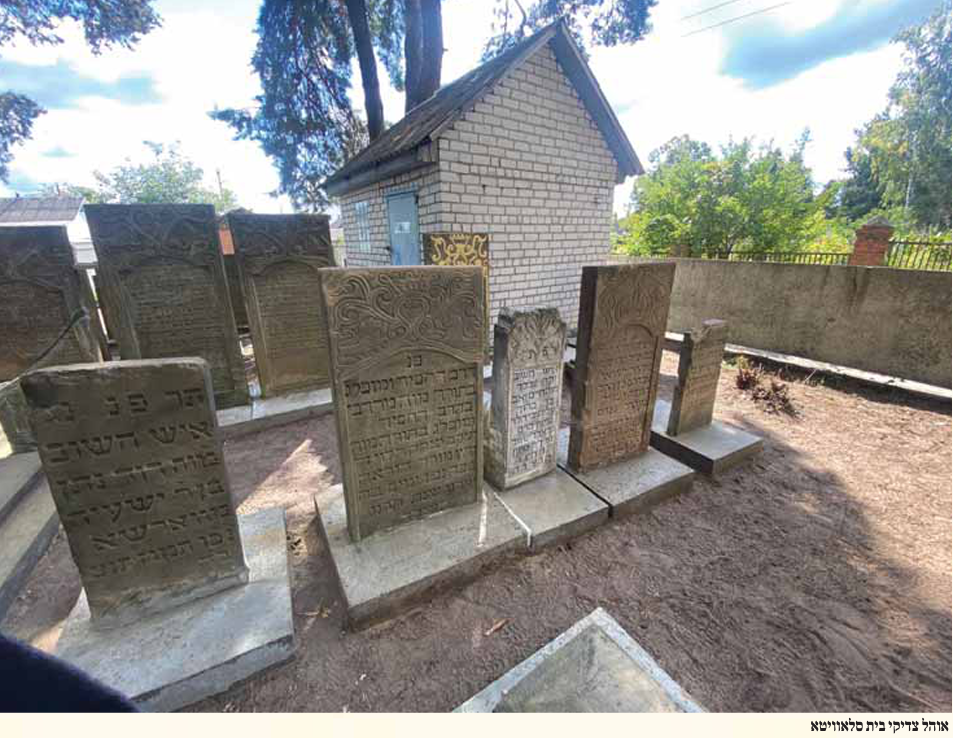
Rav Pinchos Shapira of Slovita zt"l
הרב פנחס בן משה שפירא זצ"ל
Tammuz 14 , 5632
Rav Pinchos Shapira of Slovita zt"l
Son in law of Rav Yehoshua Heschel ben Yaakov Shamshon of Shpitevka
Named after his illustrious ancestor, his grandfather Rav Pinchos Koretzer, he was born soon after his grandfather's passing.
He continued his father's publishing house and printed many important seforim. Together with his brother Rav Shmuel Abba they were both imprisoned during the infamous libel of the year 5699. He was sentenced to flogging and exiled to Siberia although he remained in Moscow.
"They were punished and sentenced to run the gauntlet between rows of soldiers who flogged them with cruel blows and due to Hashem's kindness and chessed they survived the ordeal. The efforts of their friends and relatives bore some fruit and the Siberian exile was delayed to Moscow. There for seventeen years the brothers remained until the death of the wicked Czar Nikolai the first. When his benevolent second Czar Nikolai II emancipated and liberated many he also granted the brothers some clemency and they were finally allowed home.
On the 11th of Adar 5601 (1840) a fire broke out that consumed the Vilna press, all the seforim and machines went up in flames and two workers lost their lives in the deadly fatal blaze, the partners were left impoverished and the Vilna Romm Press's fate was seen by some as the hand of Divine Punishment." (MeOran Shel Yisroel)
His sons were Rav Yehoshua Heschel the printer in Zhitomyr who married Gittel the daughter of Rav Michel of Vishnovitz, who was son of Rav Mordechai Kremnitzer the son of Rav Yechiel Michel Zlotshuver.
Rav Pinchos passed away on 14 Tammuz (1872) 5632.
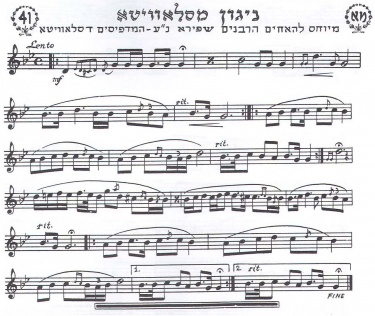
Chabad tradition has it that as the two Shapiro brothers, Rav Shmuel Abba and Rav Pinchos of Slovita ran the gauntlet between the blows of the soliders who carried out the Czar's decree to flog them over the false libel as is known, in the midst of the ringing blows as they were flogged, they sang a niggun, a song of the soul's lofty ascent, the power of Yaakov's pride with trust in Hashem! This Niggun's notes have been recorded in Chabad's Sefer Niggunim Niggun 41 and can be heard sung by Chabad chassidim to this very day, known as the Niggun Slovita. (cited by Likkutei Imrei Pinchos Sha'ar Sippurim 125)
Stories of Rav Pinchos Shapira of Slovita zt"l

The brothers accepted their fate with bitachon and equanimity. The night before their beating, they were visited by two chassidim, Rav David of Vaslikov and Rav Nota of Chaslivitch. After speaking enthusi-astically in Torah, as if nothing unusual was about to happen, Rav Shmuel Abba quietly told them, “Tomorrow, we will be beaten and it should be arranged that there is a minyan, a doctor, ice, and lemon juice [as an antiseptic]. Also, any blood or fragments should be collected.”
The two visitors recorded the impact upon them: “We stood there astounded. Holy fear overwhelmed us and we could not say a word. The impression was so powerful that it will never be erased from our memory all our lives. Before our eyes, we saw, as it were, Avraham Avinu before the Akeidah, totally devoted to do the will of his Creator, and Rabbi Akiva before they combed his flesh, without saying anything and without ruffling their tranquility a hairsbreadth.”
In those days, military beatings were administered by spiessruten (knouts), a punishment introduced to Russia by Prussian army officers. A more sophisticated method of administrating this punishment was “driving one through the stroy (line-up).” This meant running (or rather, being slowly led through) a gauntlet of two rows of 250 soldiers armed with knouts. Resultant death from heart failure or blood poisoning was not uncommon. To receive 1,500 blows, the brothers would pass between the rows three times.
As the two brothers approached the place of their sentence, they sang a special niggun, which is preserved until this day.
During the beating, Rav Pinchas Shapiro immortalized his memory by refusing to move on after his yarmulke fell off. Unable to go back and pick it up because he was being led along by two long ropes tied to his hands, he simply stood stock still as blows rained on his back until someone replaced the yarmulke on his head.
The two brothers regained consciousness on Shabbos and their first words were, “We must recite Kiddush!” After saying Kiddush, Rav Shmuel Abba washed and said Hamotzi, but was too weak to eat a morsel of bread. Whenever he recalled this incident in later years, he said that he was still sorry about this beracha levatalah.
It took them months to recuperate enough to begin walking in chains to Siberia and, by the time they arrived in Moscow, at the end of 5600/1840, they were too ill to proceed. After months of recuperation, officials petitioned that the brothers be permitted to return to Slovita, but Czar Nicholas I insisted that “if they are ill, they should be left in Moscow in a bogadelnia (old age home), but they must not be returned home.”
Even after fifteen years, the brothers were still not allowed to return to a normal Jewish community.
As Bibikov, now Minister of Internal Affairs, explained, “They can exert a harmful influence upon those Jews among whom they will settle and, in addition to this, it can also inspire in other criminals a hope for such types of ameliorations.”
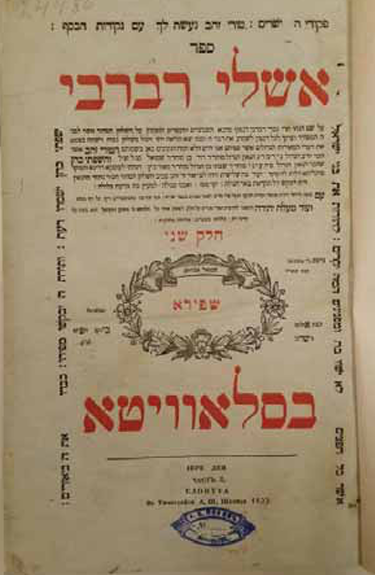
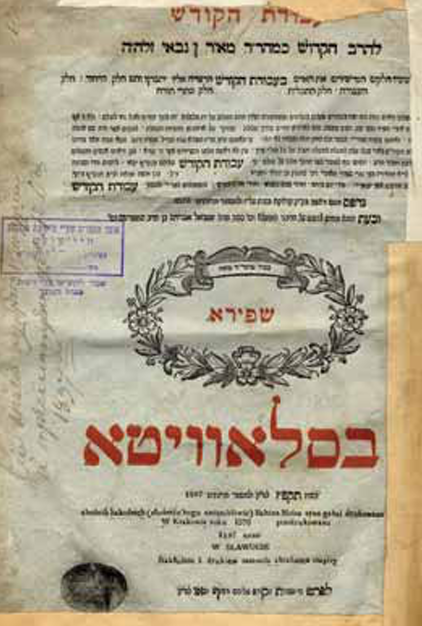
The brothers’ only consolation was that, in 5607/1847, their sons won the tender to open the Russian Empire’s second authorized Jewish printing house, in Zhitomir. The first was the Romm Printing House in Vilna. All other Jewish printing establishments had been closed down.
The brothers were only released in June 5616/1856 by Czar Nicholas I’s more liberal son, Czar Alexander II, who is famous for his emancipation of the Russian serfs.
Surprisingly, Rav Shmuel Abba did not greet the news joyfully.
“I fear that I am now losing my freedom,” he moaned. “There, at home, when they greet us as martyrs, will my strength be sufficient to weather the test? When will they demand of us that we become gutten Yidden (rebbes)? I implore Hashem to protect me from that path …”
His fears materialized after Rav Aharon the Second of Karlin handed him a kvittel. Admirers insisted that he become a rebbe in Shepetovka and both brothers were revered as rebbes for the rest of their lives.
Nowadays, their memory is immortalized not only by their martyrdom, but also by their holy sefarim. As Rav Aharon Roth, the Shomrei Emunim Rebbe writes in his sefer, Taharas HaKodesh: “Therefore every G-d-fearing person should strive to acquire sefarim of old prints … especially from the print of Slovita and Zhitomir, [of the Shapiro brothers,] the grandsons of the holy Rav of Koretz, who were exaltedly holy men.”
(Chief source: The Drama of Slovita, by Saul Moiseyevich Ginsburg, University Press of America, Inc. 1991. Translated from the Yiddish by Ephraim H. Prombaum) http://strangeside.com/printing-press-the-slovita-controversy/
When the grandsons of Rav Pinchos Koretzer, who ran the Slovita Press, were libeled and falsely accussed, many tried to prove their innocence, that all the accussations against them were false, to no avail.
Finally the authorities agreed that if three prominent Jewish leaders and rabbis would testify as to the innocence of the Shapira brothers of Slovita then they would be exonerated and cleared.
One of the selected leaders was none other than Rav Pinchos Koretzer's prominent disciple, Rav Raphael of Bershad, who inherited his rebbe's penchant for truth and emes at all costs. So much so that they nicknamed Reb Raphael der Emesser! They used to say that he was so truthful and so careful not to utter even a doubtful truth or a possible falsehood that if for example it was raining outside, and you asked him once he came in doors if it's raining out there? He would reply: "When I was outside it was raining." Since perhaps in the interim when he came in doors it had maybe ceased to rain, therefore he could not answer in the present tense to something he could not directly see right now! This was the very same elder chassid who had been bentshed by none other than the holy Baal Shem Tov's blessing for arichas yomim - a long life. (Kovetz HaTamim VIII Letter 284). When he was asked to come testify on behalf of Rav Pinchos Shapira he did not know what to do. On the one hand it was a matter of life and death and therefore fell under the heter for pikuach nefesh. On the other hand, although he was sure that Rav Pinchos was innocent and that the libel was a fabricated falsehood, he could not bring himself to say with certainty an out right lie, that he had personally witnessed this innocence when the truth was that he was sure of it but had never seen so himself. Initially he agreed to testify, yet as the date approached he began to daven to Hashem:
Master of the World! I have never let a false word cross my lips, and I have never uttered a lie my entire life! I have never testified to a certainty that I cannot verify, nor have I ever resolved a doubt that I myself did not know its veracity! Ribono Shel Olam! I ask of You please, with every expression of pleasing I plead, please take away the blessing for long life so that I not be forced to say something that I myself did not witness!" His prayers were answered, the very next day he passed away, and when they needed his testimony he was no longer among the living. . .and since Rav Raphael's testimony was one of the three, the entire matter was null and void and the judgment of the Shapira brothers of Slovita was a sentence of torture and exile. (Shmuos VeSippurim Volume I pg 243)
The chabad chassid Rav Raphel Kohen heard this from his father Rav Baruch Sholom Kohen:
During the time that the two Shapiro brothers of Slovita were imprisoned they did their best to daven and recite Tehillim. There was among the prisoners, an apostate and heretic who knew enough Jewish law and halachah to try to harm the brothers. His hatred of all Jewish matters led him to act, and so he filled the chamber pot and befouled the cell to prevent them from reciting any holy words. Rav Pinchos Koretzer's grandson were momentarily dismayed and downcast, what would they do now? How could they daven? Suddenly, one of the two was struck with inspiration: It's true we cannot say Tehillim but is that a reason for our spirits to fail or falter?! We must rejoice and be happy that as Jews that alone is an avodah! The very fact that we refrain also fulfills the Divine Will of our Creator! And if so we need to be beSimchah and thus they began to dance in jail over their very Jewishness! (Shmuos VeSippurim Volume I pg 244)
When the Shapiro brothers of the Slovita Press were about to run the gauntlet through rows of soldiers to carry out their sentence and flog them for the false libel, the authorities feared that the first troop had been bribed to only deliver soft perfunctory blows and so at the last minute they switched the troops, and they stripped the two brothers down bare so that the deadly blows were dealt harshly and cruely indeed! In the midst of all this, the yarmulke - the kippa or head covering fell off one of the brother's heads, he retrieved it despite the blows that continued to rain on him, as obviously anyone who ran quickly fared better, yet despite all this he sufferred it, rather than take even one step with his head uncovered. (Rav Raphael Kohen as heard from Rav Shmuel Gronem)
(Shmuos VeSippurim Volume I pgs 243-244)
Another tradition is that it was the younger brother whose head covering fell off, despite being tied and bound by ropes that led him to run the gauntlet, and therefore being unable to retrieve the fallen cap, he stood still as the blows rained down upon him, he accepted the Heavenly decree upon him with love and paid no heed to the pain and suffering of the bludgeoning as the soldiers struck his immobile form, eventually someone replaced his head covering and only then did he consent to move on and miraculously he survived the ordeal with the grace of Heaven. (Seder HaDoros MiTalmidei Baal Shem Tov as cited in Likkutei Imrei Pinchos Sippurim 124)
I once heard from a Bershader chassid that Rav Pinchos Koretzer used to say that studying the sefer Ohr haChaim haKadosh is a segulah for the neshamah, similar to studying the Zohar haKadosh.
This is because Rashbi had the neshama of Moshiach of his generation, and also Rav Chaim ben Attar author of the Ohr haChaim haKadosh also had the neshama of Moshiach of his generation. He ordered his descendants, the Shapiro grandchildren of the Slovita Press to publish the Sefer Ohr haChaim HaKadosh and that that would save them from evil and harm. They fulfilled his command until there were so many published editions of the Ohr haChaim, that the seforim greatly outnumbered the demand and there were no buyers left to purchase copies. Therefore, they stopped publishing copies of the sefer, that very year that they ceased publishing the Ohr haChaim the infamous libel occurred and they were falsely accussed. (Migdal Oz pg 268 cited by Likkutei Imrei Pinchos Sha'ar haTorah 15)
During the time that the two Shapiro brothers of Slovita were imprisoned they were cast into a jail cell with many other prisoners. Due to the dirty, filthy state of the cell, they were halachically forbidden to daven. One of them said to the other: Let us sing a niggun! The niggun they sang roused the spirits of all the inmates and before long they all broke out in a dance. When the warden and guards saw this they ordered the Shapiro brothers separated from the other prisoners and as soon as they were in their own cell they breathed a sigh of relief! Here, they would now be able to serve Hashem properly. One brother said to the other: I now understand the meaning of a kameo amulet that the Baal Shem Tov once gave to a wealthy man that invited him as his guest.
The Baal Shem stayed with him, and all Shabbos he did not utter a word. on Motzaei Shabbos the wealthy man's wife requested that the Baal Shem daven that they achieve salvation and have children. The Baal Shem Tov made havdalah and called the wealthy man to look into the cup, where he saw in the reflection an evil harmful spirit seeking to harm and injure him! On the spirit were written letters Yud Shin Bais, Shin Bais. Until now I had no idea what this meant. However, now I think that perhaps it stood for the acronym Yehi Shalom BeCheilach Shalva BeArmonosayich (Tehillim 122:7). (Sippurei Maran HaRamach Baal Shem #15, Shemous veSippurim Volume I pg 244 as cited by Likkutei Imrei Pinchos Sha'ar Sippurim 122)
During the time that the two Shapiro brothers of Slovita, Rav Shmuel Avraham Abba and Rav Pinchos, were jailed the warden came and explained that the rule was that such a terrible crime that they were imprisoned for called for a harsh sentence; the cell that they would be held in was forbidden to have a window. They were forbidden from having any light whatsoever! Upon hearing such a harsh pronouncement, that they would be held in a dank dark gloomy cell, with no light or air, Rav Shmuel Abba was thoroughly downcast. Seeing this, his brother Rav Pinchos turned to him and said: Why is the evil one - the yetzer hara called a king and an old fool? (Koheles 4:13 Rashi). Is he not wise? Does he not make fools out of others?! Rather, the truth is that he is in fact a fool! See here, look at us, we are jailed and imprisoned by decree of the Czar! However, the evil one, the yetzer hara, what is he doing here together with us in this prison, who put him in jail?! Rav Shmuel Abba understood the rapport, this despondancy and sadness was none other than the evil yetzer hara's doing, he caused Rav Shmuel Abba's feelings of depression and not the jail warden's words. No sooner did he realize this then his calm and good mood were restored! (Shemuos Tovos 44:2 cited by Likkutei Imrei Pinchos Sha'ar Sippurim 123)
The Holy tzadik Rav Pinchos Koretzer was able to achieve that when his grandson, the Shapiro brothers of Slavita were being flogged, angels stood at their backs to receive the blows. (Sippurei Maran HaRamach cited by Likkutei Imrei Pinchos Sippurim 126)