Rav Hillel HaLevi of Paritsh zt"l
הרב הלל בן מאיר מפאריטש זצ"ל
Av 11 , 5624
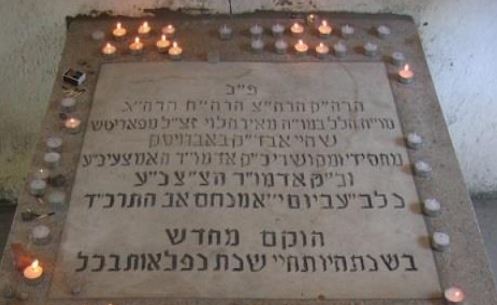
Rav Hillel HaLevi of Paritsh zt"l
Rav Hillel was known as a tzadik and half a rebbe! Rav Hillel was born in Khmilnyk, Ukraine, and grew up in Chemtz (in the vicinity of Minsk). He was a talmid of the Alter Rebbe, Rav Shneur Zalman the founder of Chabad, through studying Tanya, and later a disciple of his son Rav DovBer the Mittler as well as his successor the Tzemach Tzedek. He served as the Rav of Paritch (Parwich), near Minsk, Russia, and Bobroisk, Belarus. He authored Chassidic teachings on Chumash printed and published as Pelech HaRimon. See Bereishis here https://www.hebrewbooks.org/21290, VaYikra here https://www.hebrewbooks.org/16006 and Shir haShirim here https://www.hebrewbooks.org/15637.
And a collection of his teachings was published as Imrei Noam https://www.hebrewbooks.org/21952
He also authored two perushim on Rav Dovber, the Mittler's seforim, a commentary on Sha'ar HaYichud and a commentary on Kuntres HaHispa'alus https://www.hebrewbooks.org/43257.
You can listen to two Niggunim - Hasidic melodies composed by Rav Hillel Paritsher here https://www.chabad.org/multimedia/music_cdo/aid/4771664/jewish/Nigun-Reb-Hillel-Paritcher.htm and here https://www.chabad.org/multimedia/music_cdo/aid/140718/jewish/Nigun-Dveikus.htm
Stories of Rav Hillel HaLevi of Paritsh zt"l

Rav Hillel of Paritsch was renowned for his punctilious observance of the mitzvos, prepared to risk his life for the merest detail ordained by Chazal. The Czarist regime of his day decreed that all Jews were to shave off their peyos, and some unscrupulous informer told the local authorities that Rav Hillel’s peyos were still intact. They decided to shear them off by force, but Rav Hillel covered them tightly with his hands to protect them. The soldiers drew their swords and forcefully began hitting his hands and head, causing him to scream. His neighbor, a Jewish tailor who had a good relationship with the officers in charge, heard him and came running, and after promising them gifts, convinced them to leave. Grateful for his help, Rav Hillel blessed the man, and promised him that “after a hundred and twenty years” he would be rewarded by being buried next to him.
[Rav Hillel once explained that his dedication to maintaining his peyos and beard came from having seen a hand-written essay of the Tzaddik Rav Pinchas of Koretz, in which he wrote that adopting non-Jewish clothing styles and appearance was the fiftieth Gate of Impurity, which would have rendered the Jews unable to be redeemed from Egypt, had they fallen one more level (into it).
Similarly, in the times preceding the revelation of Moshiach, there will be an endeavor to make the Jews change their clothing and appearance, and unfortunately it will succeed. Only in the merit of those individuals who refuse to change their appearance even at the risk of their lives will all the Jews be blessed with the Ge’ula. Rav Hillel concluded, “Anyone who had this manuscript would of course be willing to give up his life for the sake of traditional Jewish dress and appearance.”]
Many years passed. Rav Hillel, in the meantime, became Rav of Babruisk, and would travel every year around the provinces and to the cities of Kherson and Yekatrinoslav, teaching Torah as well to the farmers of the Jewish agricultural colonies, who greatly admired him. In the summer of 1864, at age sixty-nine, he suddenly fell ill while staying in Kherson – which is very far from Babruisk and Paritsch in White Russia – and was niftar there.
On the following day, amidst widespread mourning, he was brought to burial, and his talmidim and admirers flocked there for many years thereafter to daven at the graveside of this Tzaddik.
Sometime later, on a bitterly cold and stormy day, an unknown elderly traveler passed away in the town’s communal hostelry. The Chevra Kaddisha (Jewish Burial Society) prepared his body and took him to be buried, intending to place him in the section for unknown people. However, due to the fierce winter snow, they unknowingly buried him near Rav Hillel. A day or two later, it was noticed that the new grave had been dug right next to the resting place of the illustrious Rav Hillel. When the facts came to light, a great hubbub arose in town: was it proper that an unknown traveler whom no respectable citizen even knew, a nobody who had passed away in the communal poorhouse – that such a one should be buried next to the Tzaddik?
It was too late, though, to change things: the Torah would never allow it. At least let them find out just who this individual was. His identification papers disclosed his name and that of his father, and the fact that he came from Paritsch. The communal worthies of Kherson therefore wrote to their counterparts in Paritsch, asking to be told at least whatever they knew about this man.
The answer from Paritsch identified him clearly: he was a retired tailor, who had been traveling in order to live with one of his children. They added that this same tailor had many long years earlier been promised by Rav Hillel that “after a hundred and twenty years” he would be brought to rest next to his own resting place.
And so, the decades-old promise of Rav Hillel of Paritsch came to fruition.
Adapted by Yerachmiel Tilles from Lma’an Yishme’u #78, and from Sipurei Chassidim, as translated by Uri Kaploun in A Treasury of Chassidic Tales (Artscroll).
Rav Hillel of Paritsch used to spend a substantial part of every year traveling through the towns of the southern parts of Russia in order to give instruction in the applied ethics of Chassidus, and to arouse people to repentance wherever the need arose.
He once arrived in a town where the Jewish tavernkeepers kept their businesses open on Shabbos. Rav Hillel was shocked to hear this, and invited them all to meet him. When he had explained to them what a serious matter this was, they all undertook to conform to proper observance – on one condition: that he persuade a certain wealthy tavern-keeper, whose turnover was the highest in town, to do likewise, for otherwise they would not be able to survive competition with him. The Tzadddik thereupon sent for that man – once, twice, three times – but the wealthy tavern-keeper ignored the invitation.
Rav Hillel stayed on in the town for Shabbos. In the morning, the wealthy tavern-keeper suddenly suffered increasingly severe pains in the stomach, and his wife, fearing that they were brought on by the disrespect her husband had shown the Tzadddik, hastened to seek him out, so that he should intercede on his behalf. While Rav Hillel was at the Shabbos midday meal surrounded by a large company of Chassidim, she burst into the room, and, with tears in her eyes, implored the Rebbe to give her husband his blessing for a speedy recovery.
The Tzaddik remained silent.
His Chassidim were dismayed: “Rebbe, at least give the blessing that is traditional in such cases on the holy day – ‘It is Shabbos, when one may not cry out; healing will come soon!’”
But Rav Hillel said not a word. The woman left bitterly disappointed, and her husband’s pains grew worse.
On Motzo’ei Shabbos, the Tzadddik was discoursing with his Chassidim at a table on which stood a samovar, in fulfillment of the Talmudic dictum: “Hot beverages after the departure of Shabbos serve as a cure.” In ran the same woman, weeping and wailing, begging the Tzaddik to have pity on her husband and to daven for him.
Rav Hillel simply said: “It is Shabbos, when one may not cry out; healing will come soon.”
The Chassidim were amazed. On Shabbos itself the Tzaddik had said nothing – and now, when the holy day was over, he said these words usually uttered only on Shabbos!
Rav Hillel continued: “If Shabbos itself will no longer have cause to cry out against him, then healing will come soon! Go along and tell him that if he gives a solemn handshake in the presence of three witnesses that he will close his business on Shabbos, then he will be cured.”
Three Chassidim hastened to his bedside to convey the Rav’s message – and he earnestly gave his word of honor.
His illness passed, and the sanctity of Shabbos in that town became something noteworthy indeed.
Adapted by Yerachmiel Tilles from the rendition in A Treasury of Chassidic Tales (Artscroll), as translated by the incomparable Uri Kaploun
Divrei Torah of Rav Hillel HaLevi of Paritsh zt"l
To Rav Hillel Paritcher's question whether to review Chassidus even in towns where the people have no idea what Chassidus means, the Mitteler Rebbe responded: "The soul hears the words of Chassidus." As it is written, "Flowing from Lebanon." (Shir HaShirim 4:15.) In Hebrew Levanon is spelled Lev Nun. "Lebanon" thus represents the 32 paths of Chochma (Wisdom Lamed&Bais=32) and the 50 Gates of Binah (Insight Nun=50) of the soul. When the soul hears, from there issues a "flow", a "stream of droplets" into that "radiance" or ha'ara of the soul which vitalizes the body; this results in a strengthening of "asay tov - do good" expressed in the 248 positive mitzvos, and of "sur me'ra - turn away from evil" expressed in the 365 prohibitions. (It is explained that only part of the soul invests itself in the body to give it life; this is called the "radiance" or reflection (ha'ara) of the soul, in contrast to the essence (Levanon), which remains "above." While the simple person hearing Chassidus does not comprehend it in the least, his soul does possess the qualities of intellect, chochma and bina, that do comprehend, though he is not conscious of this. However there is an effect on him, the "flow" from Levanon, intellect.) (See HaYom Yom 24 Adar I)