Rav Gershon Shaul Yomtov Lipman Heller zt"l
הרב גרשון שאול יום טוב ליפמן בן נתן הלר זצ"ל
Elul 6 , 5414 / Elul 26 , 5414
Rav Gershon Shaul Yomtov Lipman Heller zt"l
Born in Wallerstein, Bavaria in the year 5339 (1579), Rav Yom Tov was orphaned from his father before he was born and raised by his grandfather, Rav Moshe Wallerstein, who served as Chief Rabbi of all German Jewry. He was a descendant of Rav Nosson, author of the Aruch.
His two chief mentors and rebbis were the Maharal of Prague, Rav Yaakov Ginzberg, Av Beis Din of Friedburg and Prague, and Rav Shlomo Ephraim Luntshitz, author of Kli Yakar and Olelos Ephraim.
At age eighteen, in 5357, he was appointed as a dayan and rosh yeshiva in Prague, in the beis din of the Maharal. His fame spread throughout the entire world as a gaon. At age thirty, he authored his magnum opus, the Tosafos Yom Tov on Shas Mishnayos.
In 5378, he authored two selichos describing the worries and fears of the Jewish community over the Prague rebellion. These were published as Selichos on the 14th of Cheshvan in Prague, 5381.
In MarCheshvan of 5385, he was appointed Av Beis Din of Nikolsberg, Moravia, and on Rosh Chodesh Adar of 5385 to Av Beis Din Vienna.
Vienna was a newly established kehillah, and some of the new takanos and reforms he established included the daily study of Orchos Chaim of the Rosh before Shacharis, which he personally translated into Yiddish (published in Prague in 5386) so that everyone could understand them.
In Teves of 5387 (1627), Rav Heller was appointed Av Beis Din of Prague. He began his tenure there in Nissan, and about half a year later he was appointed as Rosh Yeshiva as well, succeeding his mentor, the Maharal. He completed Ma’adanei Melech and Lechem Chamudos on the Rosh and began work on his sefer, Malbushei Yom Tov, a super-commentary on the commentary of the Levush on the Arba Turim.
The backdrop to his tenure was the Thirty Years War (1618-1648), a time of chaos and uncertainty for the populace of Bohemia and Prague, and especially for its Jews. The war emptied the government coffers, leading them to impose heavy taxes, a great financial burden upon the Jewish community. While it was the government officials that levied the taxes, the government left the collection up to the Jews themselves. This led to bitter disputes, as many of the wealthier and more powerful figures in the community tried their best to shirk responsibility, while the poorer and weaker Jews were unfairly burdened with taxes they had difficulty in paying.
The Tosafos Yom Tov was very upset by such underhanded measures that went against the derech haTorah, so he had himself appointed to the committee overseeing the tax collection. He saw to it that the taxes were collected evenly and fairly so that wealthier Jews shouldered the burden according to their means.
This act, alongside his other reforms as rabbi, earned him some bitter opponents, who initiated a slanderous libel against him and falsely accused him before the king. The slander claimed that he had disparaged and insulted the Christian faith in his sefarim Ma’adanei Melech and Lechem Chamudos. King Ferdinand II accepted the false rumors and ordered the Tosafos Yom Tov brought in chains and iron
A Fast For All Generations
On the 4th of Tammuz, the Imperial Judge arrived to reveal the terrible decree. On the 5th of Tammuz, 5389 (1629), a date that he would later establish as a fast day for his family and all of his descendants, the Tosafos Yom Tov left Prague. He writes about this in Megillas Eivah:
“And now my children, listen to me and may your souls be revived. As I was looking through my manuscripts with the commentaries and chiddushim I composed that Hashem merited me to author, I came across something I had written down that I had heard from Rav Pinchas of Cracow, a great man, head of the leaders of Vaad Arba Aratzos – the Council of the Four Lands, the son of Rav Zalman Yeshaya Segal Horowitz of Prague. . .when I was in Prague I heard him say: ‘I have a tradition that during the time of the harsh decrees, when the government decreed that on the 5th of Tammuz all the holy Jewish books should be burned, the wise sages of that generation, by means of a she’alas chalom – a dream quest – made an inquiry and asked why this evil had befallen them. They were answered: “Zos Chukas HaTorah K’Targumo.” They interpreted it to be referring to the Aramaic translation of the pasuk in that week’s parsha reading, which was Chukas. The Aramaic translation of the pasuk is “Da Gezeiras Oraisa,” where the word “da” is equal in gematria to 5 (Dalet plus Alef = 4 plus 1).’ I believe this refers to my sefarim, which were originally ordered to be burned and destroyed, and because of them I was forced to leave my home in Prague on the 5th of Tammuz to the Kaiser’s court. The dream spoke of a gezeira – a decree; it was regarding the ancient decree, but I believe it refers to my decree as well, as I was arrested over matters of chukas haTorah. I was arrested on the 17th of Tammuz after chatzos (midday), and I was released 28 days later after chatzos in Menachem Av, equaling a period of forty days, the same as the forty days of disgrace and wandering of Am Yisrael in the desert. I therefore decided to instruct you all, and all your descendants, my sons and my daughters and my sons-in-law and daughters-in-law until the coming of Mashiach, to fast on the 5th of Tammuz until after Maariv. Since it falls out in the summer, when the days are longer, I do not decree until the time of nightfall after the stars come out. If the date falls out on Shabbos, it should be pushed off until Sunday. They can fast until after they daven Minchah Gedolah, and they need not complete the fast longer than this time. Whoever has a weak constitution or is pregnant or nursing can redeem themselves with no less than the value of three large Viennese coins. I was in doubt whether or not to establish the 28th of Menachem Av, the day of my freedom, as a festival and yom tov, as do many of our people to commemorate the day they went free or were saved from a judgment of death. However, I was left bereft and penniless with nothing but the shirt on my back; all my honor and glory were taken from me as well as the rabbinate, and my debts were so heavy I saw no way to repay them since I was left with no means or property. I debated the matter back and forth, and in the midst of my indeterminacy and deliberations, the sefer Yosef Lekack, a commentary on Megillas Esther by Rav Eliezer Ashkenazi (1513-1586, Yahrzeit 22 Kislev) author of Maasei Hashem, came to hand. In the Introduction, he asks, the following question: ‘Why is it that the Kohanim Bnei Chashmonai decided not to establish any festival days to commemorate and celebrate the miraculous salvation and redemption of Am Yisrael? It was an event that demonstrated the supernatural, a victory of the few over the many, their redemption was even greater than the one in the times of Mordechai and Esther. The events of that time, which became Purim, were not overtly supernatural or miraculous; they were instead covert and hidden in nature where the king’s heart was overturned in an instant from evil to good. The answer he gives is that in the days of the Chashmonaim, the joy was incomplete since so many had died and the Beis Hamikdash was ransacked.’ I am in a similar situation, for my joy remains incomplete and I am still filled with sorrow and grief. I remain anguished and pained until Hashem favors me and restores my past crown of glory and improves my future,” (Megillas Eivah).
On the 8th of Tammuz, the Tosafos Yom Tov set out for Vienna, where he was accused, interrogated and jailed. Imprisoned while awaiting final judgment, his life was in great danger. The leaders and heads of the community rose up and took action to defend him and secure his release; even gentile officials and ministers who had met him defended his innocence and protested his imprisonment on an offense that was nothing more than a false libel.
He languished in prison for forty days. On the 28th of Menachem Av, 5389, the community’s efforts bore fruit and while he was released and exonerated from the capital offense, the magistrate ordered him to pay a bond of 12,000 gulden to King Ferdinand II which was in those days a princely sum that all the Jews of Vienna and Prague together could not raise. Furthermore, the magistrate ordered that his sefarim be burned and that henceforth he was forbidden from serving as an Av Beis Din in all the kingdom and its provinces. This final judgment was a terrible blow to the Tosafos Yom Tov, for now he had lost his entire livelihood and source of income. Eventually the sentence was commuted, his sefarim were censored rather than burned and he was allowed to serve as Rav but not in Prague itself. The troubles, tragedy and suffering were recorded in his autobiography Megillas Eivah. Eivah, he writes, “stands for the acronym Eicha Yashva Badad HaIr – The city of Jerusalem sits solitary,” an echo of Megillas Eicha, which we read on Tisha B'Av. He concludes his preface with the remark, “Whoever reads this and suffers along with me in my sorrow shall be absolved in this merit to be saved from all trouble and suffering.” (www.HebrewBooks.org/9529; translated into English as “The Feast and the Fast” published 1984 by Rabbi CU Lipshitz and Dr Neil Rosenstein, Moznayim).
Finally, in Iyar 5392 (1631), the Tosafos Yom Tov was appointed Av Beis Din in Nemirov, Poland, and from there, a few years later in Iyar, 5395 (1634), he moved to serve as Av Beis Din in Ludmir, Volhynia.
While in Ludmir, his enemies again reared their heads, as he describes in Megillas Eiva: “I awoke as a man from slumber and resolved to renew the laws from the earlier gaonim forbidding the practice of selling and purchasing the position of Rav from the local government ministers. A historic precedent that existed from the times that the position of Kohen Gadol was sold and purchased during Bayis Sheini – the Second Temple period. Previously, the Sages had enacted bans of excommunication, curses, oaths, fences and fines for transgressing these laws and decrees, but despite their efforts, breach after breach occurred, and the law became so full of holes that it became a matter of jest and seemed to people as if it was permitted.
“In Ludmir we instituted new safeguards. While previously they had forbidden the sale and purchase of the position of Rav, I added to this and forbade the hiring and employment of such people as well. This earned me new enemies, accusations, false and baseless hatred, but I was undeterred.
“On the 18th of Iyar, in Vizhnitz, together with the communal leaders of Volhynia, Ludmir, Ostrog, Kremenetz, and Lutzk, we gathered to renew these enactments and ordinances in all four provinces. Afterwards, I agreed to travel to Lublin and Yaroslavl on market days of public gathering where this proclamation was signed and ratified by the Vaad Arba Aratzos – (Committee of the Four Lands) together with thirty of the greatest leaders. It was read and proclaimed throughout all the shuls of Yaroslavl and the fair in Kremenet. Two of the rabbanim from the Vaad Arba Aratzos who agreed with me issued a proclamation on Shabbos Vayikra to prohibit the illegal sale and purchase of rabbinic positions. . .the more I acted and expounded the more my enemies did all they could to oppose me. . . they did all they could to expel me from the rabbinate” (Megillas Eivah).
The Tosafos Yom Tov finally overcame his enemies when their plots failed and he was exonerated. His former honor and glory were restored on the first day of Chol HaMoed Sukkos 5404, when the good news arrived that he was to be appointed as the Rosh Yeshiva together with Rav Yehoshua in Cracow. He arrived in Cracow on the 27th (some versions of the text say 28th) of MarCheshvan and was received with honor and dignity.
A Feast For All Generations
On Sunday, the first of Adar Rishon 5404 (1644), he was officially appointed Av Beis Din, and he wrote in his Megillas Eiva a new directive that his family observe the 1st of Adar as a personal family celebration of thanksgiving, to thank and praise Hashem on the day he was officially installed as Av Beis Din Cracow:
“Up until now, I hesitated to establish a day of feast and festival; however, I now resolve to establish this day as a Yom Tov festival. Mi’shenichnas Adar Marbin B’Simcha! The first of Adar, the second day of Rosh Chodesh, is established for all generations for my children and descendants, sons, daughters, sons-in-law and daughters-in-law, because on that day my crown and honor were restored and I was appointed Av Beis Din and Rosh Yeshiva of the great and holy congregation of Cracow and all its neighboring provinces. May Hashem merit us all to serve Him and fulfill His laws, and [may I] live out my days not for the pursuit of wealth, but for an exalted yearning as demonstrated by my conduct until the coming of Mashiach, amen. The symbolism of the year when the attribute of harsh judgment was leveled against me is Shaphat (judgment = the year שפ''ט(1629). The symbolism of the year of my redemption, when my crown of glory was regained and restored, is ת''ד (1644) = Das – the law, ve’ha’das nitna beShushan haBira – and the law was enacted in Shushan,” to sing and rejoice with a happy heart. So saith Yom Tov Lipman ben Nosson HaLevi Heller,” (Megillas Eivah).
Sefarim
Besides his magnum opus, Tosafos YomTov on Mishnayos, he also authored Darkei Hora’ah, Malbushei Yom Tov, Ma’adanei Melech, Pilpula Charifta and Lechem Chamudos on the Rosh, Toras Ha’asham a commentary on the Rema’s Toras HaChatas, Tzuras HaBayis on Yechezkel’s prophecy of the Third Binyan Beis HaMikdash, and a commentary on Bechinas Olam, Parshas HaChodesh on Kiddush HaChodesh of the Rambam. He also wrote Tuv Taam on Rabbeinu Bachaya, and Megillas Eiva, the autobiography of his troubles and calamities as well as his salvation from his enemies by Hashem. Some of his Shu”t and responsa are cited in many collections.
Geneology
His wife was the daughter of Rav Aharon Moshe Teumim, the father of Rav Yeshaya Teumim, who was the father of the Kikayon D’Yonah, a descendant of Rashi and Dovid HaMelech.
His descendants include many famous rabbinic figures and Chassidic rebbes. Below is a list of his children, sons-in-law and some of his more prominent descendants:
Sons
Rav Moshe of Prague – printed Megillas Eivah.
Rav Shmuel of Nemirov – see the story about him below in the story section.
Rav Avraham of Prague – Rosh Yeshiva Skola, ancestor of Rav Moshe Aharon Heller, Av Beis Din of Sniatyn, Rav Meshulem Feivish of Zbaraz, author of Yosher Divrei Emes and of Rav Shmuel Heller of Tzfas.
Rav Liva of Brisk, Rav Alexander of Prague (these two names appear in certain editions of Megillas Eivah and not in others) Rav Yehuda Leib Heller HY”D (Yahrzeit 15th Tishrei)
Sons in Law
Rav Yosef Yaakov Kahana – Kat”z Rosh Yeshiva Turinsk, married to Raizel, ancestor of the famed rabbis Rav Yehuda Kahana, Av Beis Din Sighet and author of Kuntres HaSfeikos, as well as Rav Aryeh Leib, author of Ketzos HaChoshen.
Rav Shmuel Bash of Prague – married to Dobrish. Their shidduch and her untimely death is described in Megillas Eivah.
Rav Yoel of Brisk – descendant Rav Yoel Sirkis (known as the Ba”ch), who married an unknown daughter. He was an ancestor of Mordechai Yosef Leiner, founder of Izhbitza – Radzyner Chassidic dynasty.
Rav Tzvi Hirsch –married to Rivka, ancestor of the Eichensteins and Safrins of the Zidatchov/Kamarna Chassidic dynasties.
Rav Ze’ev Wolf Slovis Segal -- married to Nissel, ancestor of the Maharam Schick. The marriage of their son, Nosson (named after Tosafos Yom Tov’s father) to the daughter of the gaon Rav Moshe Av Beis Din Chelm, the son of Rav Moshe Av Beis Din Brisk and grandson of the communal leader Rav Shaul Wohl is described in Megillas Eivah.
Rav Aharon Frankel Mirels -- married to Rechel Nachele, were cousins. Rav Aharon’s father, Rav Koppel, was the son of Avraham Heller, the Tosafos Yom Tov’s uncle (his father’s brother).
At age 77, as he lay in his sickbed, two additional names were added (as is customary by some to change a sick person’s name by adding names), so the names “Gershon Shaul” do appear on his matzeiva. The Tosafos Yom Tov passed away on the 6th of Elul (Some say the 26th Elul as it appears on his matzeiva; others claim the matzeiva reads “On Yom Dalet, Vav Elul, meaning Wednesday, the 6th of Elul) 5414 (1654).
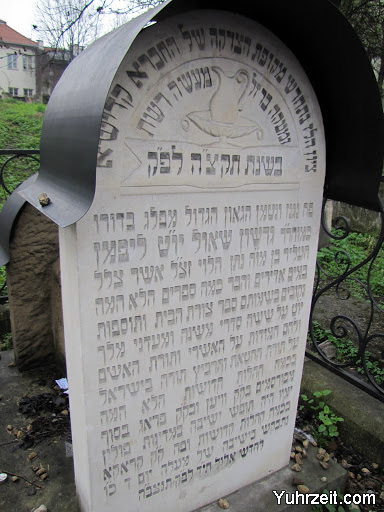
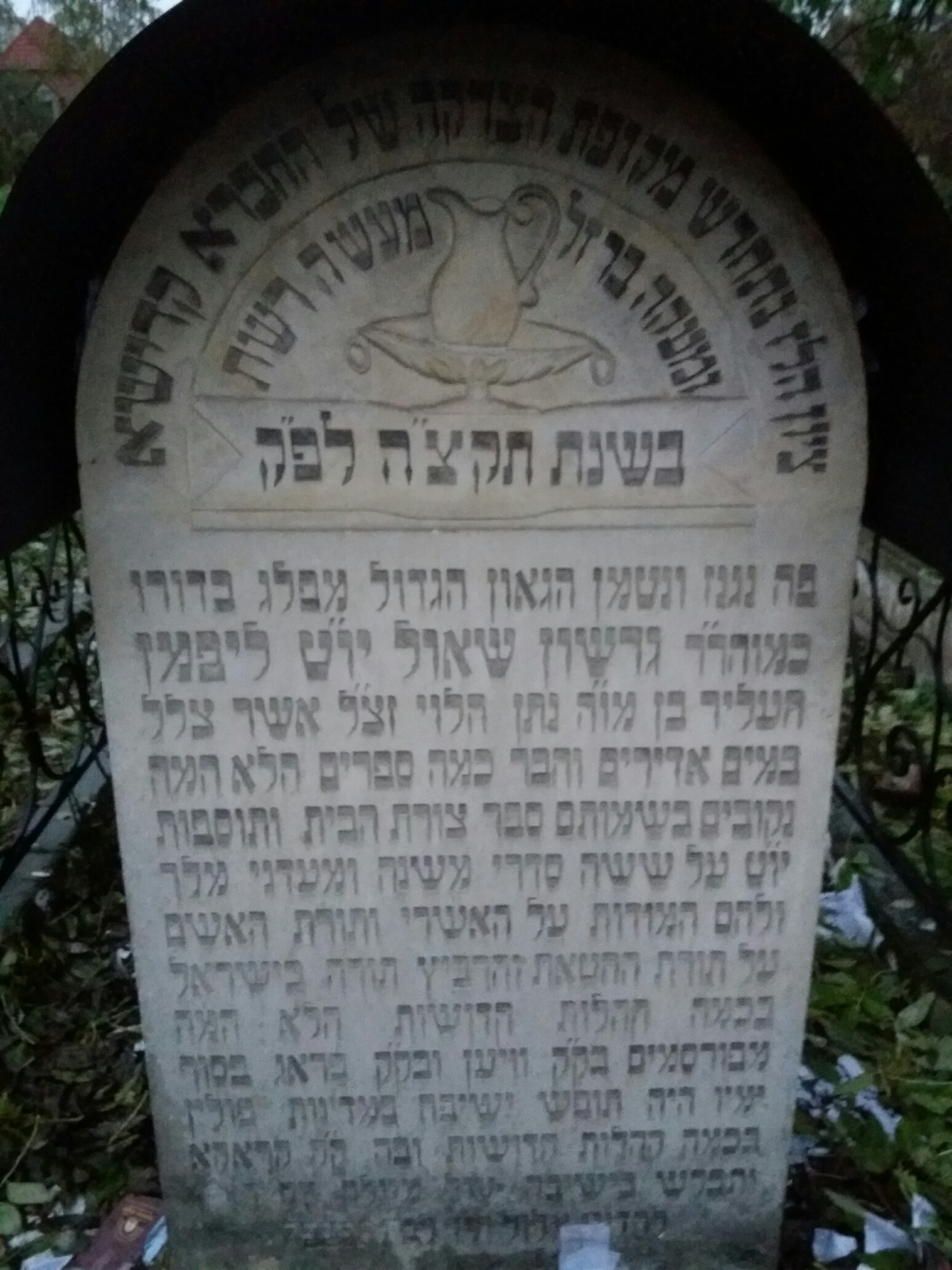
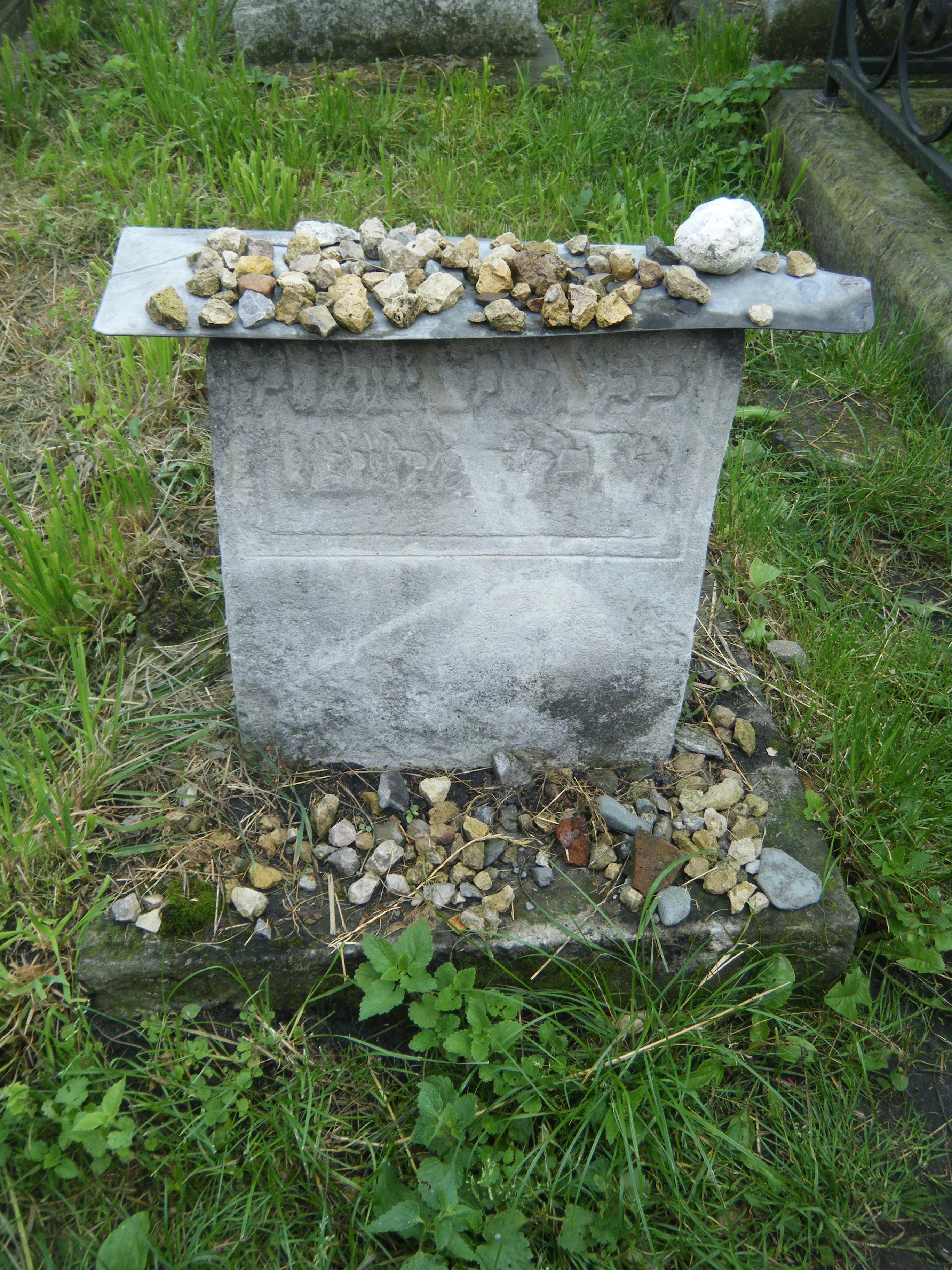
Illustration 2: Refurbished matzeiva in old Jewish Cemetery, courtyard of Rema Shul, Kazimeriz, Crakow.
Here lies the great gaon of his generation Our master, the Rav Gershon Shaul Yom Tov Lipman Heller Son of Rav Nosson HaLevi.
He dove into deep waters [of Torah] and authored several sefarim, whose names are Tzuras HaBayis, Tosafos YomTov on Shas Mishnayos, Ma’adanei Melech and Lechem Chamudos on the Ashri (Rosh), and Toras Ha’asham on the (Rema’s) Toras Chatas
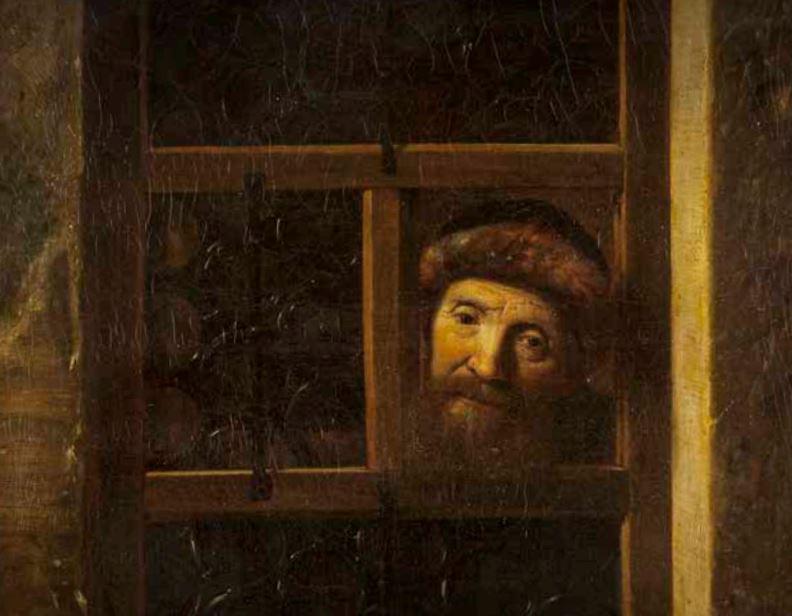
He taught Torah in Klal Yisrael and served in several renowned holy kehillos and congregations [in] Vienna and Prague, and at the end of his days he established the Yeshiva in Poland. And here in Cracow, he was asked to attend the Yeshiva shel Maalah – the Heavenly Academy -- on Wednesday the 6th of Elul, 5414. The Illustration : Man at Window, 1653, by Samuel van Hoogstraten, attributed to Rav Heller, the Tosafos Yom Tov, in Kunsthistorisches Museum in Vienna, Austria.
Stories of Rav Gershon Shaul Yomtov Lipman Heller zt"l

In Part II of Megillas Eivah, Rav Heller’s son Shmuel writes:
I will be brief and record these events in order to demonstrate to all of Klal Yisrael just how great is the power of dispute and machlokes and how many sins controversy cause, in order that a person should greatly distance himself from this, as far away as possible. . . In 5385 (1625), when my father was still the Av Beis Din in Vienna, he sent me off to study in Metz, France at the yeshiva of the gaon Rav Mordechai ben Rav Moshe Luria, Av Beis Din of Worms. I studied there for four years until 5389 (1629). On Rosh Chodesh Sivan, I received a letter from my father, who was now Av Beis Din in Prague, asking me to come home . . . I made my way home on foot along with other yeshiva students. . . I arrived in Vienna happy of heart and carefree, unaware that my holy father sat alone, imprisoned in one of the jail cells of this very city waiting to stand judgment for a capital offense punishable by death! In this manner, see how Hashem prepared the remedy and the cure before striking the blow, and how Hashem arranged the turn of events so that a wondrous thing would occur through me that would later set in motion and secure my father’s release. Before I entered the city, I lay myself down on some green turf to rest a bit by the forest in an area often used for pleasant outings and day trips by the citizens of Vienna. That day, the place was peaceful and quiet; I had it all to myself because there was some great festival and parade taking place in Vienna.
I placed my bundle beneath my head and I imagined who I might visit first, knowing that my father had served here previously as Av Beis Din. Surely I would be warmly welcomed and received by his many friends. As I lay daydreaming I heard a loud cry for help, “Help us, save us, or we shall be lost!” I looked and saw a wild bull chasing after a young noblewoman and a young nursemaid with a boy in her arms. They fled, running away from the charging beast. The wild bull was only several kilometers distant and gaining on them in wild anger due to the waving of the red kerchief the nursemaid had tied round her neck. Bulls will charge in anger when they see red waving, as is well known. As soon as I saw this I ran forward, untied and pulled the kerchief off and cast it aside at the feet of the charging bull. The bull attacked it and proceeded to tear it to shreds with his horns while the women hid behind one of the trees. At that moment a carriage arrived with the young noblewoman’s husband dressed as a nobleman in silk and finery and bearing a coat of arms. The carriage had a woven coat of arms as well. The women approached and explained what had happened and pointed at me, introducing me as their rescuer. The nobleman explained that he was the French ambassador, and apologized for not speaking German. He spoke to me in French and inquired as to my name and identity. [See now the Divine Providence] In the four years I was away in Metz, France I learned the French language, so I responded that I was a Jew and the son of a great rabbi. The Ambassador invited me to his home and wished to reward me handsomely. I declined, so he asked how he could repay my kindness and good deeds. I answered that my reward should be that if ever he would think well and good of the Jews and see that we do good without hope or desire of a reward, that this good thought would suffice. The nobleman insisted that he would be at my service should I ever require it and that I would always be considered a good friend. He said, “Since the Jews are often persecuted and downtrodden in this country, perhaps one day you will need my services since, as the French Ambassador, I have power and influence. If you ever need anything, please come see me so I can thank you and repay your kindness.” We parted in friendship, after he inquired where I learned such good French and having given me his address and his thanks, regretting that I was a Jew and they could do no more for me to better me and my station. He, his wife, the nurse and the child continued to Vienna to join in the merry making and parade while I took up my bundle and went to the Jewish quarter of Vienna. . . I decided to visit my maternal uncle, my mother’s brother Rav Baruch Zatruner. . . They began to cry and it wasn’t long before the entire matter of the accusations against my father of false slander and libel, and his subsequent imprisonment was made known and revealed to me. . . I sat dazed. . . I visited my father. . . after I met with the community leaders and learned of the news and how things stood. I went straight to see the French Ambassador. . .“I beg your honor repay my heavy debt, for I only saved three lives and I asking you to save the lives of my father and all the members of the Jewish community.” As I said these words, I fell at his feet, soaking them with tears. . . “I praise and thank the Creator I shall not remain long in your debt. Your father shall live and the community shall be saved . . .” Immediately I sent word to my father through his defense counsel, as Rav Hena was permitted to visit him at all times. None of the Jews of Vienna slept that night for fear of my father’s life and that we would all be expelled and exiled. . . The ambassador appeared after a half hour’s wait that seemed like a lifetime and said, “Dear son, your father shall live and your community will not be expelled. They have shown mercy, not one person will be forced to leave their home, and they commuted your father’s death sentence to a fine.” (Megillas Eivah Part 2)
Rav Yekusiel Yehuda Greenwald of Budapest once related:
Rav Shmuel, the son of Rav Yom Tov Lipman Heller, lay unconscious, dying in his sickbed. Seeing his son’s worsening condition, Rav Heller approached the trunk were he kept his writings and manuscripts and removed a copy of the then unpublished manuscript of his monumental commentary on the Mishna, the Tosafos Yom Tov. Clutching his precious sefer, he declared heavenward:
“Ribono Shel Olam – Master of the World! Perhaps I had some pride or took some physical pleasure in the composition of my sefer, and if so, I am ready and willing right now to cast the pages into the flames and burn it!” He prepared and stoked the fire in the fireplace until suddenly, as he was about to relegate the handwritten manuscript to the flames, his son Shmuel cried out excitedly: “Tatty Tatty! Please don’t do it!”
The Tosafos Yom Tov was overjoyed and he ran to his son’s side and approached the sickbed. Shmuel told his father: “I was in the World of Truth, on High and I saw the Heavenly tribunal, deliberating my fate: would I live or die? Suddenly I saw Rav Yehuda HaNasi, the author of the Mishna, approach and advocate on my behalf. “Leave him be, allow him to live and descend back to earth, for his father authored the commentary Tosafos Yom Tov sincerely for the sake of Heaven, lishma, and many times he succeeded in arriving at the truth and getting things right. See how he now wishes to destroy and burn his manuscript!” No sooner did he say this when my fever broke and I awoke and I felt better now.” They celebrated his recovery with a festive meal, inviting all the rabbis of the town to share and rejoice.
(Yechabed Av, Shem Ha’gedolim Ha’chadash pg 30b) (See also Responsa Shu”t Tirosh Yitzhar [215] where he cites the sefer Chefetz Hashem of Rav Chaim Ben Attar, the Ohr HaChaim HaKadosh, who writes that he has a sign that proves that he studied Torah lishma because many times he arrived at the truth by reaching the same conclusions as the Ramban, the Ran and the Tosafos Yom Tov).
Once, as the Rebbe Reb Bunim of Peshischa sat together with his disciples, an elderly talmid chacham, who remembered Rav Bunim from his younger days when he was in Vadislov, approached and greeted him. Since he remembered Rav Bunim as a youngster, he did not greet him by the title Rav or Rabbi and the disciples and talmidim of his chevraya were upset by this and rebuked the elderly guest for his lack of honor and respect for their rebbe. “You know what?” replied the elderly talmid chacham from Vadislav, “I will test your rebbe and ask him a question from the commentary of the Tosafos Yom Tov. If he knows the answer I will indeed honor him with the title Rav and Rebbe.” He asked Rav Bunim, and the Rebbe Reb Bunim closed his eyes in concentration and rested his head on his arm for several minutes. Finally he lifted his head, opened his eyes, and delivered a very good explanation in the Tosafos Yom Tov, answering the visitor’s question. The guest was amazed. “I asked many scholars, but no one could answer my question. How did you know the answer?” “Well,” explained the Rebbe Reb Bunim, “I ascended on High and asked the neshamah of my departed rebbe the Yid HaKadosh, who in turn went to visit the Tosafos Yom Tov himself in the heavenly academy. He explained that the printer had missed a few words. He explained the answer to me and that’s how I know it!” (Yechabed Av, Shem Ha’gedolim Ha’chadash pg 30b)
GIVING TO THE LAST PENNY
A long time ago in Krakow / Cracow during the tenure of Rav YomTov Lipman Heller author of the Tosfos Yom Tov on Mishnayos there was a special chevra tzedaka, an institution of charitable giving where all the money donated for the poor, for the orphans and widows, for the indigent and the hungry was collected. Off course none other than the Tosfos Yom Tov himself was the president of this charitable organization. He saw to the collection and distribution of funds, often donated hefty sums from his own pockets and when the coffers were empty he himself took on the role of collector, and made his rounds among the wealthy Jews of Cracow seeking their support for the plight of the poor. And so did Rav Zelig Margoliyos testify in the introduction to his sefer Chibburei Likkutim: Despite his role as Av Beis Din of Cracow, he himself supported the poor to the point that after he passed away there was no money left to even purchase him the burial shrouds; all his money had been donated to tzedaka as charity for the poor.
THE STINGY MISER
There was one thing that bothered the Rav, and that was Reb Yosseleh. Reb Yosseleh was a wealthy man, he was kind and good hearted, he seemed to be very respectable and ardently fulfilled the Torah and the mitzvos in all ways. . . in all ways but one. Somehow, for some reason that the Rav couldn’t understand when it came to charitable giving, no donations were forthcoming from the wealthy Reb Yosseleh. Despite his immense wealth, the man was a miser, stingy as could be! He always donated small paltry sums that were totally incompatible with ways and means. It was a puzzle but that citizens of Cracow knew that Yosseleh the wealthy was Yosseleh the miser.
One day Rav YomTov was on a tzedaka collecting mission. Despite his best efforts he simply was unable to collect enough donations to cover the great deficit and help the poor that so desperately needed the funds. That day everything seemed to be against him, one wealthy generous donor was absent and away, one had recently suffered a tremendous downturn in his business and his donations was smaller than usual, the other had gone out of business, and the final donor claimed that he was bankrupt with not even a penny left to his name. What was the Rav to do? The Tosfos YomTov felt he had run out of options, with no choice left he turned to Yosseleh.
As usual the wealthy man gave a small donation, much less than a man of means with his wealth should be able to give. The Rav was understandably upset and he argued and complained with the rich miser to give more, “Yosseleh please don’t be unreasonable, just this once can’t you give a larger donation? Even your poor neighbor who is no man of means gives a larger sum than you?!” But his words fell on deaf ears. No amount of pleading or cajoling helped, Yossele stood his ground.
HIS BURIAL IN SHAME AND DISGRACE
According to some accounts the Tosfos YomTov himself took the miser to Beis Din over his stinginess. Others say that the matter was ruled on after the wealthy miser passed away when the chevra kaddisha refused to even bury him at all. Either way all accounts agree the chevra kadisha was ordered by the Rav to bury the miser close to the fence and gate of the beis hachaim, a location known as a shameful and disgraceful place reserved for burying criminals and sinners.
THE GREATEST SECRET BAAL TZEDAKA IN CRACOW REVEALED
For a while the matter was forgotten, until something strange happened that is. First the amount of poor seemed to grow exponentially. The demand for money from the coffers of the chevra tzedaka increased sharply and then the complaints came pouring in from the poor, the orphans and the widows. “What did you do all these years?” asked the Rav who was shocked and surprised at the sudden unexplained increase in poverty. “All these years Yosseleh supported us in secret,” they revealed, shopkeepers were paid to keep quiet so they could donate food to the poor, even the poor neighbor who lived opposite Yossele revealed that his sizable donation, always incongruous to his means, was in fact Yosseleh’s as well, hidden and secret just as all his charitable works were.
It seems that the stingy miser was actual a great baal tzedaka a master of charitable giving, in its highest form. The Rambam in Hilchos Tzedaka tells us that one of the greatest forms of charitable giving is tzedaka called matan be’seiser – anonymous donation. Yosseleh didn’t want anyone to know that he was the biggest baal tzedaka in town. He shunned the honor and the fame, he remained anonymous, rebuked and even labeled as the town miser. He suffered shame and disgrace, all so long as no one revealed his secret.
YOSSELEH THE HOLY MISER REDEEMED
When the Rav realized what had happened he was greatly dismayed and distressed. Yosseleh the miser was really Yosseleh the holy donor, a great man who had supported so many poor people for so many years. He did not deserve to be shamed and disgraced by being buried in a plot usually reserved for criminals and sinners. And so the Tosfos YomTov redeemed him, he himself was buried not far, close to the holy Yosseleh, now they were to be neighbors in the nest world, by being buried himself there the Rav Tosfos YomTov hoped to atone for the accidental mistaken injustice done to Reb Yosseleh who was nicknamed Kamtzan Kadosh – the holy miser.
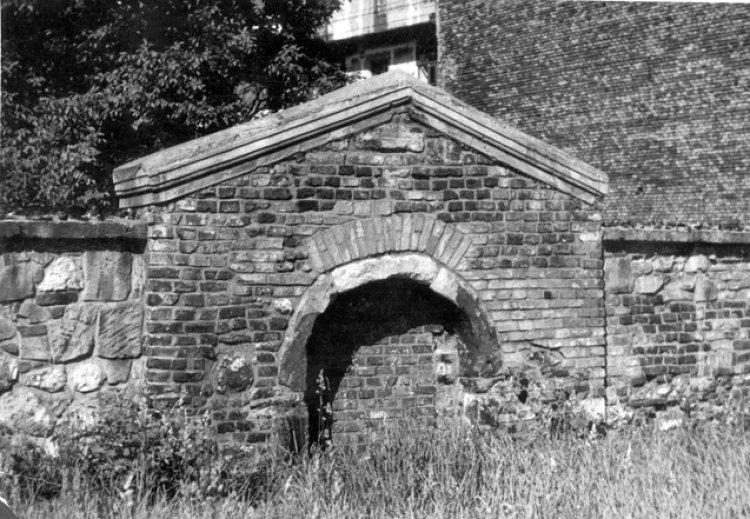
Today in the old Beis HaChaim in the courtyard of the Rema shul in Cracow you can visit the Kever of the holy tzadik, the Tosfos YomTov. He is indeed buried on the other side of the beis hachaim, closer to the old gate which was once open and today is blocked and closed. And there not far away is a small weathered headstone, this small matzeiva whose writing is barely legible has on it many stones, left by visitors. Petitioners, those that come to seek yeshuos and refuos – and have their tefilos answered. Tradition has it that this is the kever of none other than Yosseleh Kamtzan Kadosh. (Based on Al haTzadikim veal HaChassidim and Tzadikei Olam)
Rav Betzalel Rakov of Gateshead, a descendant of the Tosfos YomTov is cited as telling a story he saw in print that this story about Yosseleh was once told publicly at a convention. Afterwards the speaker was approached privately by a priest who revealed that his mother had once told him this story and that they were descendants of the holy miser of Cracow. Events have a way of leading one to another and somehow this priest eventually returned to his roots and today he is a baal teshuva learning Torah in Jerusalem. Perhaps it is the merit of his holy ancestor Yosseleh Kamtzan Kadosh the holy miser and the power of one of the greatest forms of charitable giving is tzedaka called matan be’seiser.
Divrei Torah of Rav Gershon Shaul Yomtov Lipman Heller zt"l
We should pay attention to why these berachos are different from each other. The Birkas Zimun uses the Divine Name Elokeinu (the attribute of strict justice) and the Birkas HaTorah uses the four letter name YH”V”H (the attribute of mercy and kindness. When we make a zimun we say Nevarech Elokaynu She’achalnu Mi’shelo, whereas when he recite Birkas HaTorah we say Barchu es Hashem HaMevorach).
The explanation for this difference is that regarding food and sustenance, G-d acts according to the strict letter of the law. He is obligated according to the attribute of justice to act justly and feed and sustain His creatures. Therefore, the zimun was established with the Divine Name of Elokim which is the attribute of strict justice, the Law Giver and the Master. The Torah, on the other hand, is a gift of lovingkindness as it says Yeshaya 42. It cannot be the letter of the law since Hashem did not give the gentiles the Torah even though they are also His creatures.
(Tosafos Yom Tov Mishna Berachos 7:3)
Rav Yom Tov Lipman Heller writes in Ma’adanei Yom Tov (citing the text of the Gemara Berachos Daf 3 which reads: Rabbi Yehoshua ben Levi said that whoever answers [Kaddish], Amen, Yehei Shemay Rabba Mevorach, responding with all his strength [up in the Heavens], they tear up the judgments of seventy years against him. That is why the Birkas HaTorah was established using the Divine four letter name of loving kindness, YH”V”H.)
The definition of Shemay Rabbah Mevorach is that while we are praying, we are asking that the Divine Name of Shem Yud-Hay should become whole through our redemption as we say that Hashem’s throne and Name are incomplete.
Also [a second request is that we are asking, May] His Divine Name be blessed – mevorach. The Tosafos in the commentary to Daf 3 explain this answer differently, interpreting Yehei Shemay Rabbah Mevorach as [one single prayer], ‘May His great Name be blessed.’
Rashi explains the meaning of “a decree of seventy years” as a decree that may have been made in his youth. I believe the meaning refers to a person’s entire lifetime, as the pasuk in Tehillim (90:10) tells us that an average lifetime is seventy years. The Gemara is telling us that all the decrees and harsh judgments that have been decreed or leveled upon a person throughout his entire life shall be canceled, nullified, ripped and torn up.
In his commentary, Divrei Chamudos, Rav Heller continues:
I cited two explanations for Amen, Yehei Shemay Rabba in my commentary Ma’adanei Yom Tov and there is a practical difference in outcome between the two different interpretations. According to the first explanation, that Amen, Yehei Shemay Rabbah is a prayer that the name Yud-Hay be increased and completed, the glosses of Hagahos Ashri cites the Ohr Zarua that we should not interrupt or pause in between the words Shemay and Rabbah since it is one fluent idea. However, you may pause between the words Rabba and Mevorach since, according to this interpretation, the word mevorach is a separate prayer. It’s a new request that, besides completing the name Ya”h into the four letter name YH”V”H, we are also asking that it be blessed forever for olam haba – mevorach le’alam u’l’olmei olmaya.
According to the second interpretation of the Tosafos that explain that Shemay Rabba means His great Name, and there should be no pause between Rabba and Mevorach either since it is all one single cohesive prayer. It does not mean [as the first opinion] that His name should be great and completed, rather that His great Name be blessed. . .Furthermore, the Beis Yosef cites a midrash and concludes that we should not pause or interrupt between Olmaya and Yisbarach (Ma’adanei Yom Tov and Divrei Chamudos on Rabbeinu Asher – The Rosh Berachos 3:8-9 and 3:61).
Segulos of Rav Gershon Shaul Yomtov Lipman Heller zt"l
During the infamous pogroms of Ta”ch V’Ta”t (years 5408 and 5409 – 1648-1649) the Tosafos Yom Tov fasted and beseeched that from on High it be revealed to him why such terrible calamities had befallen the Jewish people. It was revealed to him from on High that there was lightheaded, idle chatter in shul. People spoke in shul and in the middle of davening, which caused a blemish in the letter “vav” and the word for speech, dibur, was transformed into dever, a plague! When he learned of this, he composed a special prayer (others say the Maharal composed it but the Tosafos Yom Tov instituted and enacted its recitation in his kehillos. See the original nusach below) to help increase the awareness of the power of silence in shul, the destructive nature of idle chatter, and talking in shul and during davening. It is printed in many siddurim alongside the Mi Sheberach we recite on Shabbos after the reading of the Torah.