
Rav Yaakov Yosef HaKohen Katz of Polnoy zt"l
הרב יעקב יוסף בן צבי כץ זצ"ל
Tishrei 21 , 5544 / Tishrei 24 , 5544
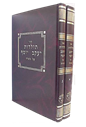
Rav Yaakov Yosef HaKohen Katz of Polnoy zt"l
Rav Yaakov Yosef Hakohen of Polnoy was descended from the mekubal, Rav Shimshon of Ostropoli and Rav Yosef Katz, author of Yesod Yosef, and Rav Yom Tov Lipman Heller, author of Tosefos Yom Tov on Mishnayos.
He was one of the very first disciples of the Baal Shem Tov to spread and teach chassidus. He was the holy Baal Shem’s beloved talmid muvhak, and is best known for his sefer, Toldos Yaakov Yosef. Chassidim affectionately refer to him as the Baal HaToldos or just the Toldos.
Rav Yaakov Yosef was appointed at a young age to serve as Rav of Sharigrod in Podolia, where he drew close to the Baal Shem after originally being one of his opponents and detractors. Chassidic tradition has it that the Baal Shem exerted himself to win him over and when he had succeeded, boasted: “Ribono Shel Olam – Master of the World! I do not request reward in the World to Come for my acts and deeds; I only request to be rewarded for giving You such a Yosseleh as this one!”
He is said to have passed away on the 21st (or 24th) of Tishrei, 5544 (1783), although the exact year of passing is unclear, as the writing on his grave marker and matzeva became worn and blurred over time. The stone is inscribed: “Ish Chai Rav Pa’alim Chassid Anav Ish Elokim Kadosh Yomar Lo” – which is roughly translated as “a busy man of much action, a chassid, a humble, G-dly man, a holy person.”
His resting place is beside that of Rav Leib of Polnoy, who is described in Shivchei HaBaal Shem as one of those who influenced Rav Yaakov Yosef to join the Chasidic movement. A single, joint ohel was erected over both monuments.
Rav Yaakov Yosef left behind a son and a daughter. His son, Rav Avraham Shimshon, succeeded him as Rav of Rashkov and emigrated to Eretz Yisrael during his father’s lifetime. His daughter was married to Rav Avraham Dov Auerbach, who succeeded his father-in-law as Rav of Polnoy. Rav Avraham Dov’s sons also made aliyah to Eretz Yisrael.
Rav Yaakov Yosef was the very first author of the chassidic movement, publishing the first chassidic sefer in history. His writings are amongst the movement’s most important as well.
His sefarim are:
Toldos Yaakov Yosef, derushim on the Torah; Ben Poras Yosef, derushim and chiddushei Torah, including a copy of the famed letter of the Baal Shem Tov, describing his messianic vision of the redemption arriving when his teachings widely proliferate; Tzafnas Pa’aneach on Shemos; and Kesones Pasim on the Torah. He often cites the firsthand teachings he received from the Baal Shem Tov, over 280 times in Toldos Yaakov Yosef alone!
The groundbreaking publication of the Toldos Yaakov Yosef caused an uproar, especially as it was full of harsh criticism for the leaders and rabbanim of that generation and their derech of learning. Rav Yaakov Yosef blamed the shortcomings and failures of the generation on these rabbinical leaders and attacked and criticized the entire establishment. Instead he suggested a new type of leader, the tzaddik and chassidic rebbe: “who would not ignore the ignorant masses, but be intimately involved in their lives and watch over their affairs, guiding, leading and loving them, and drawing them close to their Father in Heaven.” He continued, “The masses are the body and the tzaddik their heart, the soul of the generation. He must lower himself to lift them up, and Avodas Hashem could be done by anyone not just in spiritual matters but even with physical things.” These criticisms were one of the main catalysts behind the misnagdim’s opposition and a contributing factor to the cherem (ex-communication) they later pronounced over the chassidim. The sefer itself is alluded to in the Vilna cherem as well as in Rav Dovid of Makov’s kuntresim, Zamir Aritzim and Shever Poshim, polemics against the chassidim and chassidus, in which he calls it “a mesis u’mediach against Klal Yisrael.”
The sefer was publicly burned in Brode and in other bastions of the misnagdim. Tradition has it that Rav Yechezkel Landua of Prague, the Noda B’Yehudah, sat with his feet resting on the sefer. Rav Yaakov Shimshon of Shepetovka then travelled to Prague where he purportedly presented a scholarly argument that reconciled the work and its author, Rav Yaakov Yosef, to the Noda B’Yehudah, who afterwards lifted up the sefer off the ground and kissed it. The story of this meeting and debate was recorded and published as Divrei Noam and Darkei Noam, in many editions.
The chassidim, on the other hand, rejoiced with the sefer, and its appearance was reason for a Yom Tov-like celebration. Rav Pinchos of Koretz is quoted saying that: “There is no other such sefer as this which is Torah from Heaven.” Rav Yisrael the Kozhnizter Maggid once refused to pass by a certain house in Brode, saying that tumah (impurity) pours forth from there! Upon investigation it was discovered that the Toldos had once been burned at that location. Tradition has it that the very Heavens were disturbed by the Rav Yaakov Yosef’s cries of anguish over his sefer’s fate at the hands of its opponents and detractors.
Stories of Rav Yaakov Yosef HaKohen Katz of Polnoy zt"l

The Shivchei HaBaal Shem Tov relates that once Rav Yaakov Yosef became a follower of the Baal Shem Tov, he gave away all his money as tzedakah out of fear that it was somehow tainted, as perhaps he’d earned it undeservedly, leaving himself destitute. He studied all day wrapped in a tallis and crowned with tefillin. Before eating his meals, he’d study seven pages of Gemara. During the meal, between courses, his mouth never ceased reviewing his learning by heart. After the meal, he took a quick nap and when he arose he once again donned tefillin, in which he studied Torah until Minchah. He studied much at night as well; no night passed by without him rising at chatzos, even on Shabbos and Yom Tov. He was diligently involved with raising funds to redeem captives and distribute tzedakah, although he himself lived in privation and hardship. His tefillos and acts of kedushah were so intense that he trembled as his very flesh crawled with fear and awe of Hashem!
When it became known that Rav Yaakov Yosef had become a follower of chassidus and the Baal Shem, the local misnagdim ran him out of town, leaving him no choice but to spend Shabbos in a neighboring village. Around 5508 (1747), he was appointed as Rav of Rashkov and a few years later, around 5512 (1751), of Nemirov, where he served for a longer time and spread chassidus openly.
Rav Yaakov Yosef continued to consult with the Baal Shem on all matters, and he was perhaps the closest disciple. However, when the Baal Shem Tov passed away in 5520 (1760), it was Rav Dov Ber, the Mezritcher Maggid, who was appointed successor, as Rav Yaakov Yosef felt incapable of leading the fledgling movement. He recognized the Maggid’s authority and is reported as saying: “After the Baal Shem Tov passed away, the Shechina packed her bags, left Mezhibuzh and settled in Mezritch.”
Likewise, the Maggid had a fondness for and appreciated Rav Yaakov Yosef, testifying: “He merited the revelation of Eliyahu Hanavi and other great spiritual achievements.” It is generally accepted that Rav Yaakov Yosef conducted himself as a rebbe, holding a tisch and accepting petitions to daven for the sick and other requests.
After the hub of the chassidic movement moved to Volhynia, Rav Yaakov Yosef, desiring to stay close to that center, moved as well, relocating to serve as Rav of Polnoy in 5530 (1769).
A young couple had recently married in some obscure township in the district of Vilna, and the bride began to observe some strange behavior in her husband. He would rise at midnight and recite the Tikkun Chatzos – the midnight tefilla lamenting the exile; at daybreak each day he would immerse himself in the mikve; and he kept reading a certain book which he kept hidden under his pillow.
The young girl told her father, who went and took the hidden sefer from beneath the pillow. He opened the book and his entire world went black – the sefer was the Toldos Yaakov Yosef, whose mechaber was known as one of the leaders of the “Sect” – Rav Yaakov Yosef of Polnoye! His own son-in-law had become ensnared by the dreaded cult of Chassidim!
When he next saw his son-in-law, he spewed forth his anger and fury over his son-in-law’s head, pouring a torrent of oaths and admonishments on him. When he saw that this had no effect at all, he changed his approach, and attempted instead to use some gentle persuasion to try to turn him away from the evil path he had chosen. But to no avail – he saw that it was no use arguing and cajoling and instead he decided to demand that he divorce his daughter and give her a get. The young chosson refused to do either; he was bound to the Chassidic movement with all his soul, and he did not want to divorce his wife.
His father-in-law saw the situation was hopeless, so he turned and poured out his woes to his fellow townsmen for help and advice as to how to rid himself of this son-in-law. This threw the little town into turmoil, some held that all forms of pressure should be applied to force the young man to divorce his wife while others pointed out that a divorce issued under duress was invalid and that the poor bride would find herself in the middle of a labyrinth of Rabbinic responsa to decide if her get was kosher. The only way in their opinion was to offer the husband large sums of money so that he would agree to give the divorce on his own free will.
The entire town became a cauldron of boiling and heated arguments until the episode eventually reached the ears of the poritz, the noble gentile ruler and landowner who ruled that region. This poritz was an old colonel. And when he heard that the whole uproar began with a book, he asked who its mechaber was.
He was told that it was an individual who had misled his fellow Jews from the true path of the Torah; and that his name was Yaakov Yosef the Kohen, from the town of Polnoye.
Upon hearing this, the poritz asked to see the book. He himself looked at the title page and saw the name of the book and its mechaber printed in Russian at the bottom. He commanded that the young man, his wife and his father-in-law, as well as all their friends and relatives be brought before him. When all the parties had arrived, the poritz spoke:
“The time has now come to relate an incident which happened to me in my youth. Listen carefully please, and hear me out.
“Many years ago, when I was serving as a Polkovnik (полко́вник or colonel), I was encamped one winter with my unit near Polonoye. We received the order to move the camp. The procedure for such occasions was a full lineup at daybreak during which the men were given their orders.
“At roll call, three soldiers were found to be missing. So I ordered some other soldiers to go to nearby Polonoye to locate them and bring them back. After a little while they returned, but with the strangest report. They had located all three soldiers together in one house that was lit by candlelight. At the head of the table sat an old man of impressive appearance. The three missing soldiers were standing there, speechless and dumb, frozen and unable to move neither hand nor foot, as if paralyzed. I didn’t believe such a strange story, so I sent off a different group of soldiers to verify the first report. But they returned with the same story.
“I decided to go there myself. I took a few soldiers with me, and when I entered and saw the old man looking like an angel from heaven sitting at the table in deep meditation, I felt deep inside me fear, trembling and awe. And I saw the missing soldiers, standing there deaf and dumbstruck, as if nailed to the floor.
“I finally mustered up enough courage to dare to disturb his holy thoughts, and said, ‘I see, sir, that you are a holy man. My soldiers here have to leave this place today together with the whole battalion. So could your honor please do something so that we will be able to move and walk out of here?’
“The old man answered, ‘No doubt they have stolen something. If you remove the stolen objects from their pockets they will be able to leave.’
“Immediately we began searching their pockets, and found that they were full of all manner of silver vessels and objects. As soon as we removed them from their pockets, two of the men walked normally and left, but the third remained frozen and paralyzed, unable to move. His friends said, ‘He must have something hidden in his boot.’ And so it was. We discovered a small silver cup, hidden in his boot. We removed it and he too was able to move once more and he left.”
How did this all happen? It was the first night of Pesach. When the Seder was over the family had all gone to sleep, leaving the head of the house, Rav Yaakov Yosef himself, sitting at the table all night in holy meditation. The door of the house had been left open, for this night is leil shimurim, a night guarded against all harmful beings. The three soldiers had passed by, and seeing through the windows that everyone was asleep, and the front door ajar, had simply walked in and began stuffing their pockets with leftovers and matza from the table. Then they began stealing all the silver utensils which had been placed on the table in honor of the Seder. As soon as they had perpetrated their crimes they discovered that they could not move to leave, until the colonel released them.
“Now when I saw this wondrous thing,” continued the poritz, “I asked the holy Rav to bless me twice. First with children, for I was childless back then; and second, with a long life. He agreed, and blessed me. Then I asked him to tell me when my end of days would be.
“‘The end of man’s life is a secret matter that cannot be revealed,’ he said. ‘But you should know that just before the end of your life an episode will present itself to you when you publicize my name among those Jews who do not know me.’ The Rav’s blessings were fulfilled. G-d blessed me with children, and as you see for yourselves, I have lived till old age.
“‘Now tell me,” concluded the poritz, “is there anyone among you who would still speak a word against a holy man like that? No one here should see it as a sin that this young man should study a book written by such a holy man of G-d! I am now ordering you that you make peace between yourselves at once – and let no one here dare lay a hand on this young man!’”
All those present were electrified by the old poritz’s tale and they all promised to follow his instructions and to stop bickering and live in peace.
“It is now clear,” added the old poritz, “that the end of my life is near, for the last words of the holy man have been fulfilled. However, I am very pleased that I have been able to bring peace between you, thanks to the name of the holy Rav who is now in Gan Eden.” And indeed, a few months later the old poritz passed away.
(Sippurei Chassidim Al Ha’Moadim #310)
Rav Chaim Elozor Shapira of Munkascz, mechaber of Minchas Elozor, told the following story:
When Rav Yaakov Yosef of Polnoye printed his holy sefer, the Toldos Yaakov Yosef on the Torah, he traveled to Berditchev on the day of the trade fair. He brought with him two hundred copies to sell.
He rented a storefront and placed a copy or two of his book open in the window to display it to passersby who might be interested in purchasing it. He was sure without a doubt that anyone who read just a few lines and saw what he had written would run to snatch up a copy.
However, when some interested potential buyers asked him the price of a volume and the Toldos answered them that the price was a rendil (a very valuable gold coin worth hundreds of dollars), they laughed and went on their way, saying, “For a whole rendil we can buy a new wardrobe and shoes to match!”
Days passed with no sales and the fair was drawing to a close. The Toldos was despondent and began to feel very disappointed.
Somehow, word got to the Berditchever and the Kedushas Levi knew the entire story. He told his faithful Rebbetzin the entire story. “Our dear friend, Rav Yaakov Yosef, has come here to Berditchev to sell his new sefer at the fair. His asking price is too high and I am afraid that in his anger and disappointment at his situation the entire city will be punished as a result.”
Based on her husband’s sage advice the Rebbetzin decided to sacrifice one of her prized possessions.
She quickly hurried off and went to pawn her shterntichel (a beautiful crown of silver or gold and diamonds) for the sum of two hundred rendils. She handed the entire sum of money to the Berditchever so that he could purchase all the seforim and save the town from the impending tragedy.
The holy Berditchever took a young man as his emissary and gave him the entire sum, a small fortune and asked him to try and bargain with the Toldos. “Ask him to give you a discount if you buy forty or fifty books,” explained the Berditchever. He hoped thereby to make the sale seem authentic so that the Toldos would not suspect a thing.
However, when he approached the Toldos, the latter would not budge a cent from his asking price. No matter how the young man haggled and tried to wheel and deal, the Toldos stubbornly replied, “Even if you were to take the entire lot of two hundred books, I will not lower the price by even a kopeck.”
Finally, the young man purchased all two hundred seforim for the entire sum. Afterward, the Toldos, having finished his business, decided to visit the Rav of Berditchev before taking his leave of the city.
When he came to visit the Berditchever, he excused himself for not having visited sooner, since he had been busy with the mitzva of selling his seforim.
The Toldos then recounted to him the entire story of how pained he had been that at first no one bought any of his seforim. “However,” concluded the Toldos, “finally Hashem sent me a young man with a good head on his shoulders, who really appreciated my sefer and valued it so much that he bought all two hundred copies for the price I asked!”
The Berditchever listened and smiled, “Really – you don’t say!” was all he remarked at the wondrous tale.
(Otzar HaSippurim Vol. IV #15 p.29-31, Chodesh BeChodsho Munkacsz Nisan 5757 Volume 37 page 52)
Divrei Torah of Rav Yaakov Yosef HaKohen Katz of Polnoy zt"l
faith
By doing a mitzva with full faith and with attachment to Hashem through dveikus and with delight, this mitzva then incorporates within it all 248 positive and 365 negative commandments. This is as our Sages taught (Makkos 24a): “Chavakuk came and established all the mitzvos on one principle: ‘A righteous Tzaddik will live by faith.’ (Chavakuk 2:4)
(Toldos, Parshas Chayei Sora).
Just as the heart gives life to all the limbs of the body, so is the commandment of faith the source and root of all the 248 positive commandments. This is an aspect of the positive commandment of “Anochi – I am Hashem your G-d” (Shemos 20:2), which is the source of them all. And faith is also love, which is the root of all things. When a mitzva contains both faith and love together a person who fulfills it merits life in the next world as the Rambam writes in his commentary to the Mishna (end of Makkos).
(Toldos Parshas Yisro)
love of am yisroel
“Love your fellow as yourself” (Vayikra 19:18). All Jews are rooted together in unity. Therefore, one should never push away another Jew with two hands, rather etc. (the left pushes aside while the right hand draws near).
Because if one pushes away his fellow, he is in effect pushing himself away, since he is pushing away a portion of that unity and it is as if he is pushing the entire unified whole.
(Toldos Parshas Chayei Sora)
love of hashem
Love is drawn by none other than faith, which is a form of attachment and dveikus to Hashem. And when one does even one mitzva with both elements of love and faith, he is then attached to the root of all faith and it is as if he fulfilled all 613 commandments. This is because the Torah and its commandments all emanated from Hashem’s very essence, which is true unity and therefore by fulfilling one mitzva completely and with love, which is dveikus, this mitzva captures through this unifying factor all the others.
It is therefore as if he has fulfilled all the mitzvos, which are the whole of His unity and are one complete partzuf, so to speak.
(A partzuf is a Kabbalistic construct in the system of the Arizal whereby the sefiros or attributes of the divine form complete sets of ten.)
(Toldos Parshas Yisro)
What is most difficult regarding the commandment to love Hashem is the fact that we are commanded to do what at first glance seems to be something contrary to man’s ability. (That is we are being asked to feel an emotion which we would normal classify as almost involuntary. To rephrase the question, how can we be forced to feel love?)
However, the truth is that through attachment and connection to the Torah and the path of Hashem, his heart will fill with love for Hashem on its own. This is also true regarding joy, (another emotion with regard to which we could ask the same question) he will then rejoice in loving Hashem etc.
(Toldos Parshas Shelach)
faith
By doing a mitzva with full faith and with attachment to Hashem through dveikus and with delight, this mitzva then incorporates within it all 248 positive and 365 negative commandments. This is as our Sages taught (Makkos 24a): “Chavakuk came and established all the mitzvos on one principle: ‘A righteous Tzaddik will live by faith.’ (Chavakuk 2:4)
(Toldos, Parshas Chayei Sora).
Just as the heart gives life to all the limbs of the body, so is the commandment of faith the source and root of all the 248 positive commandments. This is an aspect of the positive commandment of “Anochi – I am Hashem your G-d” (Shemos 20:2), which is the source of them all. And faith is also love, which is the root of all things. When a mitzva contains both faith and love together a person who fulfills it merits life in the next world as the Rambam writes in his commentary to the Mishna (end of Makkos).
(Toldos Parshas Yisro)
love of am yisroel
“Love your fellow as yourself” (Vayikra 19:18). All Jews are rooted together in unity. Therefore, one should never push away another Jew with two hands, rather etc. (the left pushes aside while the right hand draws near).
Because if one pushes away his fellow, he is in effect pushing himself away, since he is pushing away a portion of that unity and it is as if he is pushing the entire unified whole.
(Toldos Parshas Chayei Sora)
attached in dveikus
Toldos Yaakov Yosef (Bechukosai 2, Naso 12, Naso 17)
A parable: The king’s son was lost and strayed from his father. He could not be brought back until one of the ministers removed his royal clothing and donned the simple clothing of a peasant. Then he was able to become friendly with and come close to the king’s wayward son, who had likewise become a lowlife.
Toldos Yaakov Yosef (Naso 17)
A person has ups and downs in his life. Before he falls, he must attach himself with rapture and dveikus to Hashem so that if he falls, he can elevate himself again from those fallen spiritual levels and at the same time elevate the sparks of others who have fallen. Thus every generation has its leader, and when he dons the lowly clothing of his generation, he attaches himself to them. This occurs through sin, that he is able to have some connection with them, and then, when he repents, he can bring them all back with him to his previous level. Just as one who descends into the pit first ties himself with a rope, so the Tzaddik attaches himself to the Creator before descending to the level of his generation. Thus we say, “Yaakov chevel nachalosso — Yaakov’s inheritance is like a rope” (Devorim 32:9): grasp this rope, which is bound to the Holy One Himself.
Note: See also Zohar I:83a, 140b. The Zohar explains this idea with a parable: What is this compared to? It is like a man who wished to descend into a deep pit, but was afraid that he would not be able to ascend afterward and come back out. What did he do? He tied a knot in a rope outside the pit. He said, “Now that I tied this knot I can climb out with this rope.” Similarly, when Avrohom was about to descend into Egypt, he first bound himself to his faith so that he could later come out.
attached in dveikus
Toldos Yaakov Yosef (Bechukosai 2, Naso 12, Naso 17)
A parable: The king’s son was lost and strayed from his father. He could not be brought back until one of the ministers removed his royal clothing and donned the simple clothing of a peasant. Then he was able to become friendly with and come close to the king’s wayward son, who had likewise become a lowlife.
Toldos Yaakov Yosef (Naso 17)
A person has ups and downs in his life. Before he falls, he must attach himself with rapture and dveikus to Hashem so that if he falls, he can elevate himself again from those fallen spiritual levels and at the same time elevate the sparks of others who have fallen. Thus every generation has its leader, and when he dons the lowly clothing of his generation, he attaches himself to them. This occurs through sin, that he is able to have some connection with them, and then, when he repents, he can bring them all back with him to his previous level. Just as one who descends into the pit first ties himself with a rope, so the Tzaddik attaches himself to the Creator before descending to the level of his generation. Thus we say, “Yaakov chevel nachalosso — Yaakov’s inheritance is like a rope” (Devorim 32:9): grasp this rope, which is bound to the Holy One Himself.
Note: See also Zohar I:83a, 140b. The Zohar explains this idea with a parable: What is this compared to? It is like a man who wished to descend into a deep pit, but was afraid that he would not be able to ascend afterward and come back out. What did he do? He tied a knot in a rope outside the pit. He said, “Now that I tied this knot I can climb out with this rope.” Similarly, when Avrohom was about to descend into Egypt, he first bound himself to his faith so that he could later come out.
love of hashem
Love is drawn by none other than faith, which is a form of attachment and dveikus to Hashem. And when one does even one mitzva with both elements of love and faith, he is then attached to the root of all faith and it is as if he fulfilled all 613 commandments. This is because the Torah and its commandments all emanated from Hashem’s very essence, which is true unity and therefore by fulfilling one mitzva completely and with love, which is dveikus, this mitzva captures through this unifying factor all the others.
It is therefore as if he has fulfilled all the mitzvos, which are the whole of His unity and are one complete partzuf, so to speak.
(A partzuf is a Kabbalistic construct in the system of the Arizal whereby the sefiros or attributes of the divine form complete sets of ten.)
(Toldos Parshas Yisro)
What is most difficult regarding the commandment to love Hashem is the fact that we are commanded to do what at first glance seems to be something contrary to man’s ability. (That is we are being asked to feel an emotion which we would normal classify as almost involuntary. To rephrase the question, how can we be forced to feel love?)
However, the truth is that through attachment and connection to the Torah and the path of Hashem, his heart will fill with love for Hashem on its own. This is also true regarding joy, (another emotion with regard to which we could ask the same question) he will then rejoice in loving Hashem etc.
(Toldos Parshas Shelach)
the heavenly voice
The Mishna in Avos (6:2) tells us of a heavenly voice called a bas kol, which calls out to us on a daily basis to repent and return to Hashem. The Toldos Yaakov Yosef writes that his master and teacher, the Ba’al Shem Tov, asked, “What point is there in a daily heavenly voice that no one hears?!”
He answered that on high, where the heavenly voice originates, there are no words and there is no speech; there is only the spiritual realm known as Olam HaMachshova — the universe of pure thought. Therefore, any thoughts a person has of repentance, any urges to return to Hashem and His path, those thoughts and feelings are not his own. Rather, that is the sound of the heavenly voice. Through our thoughts of repentance, we do truly hear the bas kol. (Kesser Shem Tov).
Quoting from a letter that the Ba’al Shem Tov had written to him, Rav Yaakov Yosef wrote: “Do not overly engage in fasts and self-mortification. Such practices lead to depression or anger. But the reason you should especially refrain from these practices is because, rather than improving your avoda, they prevent you from studying Torah and serving Hashem properly.” (Ben Poras Yosef).