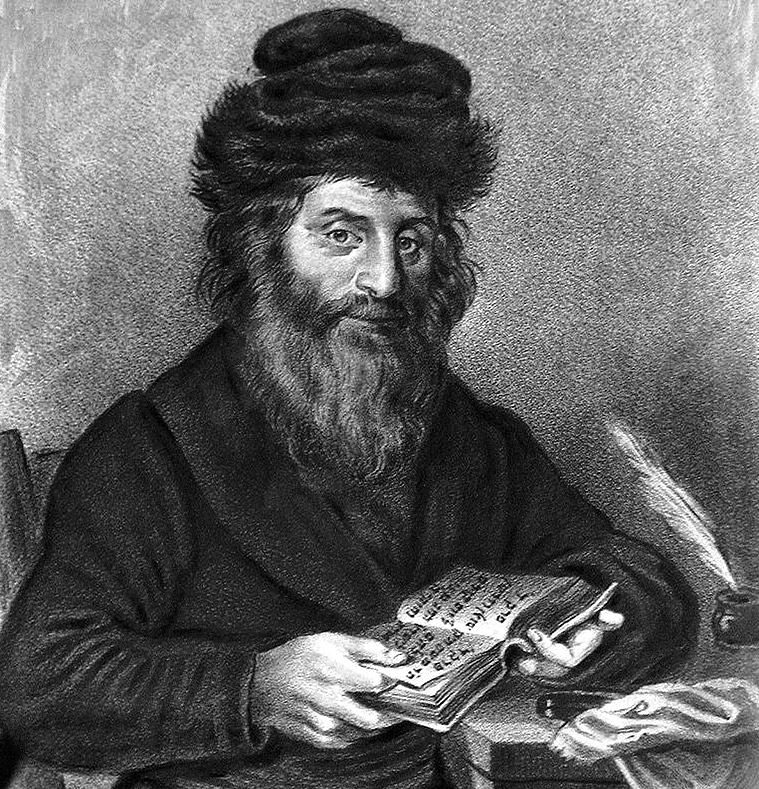
Rav Moshe Sofer zt"l
הרב משה בן שמואל סופר זצ"ל
Tishrei 25 , 5600
Rav Moshe Sofer zt"l
Rav Moshe Sofer, the Chasam Sofer of Pressburg, learned under Rav Nosson Adler of Frankfurt and Rav Pinchas HaLevi Horowitz, the Ba’al Haflo’a (a talmid of the Maggid of Mezritch). He was born in Frankfurt-am-Mein. His first position was as Rav in Boskovitz in Moravia. He married the daughter of the Rav of Prosnitz and was supported by his brother-in-law, Rav Hirsch. Unfortunately, Rav Hirsch eventually lost all his money, and the Chasam Sofer took a position as Rav in the Moravian city of Dresnitz. After five years in Dresnitz, Rav Moshe moved to Mattersdorf. The Chasam Sofer was appointed Rav of Pressburg in Tishrei of 1806, and he occupied that position for thirty-three years. After the petira of his first wife, Rav Moshe married the daughter of Rav Akiva Eiger. She bore the previously childless Chasam Sofer three sons and seven daughters.
Stories of Rav Moshe Sofer zt"l

His birth was a difficult one, and the labor was drawn out and painful. When some of the disciples and Torah scholars saw that their rebbe did not seem to do anything to try and hasten the birth of his son, they questioned his lack of motive. “Why didn’t the rav daven that his wife give birth easier and quicker?” they asked.
“Surely, you knows the statement of Chazal Yoma 38 that when one sun rises, the other sets?” the Chasam Sofer said. “When one tzaddik’s life ends like sunset, another tzaddik’s life begins like the sunrise. Surely my son will be a tzaddik; and if so, how can I hasten his birth and cause another tzaddik’s life to end prematurely?”
One day, each member of the household of the holy Chasam Sofer was ill. Among the sick was the young six-year-old Shmuel Binyamin. Over time, his illness grew worse and his life was in danger. Everyone davened on his behalf and pledged tzedakah to spare his life. They added the name Avrohom to his name. Eventually, he would endure some five to seven illness -- each severe and life threatening. The final of these harrowing illnesses reached its peak and the doctors concluded that the end was near. The members of the Chevra Kadisha were summoned to perform the final rites. They lit candles and conducted tefillos while the physicians and medical experts turned to the Chasam Sofer and said: “We know you are a holy man; surely if your prayers remain unanswered then there is no hope!”
Hearing this the Chasam Sofer stood up and began to daven by the bookcase that held all his writings and manuscripts of his Torah. Suddenly the sick child cried out, “Shema Yisroel!”
The Chasam Sofer responded to his son.
The physicians declared, “Now we really see how holy you are and our hope is restored!”.
“I myself, never gave up hope,” declared the Chasam Sofer.
Seeing the child’s miraculous recovery, the Chevra Kaddisha put out the candles and left with a sense of relief. Others heard the tzaddik say to himself: “For one yovel (a jubilee), have my prayers been answered.”
And so it was that the Kesav Sofer lived after that day another fifty years. The Kesav Sofer never fully returned to vigorous health. Physical ailments and pain continued to be part of his life; he was a ba’al yissurim, who’s suffering surely atoned for the generation and for us all.
Rav Yitzchok Aharon Landsberg, the Rav of Grossvardayan, testified during his hesped for the Kesav Sofer that he recalled him as a child. “When I studied in the Pressburg yeshivah, we all recognized his greatness. Even at nine years of age, he davened with tears. His manner and behavior was like a true tzaddik yesod olam – a righteous tzaddik who serves as a foundation of the entire world!”
At the Kesav Sofer’s bar mitzvah, following his wondrous derasha that was filled with his own novel insights (chiddushim), he received the customary derasha geshank gifts. Among these, was a singular silver box, gifted to him by the scholar, Rav Ber Frank. When the bachur opened up the box, he discovered wax candles. Puzzled, he turned to the rav and asked him what was the nature of so strange a gift?
“My child, these are your candles because they are the very same candles that the Chevra Kadisha prepared for your untimely passing all those years ago. And now they are yours. The “ner” (candle) changed to “ron” (joy): from candles for the dead, to a song of simchah and light (נר רן). The song of the morning star shall be your melody as your candle shines forth like the morning light. You will merit to illuminate the entire world like the noontime sun at its zenith!” The candles were kept in the family for years and passed down from generation to generation.
He was a humble child and hid his greatness from everyone. By age fourteen he was recording chiddushei Torah, on his learning and on the parshah, recording his insights in a secret journal. The Chasam Sofer studied late into the night and the young Shmuel Binyamin pretended to be asleep. When his father finally retired to sleep, the young Kesav Sofer got up to study in secret, avoiding the suspicion of his father who assumed his son had slept all night. In this way, he succeeded in hiding his great passion for Torah learning and his hasmada from everyone-- even his own father.
In תקצ''ב at age fifteen, he was exchanging letters with gedolei haposkim and his father’s talmidim. That year, his mother passed away. He found comfort from his mourning later that year, through his engagement to Chava Leah, the daughter of Rav Yitzchok Weiss of Gorlitz. They were married the following year תקצ''ג in Kamaran. Before the chasuna, he received his semicha and the title Moreinu from Rav Daniel Prostitz, Rav Mordechai Task, Rav Zalman, and from the rabbanim and dayanim of Pressburg. For six years, he was supported as he sat and studied in Pressburg under his father.
He passed away on Yom Rishon of Parshas Shemos 19 Teves, in the year תרל''ב after having served as rav of Pressburg for thirty years - the same exact number of years that his father had served as rav before him. (Chut HaMeshulash)
The Chasam Sofer was known to write his responsa very quickly without any afterthought or regret. Once, an issue with an aguna was presented to him, and as was his custom he wrote a quick response and handed his response to his son, Rav Shimon, to deliver it to the Bais Din in Nikolsburg. Rav Shimon thought that since this was a grave and important matter, he would delay fulfilling his father’s errand, because perhaps his father rushed the response and might want to clarify or change it later. A few days later, the Chasam Sofer asked his son if he had delivered the responsa. His son replied in the negative and explained his reasons. The Chasam Sofer proceeded to tell his son the following: “In every generation, Hashem puts a Godol HaDor who has Siyata dishmaya and the halachic responsa will be in accordance with Hashem’s will. In this generation, I was chosen for this task. Please deliver the responsa immediately.”
When the lengthy responsa was received by Nikolsburg’s Bais Din, Rav Mordechai Banet opened up the letter and just read the last few lines of the halachic decree. When the Bais Din questioned Rav Mordechai about why he had not read the whole p’sak din, he replied, “In reality, I only need to see the last line, if the Chasam Sofer said muttar or ossur – and that would be enough. However, I read a couple of the last lines because reading the ksav yad (handwriting) of the Chasam Sofer brings about tremendous Yiras Shomayim.
Rav Mordechai was the Rav in Nikolsburg and in the last years of his life, he fell sick and moved to Lichtenstadt (near Carlsbad) for treatments.
When he was niftar, the people in Lichtenstadt buried him quickly because they wanted him to stay in their town. When the people in Nikolsburg found out what had happened, they caused an uproar – until the question if they should reinter him came before the Chasam Sofer. In his teshuva (responsa), he ultimately gives three reasons why it is mutar to reinter him in Nikolsburg (even though it was a very unpopular thing to do – because it gave the non-Jews ammunition to reinter bodies at their own discretion).
He also notes in his lengthy responsa, that the people in Nikolsburg are not to be believed that Rav Mordechai wanted to have his body returned – because he states that Rav Mordechai had affirmed in his lifetime that whoever will need salvation after his petira, should just come to his kever and his tefillos will be answered – and that incentivizes the people of Nikolsburg to try to have him buried near them. However, while he was writing the responsa, the Chasam Sofer fell asleep. In his dream, Rav Mordechai appeared to him and told him that he did indeed want to return to Nikolsburg – but Hashem wanted him to be buried in Lichtenstadt for the following reason:
When he was a young man, the shidduch to the girl that he was to marry was broken. This girl suffered embarrassment due to this fact and later married the Rav in Lichtenstadt. Rav Mordechai further related that with the help and tefillos of the Rav of Lichtenstadt, it was determined that the only kappora (absolution) that he could get was by being buried next to her in the cemetery for six months. And so it was: after six months his holy body was removed and re-interred in Nikolsburg.
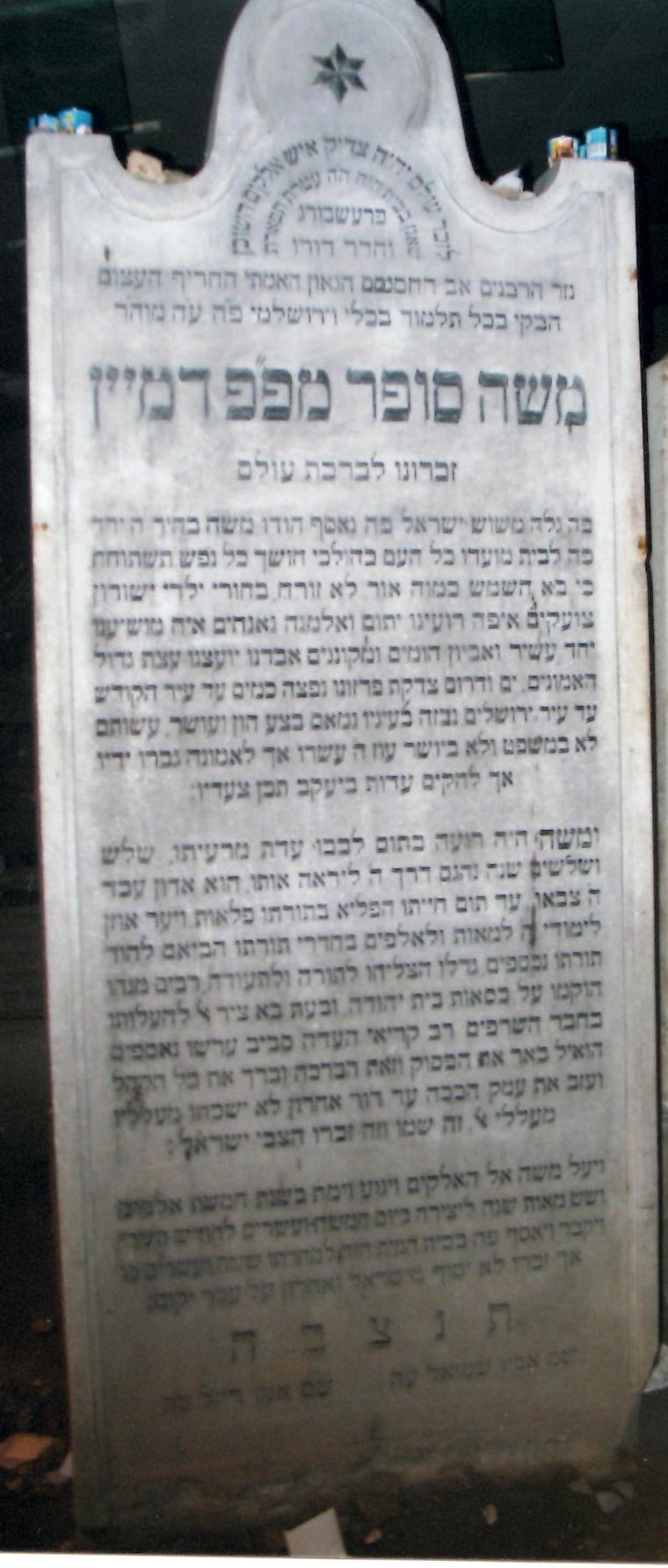
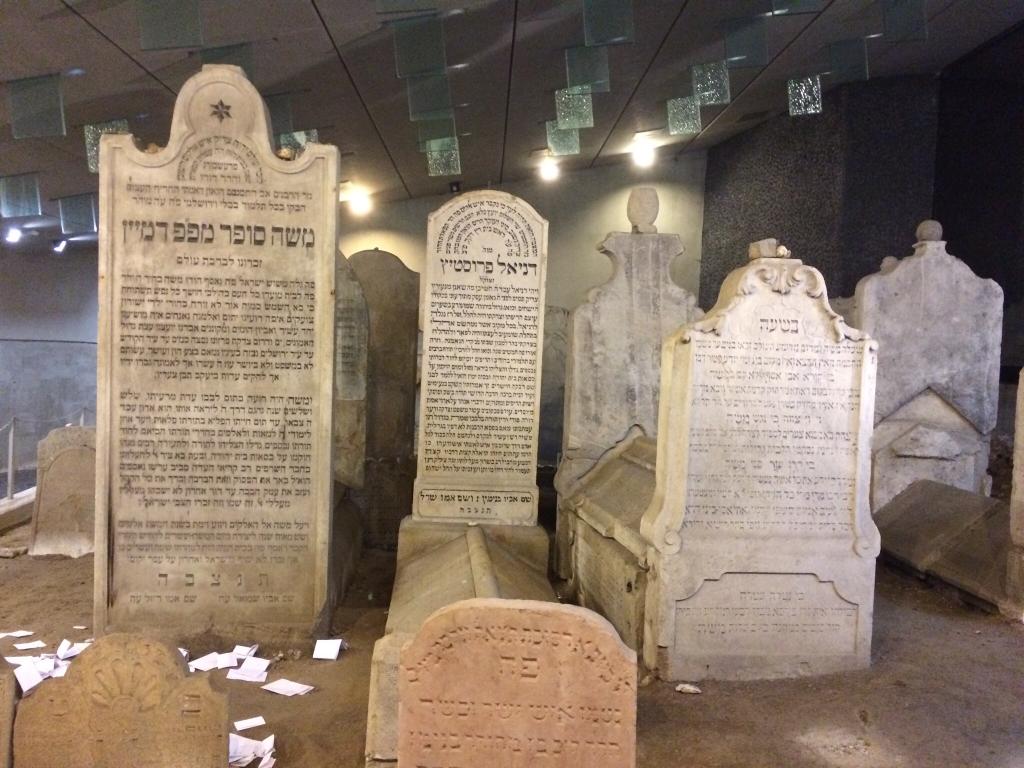
Following is the text of his matzeiva – denoting part of this story:
[Editor’s note: Several years ago, I made the trip to Nikolsburg to daven at his kever. We arrived very late at night in the bitter cold and wandered the cemetery aimlessly searching for his kever in the near-pitch darkness. We were almost at the point of leaving, when we quickly davened to be zoche to say a few chapters of Tehillim at his kever. Within seconds, we turned to the next row, and there, right in front of us, was his kever. I can attest that there is a palpable spiritual high at his kever].
Some Chassidim of the Tzaddik of Sanz were in Pressburg on Pesach, guests at the Chasam Sofer’s table. Among Chassidim, it is the custom to avoid eating gebrokts (matza that has come into contact with liquid). This is a chumra that Misnagdim have not adopted; hence, the Chasam Sofer ate kneidlach on Pesach.
When the Chassidim were served kneidlach, they were in a quandary, because they had never eaten gebrokts – and they knew how makpid the Sanzer Rav was with regard to this minhag. One Chassid did not eat the kneidlach. The other reasoned, “I’m sitting at the table of the Godol HaDor. Who am I to be more strict than he is?” and he ate the kneidlach.
When they reported their visit to the Tzaddik of Sanz, the latter said to the Chassid who ate the kneidlach, “You have earned Olam HaBa.” To the Chassid who had refused to eat them, the Tzaddik said, “You had better stand near me on Yom Kippur, and I will try to elicit forgiveness for you.”
Adapted from Four Chassidic Masters by Rav Dr. Abraham Twerski (page 194–195)
The Divrei Chaim of Sanz once told Rav Shimon Sofer of Cracow regarding his father the Chasam Sofer that:
“It was no chiddush that your father the Chasam Sofer was so great and holy and rose to such heights when he had a rebbe such as Rav Nassan Adler.
Regarding whom I heard from my own rebbe Rav Naphtali of Ropshitz who heard in turn from his rebbe the Rebbe Reb Melech of Lizensk author of Noam Elimelech who said that ‘for many years a soul such as Rav Nosson Adler’s had not descended to this world besides the soul of the Baal Shem Tov.’”
Segulos of Rav Moshe Sofer zt"l
Rav Shlomo Sofer, son of the Kesav Sofer, and grandson of the Chasam Sofer testified that they continued this custom in his family based on what his grandfather, the author of the Chasam Sofer, established.
The Chasam Sofer’s custom was that whenever he needed a yeshuah –some salvation in any matter, be it large or small, would donate charity for the sake of the ascension of the pure soul of the chassid, Rav Akiva of Frankfurt.
He [Rav Akiva of Frankfurt himself] was the first to establish the kupos (the tzedakah pushkas). He enjoined others to give a donation of tzedakah le’illui nishmaso at any time of danger or disaster - Heaven save us - to effect salvation. (Chut HaMeshulash p. 197)
In the name of the Chasam Sofer [a segulah] for success in finding lost objects, it is good to make a vow [to give tzedakah ] l’illui nishmas HaGaon HaKadosh Rabbi Akiva of Frankfurt. (Rav Yitzchok Weiss of Verboy, in the name of an anonymous talmid chacham who was a disciple of the Chasam Sofer. Alef Kesav vol. 2p. 840)