Rav Dovid Tzvi Shlomo Biderman of Lelov Yerushalayim zt"l
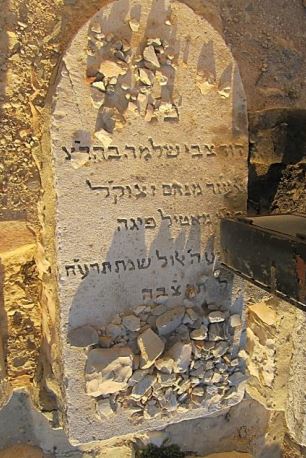
הרב דוד צבי שלמה בן אךעזר מנחם מנדל בידערמאן זצ"ל
Elul 5 , 5678
Rav Dovid Tzvi Shlomo Biderman of Lelov Yerushalayim zt"l
Rav Dovid Tzvi Shlomo Biderman, known affectionately as “Rav Duvidel,” was born in Pshedburzh on Simchas Torah in the year תר''ד/5604. His father was Rav Elazar Menachem Mendel of Lelov. His paternal grandfather, Rav Moshe of Lelov, was the son of Rav Dovid of Lelov, the founder of the Lelov dynasty, and the grandson of Rav Shlomo Tzvi Biderman. His mother, Rebbitzen Feiga Matel, was the daughter of Rav Tzvi Horowitz, whose father was the Chozeh of Lublin.
Rav Dovid Tzvi Shlomo married Miriam, the daughter of Rav Pinchos Horowitz. At the age of six, in the year 5611 תר''י, he made aliya together with his father and grandfather, Rav Moshe of Lelov, who passed away 72 days later, on 13 Teves, and was laid to rest on Har HaZeisim, near the kever of the Navi Zechariya.
Rav Dovid Tzvi Shlomo served Hashem with great rapture and deveikus. His davening was loud and filled with mesirus nefesh. His shining countenance was especially noticeable, and he was able to draw close Jews from all walks of life. For many years he did not sleep in a bed, not by day or by night, and instead studied Torah all night long. He established the Batei Warsaw neighborhood in Yerushalayim.
Rav Dovid Tzvi Shlomo passed away on 5 Elul in the year 5678 תרע''ח and was laid to rest on Har HaZeisim in the section of the Perushim. According to his explicit instructions in his last will and testament, only his name and date of death were inscribed on the matzeiva. He left behind two sons, Rav Pinchos and Rav Shimon Noson Neta.
Stories of Rav Dovid Tzvi Shlomo Biderman of Lelov Yerushalayim zt"l

Rav Elimelech Biderman tells the following story in Be’er HaParsha:
Some tzaddikim have the custom to cast items of clothing – even including their yarmulkes – into the flames of the Lag B’Omer bonfire. Once, a Yerushalmi Jew approached Rav Dovid Tzvi Shlomo to get help for his sick son. The boy had long ago ceased communicating normally; in fact, he no longer spoke at all and he seemed to have lost his mind. He had formed the troubling habit of constantly throwing off his kippah and walking around bareheaded, to the shame and embarrassment of his family. The Rebbe was about to depart for Meron and he asked them to join him.
The poor father suffered continual shame along the way from the troubled boy, who frequently ran off and had to be chased after and brought back. Finally, the group arrived in Meron. When the traditional bonfire was lit on the roof of the tzion of Shimon Bar Yochai, the Rebbe approached the young child, grabbed the yarmulke off the boy’s head, and tossed it into the flames. No sooner had he done so than the child covered his bare head with his hands and began to yell in Yiddish: “A kappel, a kappel!” (“Give me a kippah [to cover my head]!”)
Everyone present was astounded. This child, who had long ago ceased speaking and acting in any normal fashion, was suddenly talking! Furthermore, he was asking for a kippah to cover his head – after years of habitually throwing his kippah off! From then on, he was cured.
After he grew up, he decided to travel to Europe in search of a rebbe and mentor. His father wondered, “Why am I not good enough to be your rebbe?” “A father cannot also be his son’s rebbe,” replied Rav Dovid Tzvi Shlomo. “So why don’t you take the Kosel as your rebbe?” asked his father. “I need a rebbe who can respond to me and give me answers,” insisted the son.
“The Kosel does give responses and answers,” his father protested.
“Tatty,” said Rav Dovid Tzvi, “when you say ‘Good Shabbos’ after Maariv, you do indeed hear a response – but I don’t.” He left for Europe as he had planned. Once there, he became attached to Rav Aharon of Karlin (author of Beis Aharon) and when he returned to Eretz Yisroel, he established his place of davening in the Karliner beis medrash.
He travelled often to Meron, especially for Lag B’Omer, and each time he would take along a list of names of his family members, friends and followers in order to daven for them. After the large traditional bonfire was lit, he would recite all the names, and then carefully fold up the list and throw it into the fire. After the paper would go up in flames, he would say that it was like Chazal’s statement (Avoda Zara 17) that the parchment is burned while the letters ascend on High. He once remarked that, when the fire is lit, the souls of the tzaddikim descend, and then rise back up again through the flames of the bonfire.
There was once a Yerushalmi who came crying to him about the dire situation of his sick son. “Go to the holy site of Meron and achieve your salvation at the tzion of Rabbi Shimon bar Yochai,” ordered Rav Dovid Tzvi.
“But I have already been to Meron!” protested the Yerushalmi.
“Go back!” he replied. “Do you mean to tell me that if someone visited a doctor once, and isn’t yet healed, that he shouldn’t go back to the doctor again?!” The Yerushalmi returned to Meron, and his son was healed.
In the year תר''ע 5670 on Lag B’Omer, there was a strong earthquake in Meron that killed many people. At the time, the Rebbe was on the roof of the tzion, dressed in his striped kaftan and fur shtreimel, meditating and davening with his eyes closed as if it was Yom Kippur. When the earthquake started, he told all his close followers and anyone else in his vicinity to draw near and stand beside him – and all those who heeded his words remained miraculously unharmed!