Rav Chaim Ibn Attar zt"l
הרב חיים בן עטר זצ"ל
Tammuz 15 , 5503
Rav Chaim Ibn Attar zt"l
Born in 1696 in Salé, Morocco. His father Rav Moshe ben Attar named him after his grandfather, from whom he first learned Torah. In 1705, the family fled Salé for Meknès, where they lived in Chacham Moshe De Avila’s home.
At age 11 he married Patsonia, his first wife, who was such a tzadekes she even wore a Tallis & Tefillin. He travelled across Morocco and upon reaching Fez, he was appointed as Rosh Yeshiva by Rav Shmuel Elbaz. Since he had had no children, he married Esther, the daughter of Rabbi Meir of Fez, according to some accounts the couple had several daughters, other traditions say he never had any children from either of his wives.
After the Moroccon famine in 1738 he left for Algiers and then Livorno - Leghron, Italy. In Livorno he began preparing to move to Eretz Yisrael. In 1741 along with 30 of his talmidim he embarked for the Holy Land, arriving at the port of Acco, where they settled. He visited Kivrei Tzadikim and Rashbi in the Galilee and in 1742, they arrived in Yerusalayim, where he founded two yeshivot, one for niglah the “revealed” Torah and one for nistar the secrets and mysteries of Kabbalah.
His seforim include Chafetz Hashem, commentaries on Gemara, Pri Toar - on the Shulchan Aruch Yore Deah and his famed magnum opus Ohr HaHaim – his commentary on the Chumash. He also authored Rishon LeZion, a commentary on the Tanach.
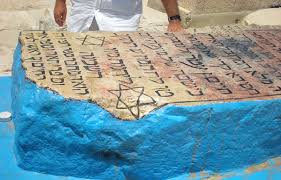
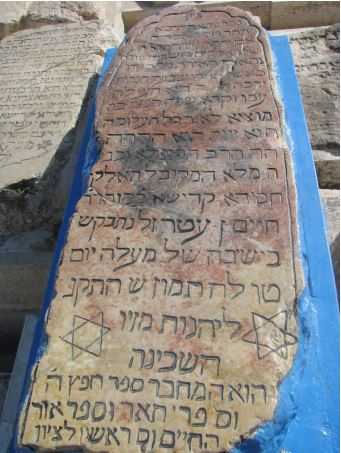
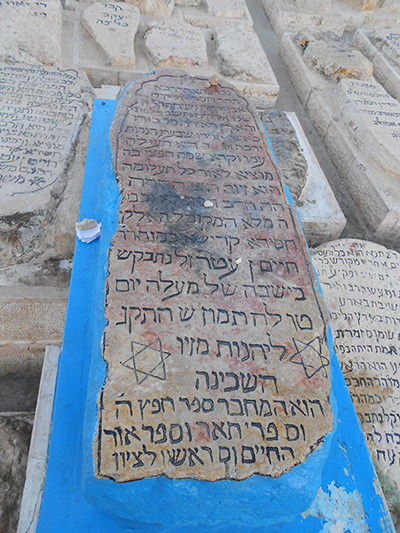
Rabbeinu Chaim Ben Attar passed away at the age of 47, on 15 Tammuz, 5503 (1743) and was laid to rest on Har HaZeisim.
Stories of Rav Chaim Ibn Attar zt"l

Once, when some of his Chassidim came from the kloiz in Haifa, they told the Rebbe, Reb Avrohom Yaakov Friedman that every Shabbos night they study the sefer Ohr HaChaim HaKodosh together. However, when they reached Parshas Vayikra and tried to study his holy words and commentary, they ran into problems – they had difficulty understanding it. They wanted to know if instead they could switch to studying the commentary of the Ramban. The Rebbe’s answer was harsh. “Do you mean to tell me if you study Gemora and reach a difficult point or sugya that you cease learning?!” Under the Rebbe’s guidance the kloiz persisted in its custom and the weekly Shabbos night shiur in Ohr HaChaim continued, as well as in the sefer Toldos Yaakov Yosef.
When the Tzaddik Rav Chaim ben Attar came to live in Eretz Yisrael, his main focus was to establish a holy lofty Yeshiva and Bais Medrash, whose purpose was to study Torah lishma on the highest level. Its students would sit all day immersed in their studies, never uttering any mundane words, wrapped in tallis, crowned in tefillin and unifying the Shechina as they studied Gemora and Rambam, delving into the depths of the Talmud, swimming in its seas and immersing in the words of dvar Hashem zu Halocha. As he himself testified in a letter written on the 22nd of Shevat tov-kuf-bais to the financial supporters of the Yeshiva in Mantuba, Italy, he named the Bais Medrash “Heichal Ahava – Medrash Kenesses Yisrael – the Chamber of Love”, to awaken Hashem’s love for Kenesses Yisrael (Kenesses Yisrael alludes to the Shechina). From the Diaspora, Rav Chaim ben Attar brought with him talmidim, and gained new ones in Yerushalayim – among whom was the great Rav Chaim Yosef Dovid Azulai – the Chida. (Ner HaMaaravi, ch. 24 p. 227)
Once, when the Chida was on one of his travels in the lands of Ashkenaz, one of the Admorim asked him to relate a story that described his Rebbe’s holy avoda in nigla and in nistar, and here is one of the tales he told:
The Ohr HaChaim had a special minhag to prepare himself to make Kiddush on Shabbos. Every Erev Shabbos he would sit and study and review with his talmidim the laws of testimony and witnesses – Hilchos Eidus in the Rambam. They would especially review the laws dealing with what things disqualified a witness and rendered him posul – unfit to give testimony. They studied this in order to do full teshuva [over any of these disqualifications.] Not only did the Ohr HaChaim do this as a preparation before making Kiddush, but when he picked up the Kiddush cup to recite the berocha over it, he would be aflame with such excitement and thoughts of teshuva and kedusha that all those present were also seized with pangs of regret and remorse so great that they would beg and plead that they too should merit to be eidim kesherim (proper witnesses) to testify to the Creation of the world in six days! (By Rav Yitzchok Alfaya in Kuntres HaYachieli Section Bais Hashem Chapter Middos Tovos #18)
Rav Yekusiel Yehuda of Sanz-Klausenberg told the following story one Sholosh Seudos [see Shefa Chaim on Parshas Naso tov-shin-mem-daled] (also found in the kuntres Tav Chaim as a prelude to certain editions of the Chida’s sefer Shem HaGedolim):
Although the Chida was counted among the younger of the Ohr HaChaim’s talmidim, still Rav Chaim ben Attar greatly admired him, drew him close and bestowed upon the Chida a special and unique berocha that from Heaven the Chida should be sanctified with the kedusha of Aharon HaKohen!
At first the Chida misconstrued his Rebbe’s meaning and thought he had been blessed with the ability to give berochos to Am Yisrael be’ahava just as Aharon and the Kohanim bless the Jewish people. However, decades later, the true meaning of this special berocha was revealed in the following amazing manner:
In his old age, the Chida ended up in Leghorn, Italy, which the Jews know as Livorno. He had refused the position of Rav again and again, although the various communities’ elders and leaders tried to have him take up the post. Instead, the Chida preferred to sit and learn Torah uninterrupted except for a four-year stint when he took up the post of Rav while he was in Egypt. Nonetheless, although he held no official title or position, all the Jews knew of his greatness and accorded him the honor and respect due to a sage and Talmid Chochom, one of the Gedolim of the generation.
One day, a community leader came before the Chida and complained to him that his wife had been seen alone in the company of another man. “If this is so,” said the Chida, “you must divorce her, give her a get and she loses any rights to collect her kesuba.”
The Dayonim heard his decision and were baffled; how could he decide such a matter without any testimony or evidence? But they dared not contradict his ruling. The Chida asked that the wife be summoned to the place in the Bais Medrash where he sat and studied, immersed in Torah. The Chida tried to persuade her gently and kindly to accept a get of divorce from her husband, but the woman was brazen and arrogant. She answered the Rav back with chutzpa and as she spat back her arguments to the Rav, the Chida remembered the berocha he had received from the Ohr HaChaim, his Rebbe, all those years ago.
Turning to the insulting woman, the Chida asked, “Please, I have just one request. Listen as I read aloud to you a portion from the Parsha in the Torah.”
The arrogant woman acquiesced to this one request and stood still as the Chida took out a Torah and began to recite the Parsha of Naso where the Torah describes the sota. As the Chida read the pesukim the woman began to leave in the middle – but she did not escape in time, for just as she reached the stairs, the Chida concluded reading the Parsha of the sota, and no sooner did he finish the last words than she stopped with her foot resting on the step, while her face contorted and her eyes bulged out of their sockets. With a shriek she collapsed and dropped dead. Hearing her outcry, many people rushed to the scene as she breathed her last, and witnessed this miraculous event.
Rav Chaim Yosef Arye Prager of Brisk writes how the Chida once met the Gaon Rav Dovid Ashkenazi of Bichov, who lived in Teverya and was sent by Rav Avrohom Kalisker to collect funds for the nascent and struggling Chassidishe yishuv there. Rav Dovid traveled in the west for some seven years collecting, and on one of his travels he met the Chida in Livorno. During their discussion about how greatly esteemed his Rebbe, the Ohr HaChaim, was among the Chassidim, the Chida replied humbly that he did not consider himself worthy of being called a true talmid who knew the Ohr HaChaim, claiming that he was just someone who had studied there in his Yeshiva. He then related to Rav Dovid the following amazing story about his Rebbe, Rav Chaim ben Attar, the Ohr HaChaim:
Once, the Ohr HaChaim was late to arrive at the Yeshiva. This was uncharacteristic of him and all the talmidim who had gathered at the appointed time for his shiur wondered at this departure from custom. When the hour grew late and the delay continued, the Chida gathered his courage and himself went to his Rebbe’s home to see what the delay was about and to call on the Ohr HaChaim. When he got there, he engaged Rav Chaim in conversation and the Ohr HaChaim told the Chida in a totally nonchalant and dismissive manner as part of the conversation, “I was late because I was stuck on a difficult Tosafos which I simply couldn’t unravel or understand at all until…Rabbeinu Yitzchok, one of the Ba’alei Tosafos, came and explained to me what he meant.”
The Ohr HaChaim used to make frequent trips with his talmidim to daven at kivrei Tzaddikim in Yerushalayim. The Chida described one such trip that he himself went on and accompanied the Ohr HaChaim and what he saw the Ohr HaChaim do on that occasion:
“In my youth I merited to travel together with the wondrous holy Chassid, our Master, Rav Chaim ben Attar and the students of his Yeshiva, to travel to daven at the kivrei Tzaddikim in Yerushalayim. When we reached the matzeiva of the Rav, author of the sefer Pri Chodosh, we watch as the Rav [the Ohr HaChaim] remained there alone for some fifteen minutes or more, davening at the kever, and his lips moved as he was talking and we understood that he was asking mechila from the Pri Chodosh that he be forgiven [for Rav Chaim ben Attar, in his sefer Pri To’ar, would rule against him and argue on some of his points] and that all that he did was purely L’shem Shomayim (for the sake of Heaven).” (Shem HaGedolim, Section on Seforim, Entry for Pri To’ar)
There are various traditions regarding how and when the Ba’al Shem Tov’s brother-in-law met Rav Chaim ben Attar, mechaber of the Ohr HaChaim, in Eretz Yisrael:
After the printing of the chumashim Ohr HaChaim in Venice in the year tov-kuf-bais, they reached the Ba’al Shem Tov, who greatly rejoiced in them. He found in them an author whose heart and soul were filled with emotion and excitement for Avodas Hashem. He sent his brother-in-law, Rav Gershon of Kitov, to Yerushalayim to visit Rav Chaim ben Attar’s Yeshiva. He told Rav Gershon that Rav Chaim ben Attar had two Yeshivos, one where they studied nigle (the revealed Torah) and one where they studied the hidden secrets of Toras HaKabbola. The Ba’al Shem warned Rav Gershon to try to attend the Yeshiva for nistar and not to reveal to the Ohr HaChaim who he was, hiding his identity until the Ohr HaChaim would feel it and understand for himself.
When Rav Gershon arrived he requested permission to hear a derosha from the Ohr haChaim. Permission was granted and he studied in Yeshivas HaNigle for about a week. Afterward, he requested admission to the other Yeshiva for Kabbola.
“Who revealed to you that I have a Yeshiva for nistar?”
He answered that his brother-in-law, the Ba’al Shem, had told him. The Ohr HaChaim did not know him, but he scrutinized Rav Gershon from head to toe and declared him fit and ready to study Kabbola. After studying there for three days, the Ohr HaChaim gave word to prevent him from coming back and Rav Gershon found his way blocked from entry. When Rav Gershon approached the Rav’s house to find out why he had been banned, the Ohr HaChaim saw him and said, “I am angry at you. Why didn’t you say your brother-in-law was the Ba’al Shem Tov? You just said, ‘Rav Yisrael Ba’al Shem!’ I don’t know any Rav Yisrael Ba’al Shem, but I know who the Ba’al Shem Tov is! I know him from seeing him in the supernal worlds!” and he no longer allowed Rav Gershon access to the Yeshiva, explaining that he needed no other Rebbe or Rav if he already had the Ba’al Shem Tov. (Doresh Tov Tshortkov, Acharon Shel Pesach p. 194)
Rav Yitzchok of Neshchiz related on Motzoei Shabbos Parshas Behaalosecha, tov-reish-kaf-zayin:
Rav Gershon of Kitov met the Ohr HaChaim in Eretz Yisrael and told him about his brother-in-law the Ba’al Shem Tov. The Ohr HaChaim replied that he had heard of him and that his name was Yisrael. Rav Gershon Kitover also asked the Ohr HaChaim why he kept a certain talmid in his Yeshiva whom Rav Gershon had seen behaving improperly, unbecoming for a Yeshiva student. “This is our way,” answered the Ohr HaChaim. “We draw closer those who are distant – we are mekarev rechokim.” (Zichron Tov p. 16 #8)
When Rav Gershon of Kitov traveled to Eretz Yisrael, the Ba’al Shem Tov told him to meet with the Ohr HaChaim. “If he doesn’t know of his greatness, send him regards from me and tell him I see him in Moshiach Heichal – the supernal palace, where Moshiach sits on a throne and studies the Ohr HaChaim.”
When Rav Gershon came to Eretz Yisrael, he arrived at the Ohr HaChaim’s Yeshiva and asked why he studied with talmidim who behave inappropriately; others say that he asked why he studied with people with lowly souls.
The Ohr HaChaim asked Rav Gershon from where he hailed. When he said that he was from Polnoy, the Ohr HaChaim responded that he should return the following day. The next day, the Ohr HaChaim told him, “I saw your Rebbe and he is a very great man.”
Rav Gershon then related his regards from the Ba’al Shem and relayed the Ba’al Shem’s message. The Ohr HaChaim responded, “I don’t know what favor he does me by revealing my greatness. Tell him I saw the Angel of Death and that he stands with one foot on Polnoy and the other on the entire world.” This was a hint at the danger facing European Jewry and that they would need mercy. He also responded that the reason he studied with people with lowly souls was because he sought to redeem holy sparks from places that they had been captured and held hostage. (Kisvei Ri Shuv of Brisk)
When Rav Chaim Dovid, the doctor of Pietrokow, lay on his sickbed, he was visited by the Tiferes Shlomo. The Rebbe found the good doctor crying and he thought that he was crying over the misdeeds of his youth, since he was a ba’al teshuva. The Tiferes Shlomo asked him, “Why are you crying? Don’t worry your past. Those days will fall away and be forgiven and forgotten.”
Rav Chaim Dovid answered the Tiferes Shlomo, “I do not wish them to fall away and be forgotten. Rather, I wish to do teshuva out of love! Then all my intentional transgressions will be transformed into merits! And in the merit of studying the sefer Ohr HaChaim HaKodosh on a weekly basis and memorizing it, surely they will all become zechuyos (merits)!” (Kodesh Hillulim p. 75)
The Rebbe Rashab of Lubavitch taught and commanded his son, the Rebbe Rayatz, to fulfill three practices, one of which was that he should study Chumash with Rashi and the commentary of the Ohr HaChaim HaKodosh. (Shivchei Ohr HaChaim)
From when he was just six years old Rav Yaakov Yosef of Skver studied the entire commentary of the Ohr HaChaim HaKodosh on the weekly Parsha, all by himself. He would constantly speak about how important the study of the Ohr HaChaim HaKodosh is and once remarked: “Ich veis nisht viazoy ich valt gekent a’durech di letzteh fiftzig yohr ohn Ohr HaChaim – I don’t know how I would have survived the last fifty years of my life without the Ohr HaChaim!” (Toldos Yaakov Yosef Skver p. 22)
Rav Yaakov Yosef of Skver used to say, “The first Chassidishe sefer is the Ohr HaChaim HaKodosh.” (Be’or HaChaim p. 241)
Rav Yaakov Yosef of Skver used to say that every word in the Ohr HaChaim HaKodosh is an entire body of Yiddishkeit and that there is almost no Chassidus of which the Ohr HaChaim is not the bread and butter of its basis to the extent that one can fully and truly say that the Ohr HaChaim HaKodosh is the one sefer that has been most widely accepted by the most Chassidim (Nachlas Tzvi Kovetz 7 p. 52)
Rav Yaakov Yosef of Skver used to say that every word of the Ohr HaChaim is like a whole Torah in and of itself. He even said, “One cannot be a full-fledged Jew without studying this holy sefer!”
If ever a bochur suffered a downturn in his Yiras Shomayim, the Rebbe ordered him to study the Ohr HaChaim even on non-mussar topics, because he said that studying his holy words was a segula to work on the soul.
Rav Neta Freund once told how every year on Simchas Torah, Rav Yaakov Yosef of Skver would complete the Ohr HaChaim and then begin studying it anew from Bereishis. He then danced with the sefer Ohr HaChaim in hand like we dance with a Sefer Torah. Whoever witnessed this event can begin to understand the profound connection that Skverer Chassidus has with the Ohr HaChaim.
(Sources: Hillula Kadisha p. 317–318)
Once, Rav Shneur Zalman of Liadi told his mechutan, Rav Levi Yitzchok of Berditchev, the following story regarding the dveikus of the Ohr HaChaim:
There was once a terrible decree enacted against Bnei Yisrael by the goyim and the leaders of the kehilla decided that they must daven and bribe the authorities to attempt to rescind the harsh judgment. They voted and unanimously agreed that they must take emergency measures and ask the Ohr HaChaim to daven on their behalf.
Quickly they rushed in alarm to the Ohr HaChaim’s Bais Medrash, where they found him sunk deep in holy thoughts. They could see with their own eyes that the Tzaddik was in a world of his own and they feared to approach him. They waited, patiently hoping that any minute he would awaken from this state, but were disappointed to see that as time passed the Tzaddik’s condition remained the same; he was in a state of such intense dveikus that he neither responded nor even acknowledged their presence.
They knew that if anyone should touch him even just slightly, or brush against his clothes, he would immediately awaken, and they were sure that he would gladly come to their aid in such a time of distress and need. Still, they were afraid to disturb the Tzaddik, because they knew just how careful he was and how upset he became when anyone touched him or disturbed his immediate surroundings, interrupting his state of intense tahara. They therefore finally decided to bring a young, pure child, who had never sinned or thought negative thoughts. They immersed the child in the mikve and dressed him in brand new clothing; only then did they allow the child to touch the cloak of the Ohr HaChaim HaKodosh gently, just for a second. As soon as the child’s fingers brushed the Tzaddik’s cloak, he awakened from his dveikus and returned to normal.
Concluded Rav Shneur Zalman of Liadi to Rav Levi Yitzchok of Berditchev, “See just how great a level of dveikus the Ohr HaChaim HaKodosh had; his love and awe of Hashem were also amazingly lofty as well. (Lemaan Yeidu Bonim Yivoldu #91)
This story was heard from the chief Rav of Teverya, Rav Yaakov Chai Zerihan:
When Rav Chaim ben Attar, mechaber of the Ohr HaChaim, arrived in Teverya, he went to the Bais Medrash and found a group of talmidim sitting together and studying under their master and teacher Rav Chaim Abulafia, who sat teaching them Torah and studying with them, supported by many cushions and pillows propped on either side for his comfort. When the Ohr HaChaim saw all the cushions and pillows, he said quietly to himself in wonder, “Does the Torah deserve this? [How can he relax and disrespect the Torah like that?]”
Rav Chaim Abulafia saw the Ohr HaChaim and immediately called out in a loud voice, “The Chacham Chaim has come to us!” When the Ohr HaChaim approached, Rav Chaim Abulafia rose to his feet and stood to greet him, reciting the pasuk, “Arise before your elders – mipnei seiva sokum,” and they sat and studied together sugyas of Shas. Rav Chaim ben Attar was amazed at Rav Chaim Abulafia’s great scholarship, erudition and breadth of knowledge in Torah. Then Rav Chaim Abulafia told the Ohr HaChaim, “The Torah does deserve this and requires it, due to my advanced age and weakness!” The Ohr HaChaim then asked his forgiveness.
Afterward, they left together to the kever of the Tanna Rav Akiva and, not to waste time, they rented an animal to take Rav Chaim Abulafia, who was some ninety-three years old at the time. When they arrived at the cave of the Tanna, Rav Abulafia dismounted from the donkey and they honored one another to enter first. Rav Chaim ben Attar sat and wept, “Woe are we that both Moshiachs have arrived here together at the right time!”
A great fog and mist crept over them and hid them from view. Whisperings and low conversation between them were heard as they both wept quietly. Those present later surmised that it was revealed to both Rav Chaims that they would pass away, one a year after the other. And so it was, that due to our sins Rav Chaim ben Attar passed away on the fifteenth of Tammuz 5503 and Rav Chaim Abulafia in Nissan of that following year 5504. (Hillula Kadisha p. 308 cited from Yalkut Yosef p. 42)
Rav Yosef Karo rules based on Sanhedrin 7a that a person’s judgment commences with Divrei Torah. The Ohr HaChaim, in his sefer Rishon LeTzion on Yoreh De’a (siman 245), comments on the Pesak Halocha of the Shulchon Aruch that the reason for this is that the verdict of the judgment varies according to whether or not the guilty party knew that the transgression he was committing was forbidden by the Torah or not. They therefore cross-examine the accused, asking him if he studied Torah or not, to see what he knew to be forbidden or not. If he was a Talmid Chochom, his verdict and judgment is different from one who was unlearned.
I have seen proof for my position, says the Ohr HaChaim, in a story about Rav Yehuda HeChassid regarding a wealthy man who used to shave his beard in a forbidden manner using a razor, and who was warned by Rav Yehuda HeChassid against this practice. When he was niftar, Rav Yehuda HeChassid recalled his soul. The dead man stood up and recounted his judgment, describing how he was asked if he had studied Torah. When he affirmed that he was literate in Chumash, they brought before him a sefer, opened it and asked him to read what was written there. He read the pesukim regarding the prohibition against shaving the peyos and the beard. We see, concludes the Ohr HaChaim, that before he was judged for his transgression they checked to see whether he had studied it before and this is as we explained.
The entire story as cited by the Ohr HaChaim in Rishon LeTzion is found in the Sefer HaGan (in the chapter for the fourth day) from a handwritten manuscript by Rav Zalman the son of Rav Yehuda HeChassid, who relates:
My father and master the Chassid told me that there was once a wealthy man in Speyer who used to shave off his beard using razors. My father admonished him and he did not pay any attention to my father’s rebuke, because he would retort that he was a dainty istenis and that the beard bothered him. My father warned him that his end would be bitter, that after his death demonic beings like cows and oxen would run over him, beard and peyos, and that this is the punishment for those who shave off their beards and peyos, because the pasuk says, “Do not shave the corners of your facial hair” – lo sakifu pe’as rosh’chem velo sas’chisu, whose roishei teivos (initial letters) form the acrostic spelling poros – “oxen” or “cows” [pe’as rosh’chem velo sash’chisu = poros].
When the wealthy man passed away and all the important people from Speyer sat by his body, my father wrote a Divine Name on parchment and placed it upon the dead man’s body. My father asked him what happened to his soul after death and he told my father, “After my soul left my body a great demon, like an ox or a cow, came and filled a vessel with tar and pitch and trapped my soul therein, and I was unable to escape. Then the attribute of judgment came and took this vessel from the demonic ox with my soul trapped inside, unable to flee, and they brought me before the stronghold of all souls. There, a heavenly voice rang out, asking me if I had ever studied Torah and was learned in knowing how to read. I affirmed that I had and could and they immediately brought me a Chumash and opened it and I found that it opened up straight to the pasuk about the mitzva forbidding the cutting of the beard and shaving of the peyos and I had no answer for them in my defense. Immediately, I heard them declare the verdict that my soul was to be placed in the lowest of all levels.”
In the year 5503 on Parshas Balak during Sholosh Seudos, the Ba’al Shem Tov suddenly told the talmidim, “I believe that the Ner HaMaarovi, the Western Candle, has been extinguished.” After Havdola the talmidim asked the Ba’al Shem what he meant. He explained to them, “The holy Tzaddik, the mechaber of the Ohr HaChaim, has left this world. The way I know this is because there is one secret regarding Netilas Yodayim (when we wash our hands before HaMotzi), and this secret is only revelead to one Tzaddik in each generation. Until today, this secret was given to the Ohr HaChaim – and now that secret has been revealed to me. I realized that if I have been given this secret I must be the only one who knows – and this must mean that the Ohr HaChaim is no longer with us in this world.” (Gloss Menachem Tzion to Shem HaGedolim Seforim Alef Siman 54)
Rav Chaim Uri Lipshitz used to tell this story about the Ohr HaChaim that he heard from the Arabs:
After the Six-Day War, when Yerushalayim was under Jordanian rule, the Jordanians decided to renovate and destroy the Jewish cemetery at the Mount of Olives. They began using a tractor to demolish kevorim but when the tractor reached the kever of the Ohr HaChaim the tractor overturned, killing the Arab driver. That did not deter them, however, and they sent a second tractor, which for some reason broke down just as it reached the Ohr HaChaim’s kever. They fixed the tractor and had the engine repaired, and then the second tractor also turned itself over and the driver was seriously injured. Finally, they decided to use a metal sledgehammer to demolish the kever by hand, but this time somehow the hammer flew out of the worker’s hands and struck the foreman in the head. Finally, they admitted that the Divine Hand must be involved and they gave up! From then on their nefarious plot was over; never again did the Jordanians try to demolish the tziun of the Ohr HaChaim, and eventually control of the Bais HaChaim returned to Jewish hands. (Hillula Kadisha, 15th of Tammuz, page 612)
I once heard from a Bershader chassid that Rav Pinchos Koretzer used to say that studying the sefer Ohr haChaim haKadosh is a segulah for the neshamah, similar to studying the Zohar haKadosh.
This is because Rashbi had the neshama of Moshiach of his generation, and also Rav Chaim ben Attar author of the Ohr haChaim haKadosh also had the neshama of Moshiach of his generation. He ordered his descendants, the Shapiro grandchildren of the Slovita Press to publish the Sefer Ohr haChaim HaKadosh and that that would save them from evil and harm. They fulfilled his command until there were so many published editions of the Ohr haChaim, that the seforim greatly outnumbered the demand and there were no buyers left to purchase copies. Therefore, they stopped publishing copies of the sefer, that very year that they ceased publishing the Ohr haChaim the infamous libel occurred and they were falsely accussed. (Migdal Oz pg 268 cited by Likkutei Imrei Pinchos Sha'ar haTorah 15)
Divrei Torah of Rav Chaim Ibn Attar zt"l
rejoined as one flesh
“It is not good for man to be alone” (2:18)
The Ohr HaChaim asks why Hashem originally created Adom and Chava as one being and later separated them into a male and female, unlike the animals, which were created male and female, separate from the outset? Why was mankind not created as two humans, male and female, requiring Chava to be taken from Adom?
He answers that the Torah is defining the difference between human relationships and animal relationships. Animals have many mates; generally any male and female animals have offspring, and the idea of a loyal marriage is unique to mankind. Only among humans do we find that males and females marry, have families and acquire their spouses as their mates for life. Such a concept is foreign to animals, which mate and bear offspring from many partners, with no unique relationship, such that we never say that this ewe is the wife of that ram, or this cow the mate of that bull.
But the unique relationship of marriage, of man and wife, is a human one, which Hashem created for Adom and Chava by initially forming them from one body and only then cutting them in half, separating them so that they would have to rejoin as one flesh. This quest to rejoin is why Hashem initially created them as one. May Hashem bless our families with sholom and ahava, that we each cling to our sole mates and soulmates and build happy families in Klal Yisrael.
every week shabbos renews creation
“And Hashem blessed the seventh day and sanctified it, because on it [that day] He rested [Shabbos] from all His work that He had created to be done.” (Bereishis 2:3)
The Ohr HaChaim cites the explanation we quoted above that the world lacked a permanent status of existence until Hashem created Shabbos and gave a solid foundation to the world. Based on this idea, we must point out, says the Ohr HaChaim, that on all the days before Shabbos, the world did in fact exist, so could we not then assume, he asks, that had Shabbos not been created, the world would have just continued to exist the same way it had up until that point – without Shabbos?
The Ohr HaChaim answers that Hashem revealed the answer to this question in His Ten Commandments, in which He commanded us with the mitzva of Shabbos (Shemos 20:11): “For six days did Hashem make Heaven and earth…and on the seventh day He rested”. The Ohr HaChaim says that here you see clearly demonstrated that Hashem originally made the Heaven and the earth for six days – to last for six days alone! The world was created by Hashem in its original state to last for six days and only six days, for a reason known only to Hashem and those who know such secrets.
Hashem then created an additional day; on that day Hashem blessed and sends down to the world such a large amount of shefa in such a way that to sustain the six days further and so on, this cycle repeats itself week after week to keep the world going. But without this additional day of extra shefa with which to infuse the world and extend the six days, without Shabbos, the world would cease to exist; it would be destroyed at the end of six days and revert to chaos called tohu v'vohu. Then Hashem would have to recreate it again. We see then that Shabbos sustains the world; the world exists in the merit of Shabbos. This is why our pasuk in Bereishis says, “because on it He rested from all His work”. “On it” – bo shovas – through this day of Shabbos, because of this day of Shabbos Hashem was able to “rest” from creation. All His work refers to the Creation itself and through the medium of Shabbos Hashem breathes life into Creation to sustain it and keep it going for another six days.
Based on what we explained, we can now understand another statement of Chazal (Shabbos 119b) that whoever recites vayechulu becomes a partner with Hashem in Creation. At first glance this statement is difficult to accept. How can it be that a human being can become a partner in Creation in that which has already been finished and created? There is no longer any creation going on and no work to participate and partner in! In addition, what is this great, lofty action that will allow us to achieve such a partnership? What are we to do to become participants in this?
Even if this great act was so extraordinary, who told Chazal that the reward for it was such a partnership? Perhaps such a great act deserves other rewards, such as long life, strength, health and wealth? How did they know that the reward was a partnership in Bereishis?
But based on what we have explained, this all rings tried and true, says the Ohr HaChaim, because Shabbos is what sustains the world and keeps the six days of Creation going. After those six days pass comes a Shabbos that perpetuates the world for another six days.
You must realize, says the Ohr HaChaim, that the only way for Shabbos to exist is for us, Bnei Yisrael, to keep Shabbos and observe the day, for if there are no Shomrei Shabbos to safeguard Shabbos, then there is no Shabbos!
This is why Chazal tell us (Shabbos 151b) that if someone is deathly ill we must desecrate Shabbos to save his life, for it is better to desecrate one Shabbos so that he should live to keep many more Shabbosos later on. If that person did not observe Shabbos, however, why save him? What good would it do? How would more Shabbosos be kept?
Since the world was created, there has always been a Tzaddik to keep Shabbos: Odom, Shes, Mesushelach, Noach, Avrohom and other Tzaddikim. As one passes, others are born to take up the task and keep Shabbos. Since the time of Avrohom, the shemira has never ceased from among Klal Yisrael; even in Egypt we kept Shabbos, as we learn in the Medrash (Shemos Rabba 81).
It is now clear that whoever keeps Shabbos with its sanctity creates Shabbos and thus sustains the world and all of creation. Now I ask you: Can there be a greater partner in Creation than this?!
shabbos is a new creation
The Bnei Yissoschor writes (Maamarei Shabbosos 4:4), based on the Ohr HaChaim (Bereishis 2:3), that on Shabbos all harsh judgments and decrees are canceled, as it says in the Zohar (Zohar II 135b): because the world is created anew, all past judgments and decrees are canceled.
In his sefer on Chumash, Agra Dekalla (Behaalosecha), the Bnei Yissoschor writes regarding the pasuk (Shemos 20:11) “For six days did Hashem make Heaven and earth…and on the seventh day He rested”. This is as explained by the Ohr HaChaim, that Hashem created the world to exist for only six days and only by observing Shabbos do we extend the world for another week.
This means that we need people to observe Shabbos forever, otherwise, Heaven forbid, the world would end. We see, therefore, that if any evil, bad or negative experience befalls a person, it can all be fixed on Shabbos. Because Shabbos is a new creation, it transforms even evil into good and all is rectified.
Using all these concepts, the Bnei Yissoschor reads the pasuk in Tehillim 34:20 as follows: “Many evils befall a Tzaddik and from all of them Hashem will save him”. The “evils” here are the negative experiences in life that befall us all. They are written ro’os, spelled reish, ayin, vov, sov which equal 676 in gematria. If you add to them the letters of Hashem’s Name: yud, hei and vov and hei, which equal 26, they total 702, the same gematria as Shabbos (shin, bais, sov). Shabbos is a new havaya, a new creation, and because it is a new creation it transforms those evils and saves the Tzaddik from them.
a lesson from the fish - praying for miracles to change the natural order
“Hashem blessed them (the fish) saying” (Bereishis 1:22).
The Ohr HaChaim teaches us that there is a special command given by Hashem concerning fish in the oceans and seas, because according to its nature the power and ability to reproduce and give birth requires warmth, whereas water has the opposite nature of being cool and cold. Hashem therefore gave the fish a separate berocha and “blessed them saying”. This berocha was that they should have the power and ability to reproduce and that the cold nature of the water should not prevent this.
The Tzaddik the Bnei Yissoschor cites this quote from the Ohr HaChaim in his sefer on the Torah Agra DeKalla, and adds the following explanation and chiddush: This teaching of the Ohr HaChaim explains the seemingly superfluous word leimor – “saying”. Why does the pasuk say that Hashem blessed the fish “saying”? The word usually conveys a message said over to another person, but to whom was Hashem speaking? The Bnei Yissoschor is mechadesh that leimor here refers to all future generations. Hashem blessed the fish, and this blessing for reproduction was to be a message that Hashem now delivered to all coming generations. What was the message?
We have learned that it is considered improper to ask Hashem for miracles that change the natural order (see Shabbos 53b). Based on this principle, one might be mistaken in thinking that anyone born barren, lacking the natural means to reproduce, should likewise refrain from asking Hashem to rectify the problem and give them the power to have children, since such a change would require a miraculous shift in nature to transform a barren person into a child-bearing one.
The Bnei Yissoschor says in Agra DeKalla that based on the aforementioned Ohr HaChaim such an assumption is mistaken. The pasuk in Bereishis says that Hashem blessed the fish “saying” – saying to all future generations, “Look at the fish!” The Ohr HaChaim explains that they too were created in a natural state of cold water, unable to reproduce, yet Hashem blessed them and changed their natural order to allow for them to be able to have offspring. Now you have permission to daven and ask Hashem for children, because Hashem has already changed nature for the fish; such a change is thus no longer considered a request for a miracle. The natural order has already been changed for the fish, and there is no reason to hinder you from requesting this blessing either.
shabbos is the soul of the world
“Hashem completed” (Bereishis 2:2).
The Ohr HaChaim cites a statement of Chazal in Chagiga 12 that the world was incomplete, wavering and shaking unstably until Shabbos came and substantiated the world, giving it a strong, solid foundation to exist.
The meaning of this, explains the Ohr HaChaim, is that on Shabbos, Hashem created the soul for the world. This is the secret, deeper meaning of the pasuk “on the seventh day He rested” – vayinofash – meaning literally that Hashem gave it a soul. Shabbos is the soul of the world.
who can save the world from destruction
“Fashion an Ark” (6:14)
The holy Ohr HaChaim teaches that this command can be explained by the pasuk in Yechezkel 14:14:
“Now should these three men be in its midst: [namely] Noach, Doniel and Iyov; they will save themselves with their righteousness, says the L-rd G-d.”
Three have the power to save themselves from evil, whereas only two – and obviously just one – cannot prevent themselves from destruction… This is why Noach was commanded by Hashem to build “himself” a teiva, because he was not righteous enough to be saved on his own merits. Clearly his sons were also not as righteous as he was, since together they were more than three and, had they been sufficiently righteous, they would have been saved from destruction.
In the previous pasuk the Ohr HaChaim cited Chazal (Medrash Bereishis Rabba 49), that Avrohom Avinu only asked Hashem to prevent the destruction of Sedom if there were ten Tzaddikim, and that he learned this from Noach, who did not daven that the world be saved because there were fewer than ten Tzaddikim. However, this idea is difficult to understand, because Noach was alone in his generation (and how could Avrohom learn this from Noach when their situations were not the same)! The answer seems to be that once the angel of destruction was unleashed into the world, they were required to be as righteous as Noach – or more so – in order to prevent their own deaths and save themselves.
Had Noach davened to prevent the destruction before the forces of evil were unleashed, he would have succeeded. Although others in the world were not as righteous as him, their righteousness was sufficient to save others before the destruction was unleashed. Once it was unleashed, however, only Tzaddikim of an equal stature to Noach could have stopped it and saved even just themselves. But Noach was alone.
This is why the pasuk in Yechezkel names three specific Tzaddikim: Noach, Doniel and Iyov, rather than counting any three Tzaddikim, because once permission is granted for the forces of evil and destruction to begin, only those of similar stature can succeed in saving others.
'on that day hashem established a bris with avrohom' (15:18)
We should wonder at how some people are so blind that they cannot see and fail to believe in just how lofty we will all be in the future. Here, the pasuk says explicitly that Hashem made a covenant (bris) in which He promised to give Avrohom and his descendants the ten nations, and to date only seven nations have been delivered to us. That leaves three nations that Hashem promised but has not yet delivered. These people are like dry bones; how can they cry out that we have lost hope of our inheritance, when Hashem’s oath and promise [in this pasuk] clearly contradicts them? Not to mention how even the seven nations are not fully ours, and through our sins the slaves and servants now rule over their masters and we are subjugated to them.
Hashem did this to hint to us, midda kenegged midda (“measure for measure”), just as we are supposed to be Avdei Hashem – Hashem’s servants – and we fail to fulfill our duties, and fail to subjugate ourselves to Hashem as we should, like a servant who rebels against his master, so now, in turn, are we like masters whose servants and slaves rule over them. Hashem still has His ways to fulfill His covenant.
see all the land and hashem's promise
“All the land” (13:15)
The Ohr HaChaim haKadosh teaches us that we know that a person’s sense of sight is limited by what he can observe normally within his range of vision and by sunlight. Hashem made a miracle and the boundaries and edges of the land all drew near so that Avrohom was able to gaze at and see the entire landscape, acquiring it through chazoka; after all, what greater proof of ownership can there be than land and rocks uprooting themselves and traveling to their master?
Do not doubt this as being nonsensical, because we find similar miraculous occurrences, such as the land jumping for his [Avrohom’s] slave [Eliezer] (Bereishis Rabba 59) and that land folding itself underneath his descendants (Chullin 91).
at the akeida yitzchok acquired the ability to have children
Shov oshuv – “I shall surely return” (18:10)
The Ohr HaChaim HaKodosh explains that the reason why the double expression "shov oshuv" - "return" is used is to hint at a teaching by our sages that when Yitzchok was born he was unfit to have children because his birth came through the feminine attribute known as Sitra Denukva. During the Akeida [his feminine soul departed and then] he merited a masculine soul and was subsequently able to have children.
This is why the Maloch said, “Shov oshuv eilecha ko’es chaya vehinei vein leSora, meaning: “This child is ben leSora – he is a son of Sora, the female, and he comes from Sitra Denukva, making him unfit to have children (since he is a male). However, shov oshuv – I shall certainly return,” said the Maloch, and “Oshuv – I shall come back to give him a masculine soul, through Avrohom from Alma Deduchra – from the masculine realm through his father. I shall return to him at the Akeida and there give him a new masculine soul so that he can have children, as it says at the Akeida (22:11) that the Maloch called to him from the heavens, referring to two visits: the first, the Maloch’s visit to tell them the news that Yitzchok would be born, and the second, the Akeida, to grant him a masculine soul capable of having children.
The reason that Yitzchok was born this way, explains the Ohr HaChaim, was because Avrohom had said (17:18,) “Would that Yishmoel live before You!” The Ohr HaChaim explains there that because Avrohom disbelieved Hashem’s Maloch that he would father a son, and asked that Yishmoel live, the Maloch replied that Sora would give birth. Thus, Yitzchok became known as Sora’s child rather than Avrohom’s, inheriting her feminine quality, and because Yitzchok was a male, he was therefore unable to have children.
Avrohom therefore suffered greatly at the Akeida because of this incident. There, he bound Yitzchok on the altar, and at that time Yitzchok’s soul was exchanged for a masculine soul capable of having children. This is also why at that time his soulmate, Rivka, was born, so that he could marry and start a family.
The Ohr HaChaim explains this idea further at the end of our Parsha (22:20): “And it was after these matters”. This teaches us that Rivka, the partner of Yitzchok, was born, and the reason she was born now and not before is as we explained, that Yitzchok was born from the feminine aspect called Sitra Denukva and only after the Akeida was a male soul placed within him.
'the years of sora's life' (23:1)
The Ohr HaChaim HaKodosh points out that according to Chazal, Tzaddikim are called alive even in death, and thus, even in death their bodies are alive!
He explains the reason for this: When alive on this earth, Tzaddikim are busy transforming their material, physical selves into spiritual matter that lives on. This transformation from physical matter to spiritual holiness is carried out through constant good deeds, Torah study and mitzvos that they perform while alive.
By attaching oneself in dveikus to Hashem, explains the Ohr HaChaim, all base elements of matter transform, as is explained by the Rambam. The Ohr HaChaim cites the Rambam (Hilchos Yesodei HaTorah 4:5) that all elements may be transmuted from one form to the next closest elemental form, such as from earth to water and to fire. By attaching in dveikus to Hashem, the lowest elemental matter of our body is transmuted into the element of fire, and this is the fire of the soul! Thus the Tzaddik – even in death – is alive; his body is still burning with the fiery soul from Hashem.
"the years of sora's life" (23:1)
The Ohr HaChaim HaKodosh points out in the name of Chazal that Sora died as a result of hearing the distressing account of Akeidas Yitzchok (Medrash Tanchuma); when she heard how Yitzchok was almost slaughtered, her soul departed. The Ohr HaChaim comments that this seems to be a premature death, that had she not heard such news she would have lived longer. This is why the pasuk tells us: “the years of Sora’s life”; these were the years – they could have been longer, but due to the distressing news, only these were the years of her life and no more.
Further, the years of her life in Hebrew are called Chayei Sora and this, teaches the Ohr HaChaim, alludes to the fact that Tzaddikim such as Sora are the ones who give meaning to their lives, whereas the wicked only live because of their allotted time on earth, their numbered days being their only reason for living.
Based on the Ohr HaChaim’s explanation, it sounds like Sora’s life was cut short. The Ohr HaChaim explains further on that every Tzaddik who, for some reason or other, is unable to complete his allotted time on this earth, whose lifetime is cut short, is nonetheless rewarded by Hashem fully. The shortened life does not cut off his reward and does not prevent him from fulfilling his life goal. Hashem ensures that he receives his allotted sechar and earns a reward even for those days that were taken from him. Thus, Sora’s years of life are called Sh’nei Chayei Sora, implying that Sora gave life to all her years. Her years drew their life and meaning from her actions and were illuminated honorably.
the whole truth and nothing but the truth
“I am Esov, your firstborn. I have done what you told me to do” (27:19)
The Ohr HaChaim HaKodosh asks the obvious question: how could Yaakov [whose midda is emes – truth] lie outright like this to his father?
The Ohr HaChaim says that since Yaakov purchased and acquired the birthright from Esov, he was in effect Esov with regard to this birthright. So when he declared, “I am Esov your firstborn,” he was telling the truth, being that he was in effect now the firstborn in lieu of Esov.
Then, when Yaakov said, “I have done as you asked me to do,” he was also telling the truth. Explains the Ohr HaChaim, since the reason Yitzchok asked Esov to hunt game was only because he thought Esov was the rightful firstborn and owner of the birthright, now that Yaakov was the legal and rightful owner of the birthright and legally considered the firstborn, it was he who had been commanded to carry out the instructions to hunt game.
Since Yaakov now owned the birthright, it was as if this command had been issued by Yitzchok to him to perform. Thus, Yaakov answered Yitzchok truthfully when he said, “I have done what you told me to do.”
yaakov's merit saves avrohom from a fiery death
These are the toldos (generations) of Yitzchok, the son of Avrohom… (25:19)
The Ohr HaChaim HaKodosh cites the Medrash (Bereishis Rabba 63) that quotes the posuk in Yeshaya (29:22): “Thus said Hashem to the house of Yaakov (to Bais Yaakov), which redeemed the house of Avrohom (Bais Avrohom)”. The Ohr HaChaim explains that this refers to the merit [of Bais Yaakov] that saved Avrohom from the fiery furnace, because without Yaakov’s merit Avrohom would have been burned in Ur Kasdim.
This is what our pasuk means when it says: “These are the toldos (generations) of Yitzchok, the son of Avrohom – Avrohom fathered Yitzchok”. The “toldos of Yitzchok” refers to Yaakov. Avrohom fathered Yitzchok in order that Yitzchok should then father Yaakov.
The Ohr HaChaim explains further that it was Yaakov’s merit [since his righteousness and perfection exceeded that of both his forefathers] that saved Avrohom from being burned before Yaakov was even born [because he would one day be born to Avrohom’s son Yitzchok.]
defeating the yetzer and reaching heights of prophecy
And Yaakov left Beer Sheva and went to Charan. He happened upon the place and lodged there because the sun had set, and he took from the stones of the place and put them around his head and he lay down in that place. And he dreamed, and behold there was a ladder set upon the ground, and its top reached heaven, and angels of G-d were going up and down it. And behold Hashem was standing over him…(28:10–13)
This entire episode can be interpreted to hint at the stages in a person’s life:
“And Yaakov left” – Yaakov refers to the soul, which leaves its place in the heavenly worlds. The soul is called “Yaakov” because the evil force of the yetzer clings tenaciously to our heel – okeiv.
“Be’er Sheva” – Be’er – this well alludes to the supernal chamber from which souls depart, known as the Be’er Mayim Chaim – wellspring of living waters. Sheva – this means an oath, hinting at the oath each soul swears before departing the upper world, promising not to transgress the Torah (Nidda 30b).
“He went to Choron” – Charan means “anger” and refers to the yetzer, which then enters the body as soon as we leave the womb (Sanhedrin 91b), as it says in Bereishis 4:7: “sin crouches at the door”.
“He happened upon the place” – [Chazal teach that this means he established Maariv (Berochos 26b)]. This alludes to the fact that we must daven to Hashem, Who is known as Mekomo Shel Olom, that he save us from the evil one and not leave us in the yetzer’s clutches.
“And lodged there because the sun had set” – we must conduct ourselves this way our entire lives until the sunset of our days, as Chazal say in Avos Ch. 2: “Do not believe in yourself until the day you die”.
“He took from the stones of the place” – Chazal say in the name of Rav Shimon ben Lokish (Berochos 5b) that a person should always encourage his yetzer tov – his good inclination – to overcome his yetzer hora – evil inclination. If he succeeds –good; if not, he should toil in Torah. If that does not work he should recite Shema, and if that, too, fails, he should remind himself of the day of death.
“The stones of the place” allude to the armament of Torah used against the evil one. Toil in Torah is called the building blocks and foundation of the world – binyono shel olom, hence the allusion that the stones have to toil in Torah study. Another interpretation of the Ohr HaChaim is that the stones are like missiles to be hurled against the yetzer hora to defeat him and his allies and forces. As Chazal say (Sota 21a) – Torah study saves us from the yetzer, both when we are actively engaged in it and also once we have stopped learning.
“And put them around his head” – this hints at the second piece of advice given – to recite Shema when we lie down to sleep, as a device against the yetzer hora.
“And he lay down in that place” – this refers to the last piece of advice: to remember the day of death. Lying down refers to a person’s final resting place.
After employing all these forms of warfare we are guaranteed to defeat the yetzer. Once we succeed, the Ohr HaChaim reveals, we will merit a branch of prophecy – Hashem will reveal Himself to us in a dream (as we find in the dreams of Rav Elozor ben Aroch in the Zohar I 139 and Zohar Chodosh, Lech Lecha 25a).
“And he dreamed, and behold there was a ladder set upon the ground, and its top reached heaven, and angels of G-d were going up and down it” – the ladder refers to the secret of our human soul, which leaves the body when we sleep. We know that the soul does not leave completely, which is why the pasuk says that its feet were planted on the ground, referring to the body. We can demonstrate this fact, since when a person is sleeping we can shake him awake. If his soul had completely departed, shaking his body would not cause the soul to feel anything and it would not wake him up. “Its top reached heaven” – alludes to the fact that nothing can block us or stand in our way to reach spiritual heights; since the evil one has been defeated, the soul can reach the heavens.
The angels of Hashem ascending and descending hint at the good deeds and mitzvos we perform, since each one creates an angel (Avos Ch. 4), causing heavenly lights to ascend and blessings to descend upon us as well.
“Hashem was standing over him” refers to the prophecy of the revelation of the Shechina, as the Rambam teaches us (Hilchos Teshuva Ch. 5) that we are all muchshar – each one of us has a real potential for prophecy!
why did yaakov send actual angels to esov?
“And Yaakov sent out angelic messengers before him to Esov his brother, to the land of Seir, to the field of Edom” (32:4).
The Ohr HaChaim HaKodosh asks why the pasuk apparently needlessly points out that the messengers were sent out lefonov – “before him”. He further asks why it is necessary to call Esov “Yaakov’s brother” considering that this is a well-known fact, and why mention the detailed names of their destination as “the land of Seir, the field of Edom” (when it would have been sufficient to leave out any of these seemingly extraneous details.) What difference would there be to the messengers’ mission had they gone there or elsewhere?
The Ohr HaChaim points out that when we answer the next question this will explain to us why all these details are necessary after all. The question is why Yaakov sent actual angels as messengers to Esov. Why use angelic beings for no apparent reason other than to relay a message to Esov? Surely any human being could do that just fine.
The Ohr HaChaim answers that this is why the pasuk says lefonov – meaning that the angels were there before him. By understanding that lefonov here means that the angels were right there, standing before him, rather than that Yaakov sent them “ahead of him”, the Ohr HaChaim explains that Yaakov deduced that since these angels were standing “before him”, he had every right to use them and send them on a mission. Furthermore, this mission was one that could not be carried out by mere human beings but only by angels. The pasuk therefore points out that the mission was to relay a message to Esov, a great and important person (see Bereishis Rabba 75). Had Yaakov sent simple people, perhaps Esov would have been unimpressed and not considered them worthy of an answer, or regarded their message as important in any way. Perhaps Esov would have attacked them straight away even before hearing what they had to say. Then he could have attacked Yaakov as a vulture sweeps down on his prey. Obviously, this is not the case with angels! By sending actual angels, Yaakov sought to frighten Esov and cause his heart to tremble from fear of the army of heavenly hosts, as Chazal say (ibid) that some of the terrifying angels were clothed in fiery flames and riding on horseback. This should have frightened Esov sufficiently to prevent him from harming Yaakov. The reason the pasuk points out that Esov was his brother is because Yaakov feared to go to war against his own flesh-and-blood relative because anyone of his own family had zechus avos, which might have protected Esov.
The Ohr HaChaim explains another reason for sending actual angels: Angelic beings do not travel as we do. They are spiritual and the entire world is like their immediate vicinity, likened to their daled amos (four cubits). Practically, this meant that by sending angels on a mission, Yaakov achieved a dual form of protection, because the angels never actually left him – they were lefonov – they stood before him. Even after having been sent to Esov, they remained standing guard over Yaakov; since they did not have to physically traverse any space to deliver their message, they were able to be in two places at the same time! They could reach the land of Seir and the field of Edom, Esov’s home, before he even set out to approach Yaakov, allowing them to head him off – and simultaneously they would still be lefonov – standing before Yaakov and guarding him!
'and now let us kill him' (37:20)
The Ohr HaChaim explains that since Chazal rule in Bova Kama 26a that if ten people all simultaneously attack and kill someone, they are all exempt, they all joined together as one, so that they could not be found guilty. Nonetheless, asks the Ohr HaChaim, even if they were exempt and could not be found guilty in an earthly court, still the heavenly tribunal and Hashem would judge them, since obviously they could not escape divine judgment, even if they seek to circumvent human laws.
The Ohr HaChaim asks, so why did the Shivtei Kah decide to kill Yosef? What justification can we find for their actions, especially since not only was Yosef a Tzaddik, he was also their brother, their own flesh and blood?
The law is that a ben Noach is liable for the death penalty for these transgressions, even with the testimony of only one witness, even without forewarning and even from testimony from a relative (see Rambam Hilchos Melochim chap 9). The brothers therefore ruled that Yosef was an ed zomem, and that by trying to testify against them and falsely accusing them of crimes that carry the death penalty, he himself was guilty, and thus liable for capital punishment, and they were guiltless in Hashem’s eyes for trying to kill him. In a human court, they could not have been proven as plotters since they all participated equally and simultaneously, exempting all of them.
All this happened through the chief Cause behind all causes – through Hashem’s master plan.
'and it was at the end' (41:1)
The Ohr HaChaim points out that the loshon of our pasuk, vayehi, indicates pain and suffering, because now begins the Golus and the reason behind it. Although this Golus had been decreed many years before, it was not specifically decreed at that time that the exile would take place in Mitzrayim. Egypt is known as Kur HaBarzel – the purifying furnace that heats molten rock and removes impurities so that the strongest metal emerges. And as Tosafos (Shabbos 10b) and the Raavad (gloss to Rambam’s Hilchos Teshuva ch. 6) indicate, the Egyptians enslaved and subjugated the Jews more harshly than they were supposed to, as it says: “and they forced them to labor and they caused them to suffer.”
The Ohr HaChaim gives another reason why our pasuk uses a language indicating pain and suffering: it heralds the tidings of the upcoming famine. Hashem, so to speak, suffers with us, as Chazal say (Megilla 10b) regarding the pasuk in Shemos (14:20).
The Ohr HaChaim adds that this also hints to the suffering of Yosef HaTzaddik, who had to suffer to additional years in prison after interpreting the dream of the royal cupbearer – the sar hamashkim – because he was originally supposed to be freed two years earlier (Bereishis Rabba ch. 89) and because he asked the sar hamashkim to remember him and mention him – zechartani vehizkartani – for those two requests [that were improper for someone of Yosef’s spiritual stature to make], he was punished with two more years of imprisonment and suffering.
Chazal say (ibid) that Mikeitz means the end or keitz of the darkness. This alludes to the upcoming end of the dark one, the yetzer hora, who is known as keitz kol bossor – the end of all flesh. For he, the yetzer, caused the Tzaddik to suffer two more years. This is why Hashem prevented his freedom for two years, for that time was on Rosh HaShana, a time of zikoron, when Hashem remembers us (Rosh HaShana is called Yom HaZikoron) but because the yetzer caused Yosef to rely on the sar hamashkim and ask him to remember him and mention him – zechartani…vehizkartani (Bereishis 40:14) – for those two requests he spent two more years in prison, since Hashem held back his mention and memory for two Rosh HaShanas.
“And whoever has a palate with discerning taste should taste of our words and find them as sweet as wafer in honey.”
וְטַעְמוֹ כְּצַפִּיחִת בִּדְבָשׁ
(Ohr HaChaim, Shemos 3:13)
'why did yosef refrain from contacting his father when he was in mitzrayim?'
The Ohr HaChaim asks an obvious question: All the time that Yosef was alive in Mitzrayim, his father Yaakov thought him dead, mourned for him and suffered (see Bereishis 45:26). What was the reason that Yosef refrained from contacting Yaakov? Why didn’t his father’s suffering and anguish move him to reveal that he was alive in Egypt?
This is how the Ohr HaChaim builds the question: While Yosef was enslaved we can rest assured that he was either unable to contact his father or that he tried but failed to do so. But once he was appointed as viceroy to Pharaoh we may question why he never wrote to Yaakov any letter to lessen his father’s anguish and suffering. Furthermore, during the years of famine, when there was constant traffic between Canaan and Mitzrayim, he could have contacted Yaakov. Once he met his brothers and recognized them, and discovered that his father was alive, he could have sent word to his father immediately! Who allowed Yosef to prolong Yaakov’s mourning and wait so long before revealing that he was alive?
The Ohr HaChaim gives several answers to this question:
Truly Hashem’s ways are many and varied, and He decreed that these events must unfold in this way. Because Yaakov himself spent twenty-two years away from his own father Yitzchok and was unable to honor him, he was repaid with twenty-two years of pain and suffering. Additionally, Hashem had decreed two hundred and ten years of exile, yet Yaakov had to descend with great wealth and honor. All these prophetic decrees would not have been fulfilled had Yaakov descended to Egypt sooner. However, these explanations are divine reasons why the scenario had to play out the way it did; they do not actually explain or justify Yosef’s own actions.
The Ohr HaChaim justifies Yosef’s behavior as praiseworthy. First, he says that Yosef feared for his life from his brothers. The Ohr HaChaim explains that as soon as Yosef was exiled in Egypt, he could not contact Yaakov because he feared that his brothers would discover his whereabouts. They had already attempted to take his life and had sold him into slavery. The brothers’ embarrassment at their actions against Yosef would be very great and Yosef feared their revenge. Yosef was worried that if he contacted Yaakov and his brothers discovered that he was alive they would track him down and attempt to finish him off! He also feared that Yaakov might curse his brothers and they would die, and that perhaps they would try to kill him before any of that occurred.
After he was released from prison and rose to a high-ranking position as viceroy, he was no longer concerned that he would be killed. He then held back from contacting his father for a different reason. Chazal say (Bova Metzia 59a), “Better that someone should fling himself into a fiery furnace than embarrass his friend publicly.” Yosef applied this dictum to himself and worried lest he embarrass his brothers before Yaakov, Yitzchok and any other members of his family. Perhaps he also still feared that they would attempt to kill him even now when he was viceroy; the Medrash Tanchuma says that the Maloch Gavriel had to scatter them to forestall their plot to harm Yosef. Yosef might have feared them even after the famine brought them to Egypt, until after he fed them and befriended them once more. But after showing them his mercy and love he was no longer afraid that they would harm him. All this was revealed to be Hashem’s way of running the world, arranging events through hashgocha protis so that they unfolded to fit the Master Plan. Then they no longer bore him any malice or grudge. This also removed any feelings of shame or embarrassment before Yaakov because everyone could clearly see the hand of Hashem in the way that history unfolded. Still, the Tanchuma tells us that Hashem needed to send a Maloch to save Yosef. We also could not expect Yosef to rely on this Maloch who saved him before to save him again now, because we may not rely on miracles to save us. For these reasons, Yosef is blameless in not having contacted Yaakov.
yehuda, the redeemer of captive souls, to establish the monarchy of beis dovid
Gur Aryeh Yehuda – “Yehuda is like a lion cub” (49:9).
The Ohr HaChaim gives the following introduction in which he explains this pasuk:
The first man, Odom HoRishon, was like a tree whose many branches extended in many directions. All holy souls that once came and will one day come from the side of kedusha are all branches from Odom’s tree. When Odom sinned, the side of evil captured some of these holy souls. Tzaddikim and Anshei Emes (men of truth) in each generation seek out these captive souls to redeem them and save them from the clutches of evil. The holy nation of Yisrael, Am Hashem (G-d’s people), are constantly refining the world and daily trying to save these captives and redeem them. They do this using the holy source that Hashem planted within our nation, the Torah and mitzvos. Sometimes when a holy soul becomes attached to an impure soul by force against her will, the holy soul can redeem the captive spark found in that impure soul as well; this is secret of why Shechem ben Chamor’s soul cleaved in dveikus to Dina bas Yaakov’s soul (Vayishlach ch. 34), because Dina’s holy soul drew forth and pulled out the captive holy soul which was found in Shechem. Our Sages say (Arizal in the three sources: Likkutei Torah Vayishlach, Shaar HaGilgulim 36, Shaar HaPesukim Vayeitze) that this was the soul of Rav Chanina ben Tradyon as hinted at by the acrostic his name spells – Rechavas – as the pasuk tells us that the land was rachavas yodayim (34:21) – the land was bountiful and expansive.
Sometimes such a holy soul is born into the world in a foreign body, because the klippos and impure souls spawn so many numerous offspring and it is easy for such a holy soul to slip in there as well. The holy soul desires to walk on the path of good and righteousness, and this is the secret of the souls of geirim (converts), who convert of their own volition, desiring to attach themselves to the side of holiness. Sometimes the master who holds such holy souls captive only allows them to go free if they are born into the world through sinful abhorrent unions, such as the holy soul of Rus, who was from Moav (Moav was born through an incestuous relationship). Notice how from Rus are descended the kings of Malchus Bais Dovid – and this royalty comes from Moav about whom Chazal declare (Bova Kama 38b) that their sins were worse than Amon’s! Yet, despite this, greater sanctity comes from Moav. Because Lot had greatness, his descendants were great, because even among evil and klipos, there are levels of greatness. We can see clearly that among the nations there are royal families and pedigree of kings, some greater than others and some of lesser stature such as lords, dukes and barons, demonstrating that there is a hierarchy even among the klipos.
Our Sages call these final days Ikvesa DiMeshicha – “the heels of Moshiach” – (Sota 49b). The secret here is that we are constantly refining the gross material and releasing captive holy sparks. When the last refinements have all been made, we will have reached the end – the heel. Chazal called this the okeiv (heel) because it is the end or extremity of a man’s limbs. In the past great souls were refined, freed and redeemed, such as our great patriarch and forefather Avrohom Avinu, the first righteous convert, and Sora Imeinu, Rus the Moabite, and in later generations, the souls of Shemaya, Avtalyon and Onkelos the Ger. Although today we also have righteous converts, today’s geirim are of a smaller stature than those great Tzaddikim, because we have reached the end, the final extremity – the heel. All the refinements are coming to an end.
Based on this introduction we can understand why Hashem sent an angel who forced Yehuda to be with Tamar (Bereishis Rabba 84): through such an improper union which was against the Torah, and because Yehuda was forced, and he did not recognize Tamar as his daughter-in-law, he was able to redeem the holy souls of Peretz and Zerach, held captive by the forces of evil. And how many Tzaddikim and the entire Malchus Bais Dovid were their descendants! Only Yehuda, whose lineage was royal and whose destiny was to father kings, could redeem such lofty souls in such a manner. Through this negative act (performed unconsciously and by force), he was able to enter the realm of evil and redeem its captives.
This is what the pasuk means, says the Ohr HaChaim: Before he lived with Tamar, Yehuda was a gur, a cub; afterward, he was uplifted to be an arye, a lion, because the souls he redeemed would rule as kings (the lion, king of the beasts, represents royalty). How did he merit this level? asks the Ohr HaChaim. He answers that the continuation of the pasuk holds the secret: miteref beni olisa – from that teref – from the prey that was captured and held captive, which Yehuda redeemed, olisa – he was uplifted to be the forefather of the dynasty of Malchus Bais Dovid. These lofty souls were preyed upon and captured from Odom HoRishon’s tree branches by the forces of evil after he sinned. Now, through his actions with Tamar, he redeemed them, and thus he too became uplifted, because his descendants would rule as kings.
“and she opened [the basket] and she saw the yeled (baby) and behold a naar (young child) was crying, and she had mercy on him and said, ‘this is one of the jewish children.’ (2:6)
Rav Moshe Franco, a talmid of the Ohr HaChaim in Livorno, records in Meor HaChaim the following teaching from the Ohr HaChaim on this pasuk:
Chazal say (Bova Metzia 59a) that the gates of tears were never locked. Whenever a person cries, from Heaven they have mercy on him. Asks the Ohr HaChaim: Why does the pasuk switch from yeled to naar? Shouldn’t the pasuk should have said yeled, as it does in the beginning of the pasuk? But this pasuk hints at us all; when it says a young child – naar – it means us. Naar is Am Yisrael, as Hoshea says (11:1), “Yisrael is a young child and I love him.” And when we, Klal Yisrael, daven, cry and shed tears, then Hashem has mercy on us all from Heaven. In addition, if you daven, cry and shed tears, this is a siman (proof) that he is “one of the Jewish children”.
a different divine name for a different revelation
“And I revealed Myself to Avrohom etc with name E”l Shad”ai, but My name YH”VH I did not reveal to them” (6:3).
The Ohr HaChaim explains what this pasuk means based on the peshat – the simple, straightforward meaning of these two divine names. The name E”l Shad”ai refers to how Hashem gives boundaries to His strength and might, and how He created things and gave those creations set rules and limits. He created the world in this manner till He declared, “Dai – enough!”
The name YH”VH, however, is the name of rachamim – divine mercy and loving-kindness that goes beyond the letter of the law. Using these two definitions, the Ohr HaChaim now explains what Hashem was saying to Moshe in our pasuk:
Hashem was answering Moshe’s question as to why He, Hashem, was redeeming the Jewish people early – before their time in Mitzrayim was completed. In the Bris Bein HaBesorim, Hashem decreed to Avrohom that his descendants would be exiled for some four hundred years in a foreign land. Only 210 of those years had passed so far, and Moshe was perplexed. Why was he being sent before the time was up? What point did Moshe’s shelichus to Paroh on behalf of Am Yisrael serve if they were not yet to be redeemed? [In other words, why anger Paroh if the time was not yet ripe?]
The Ohr HaChaim explains that in our pasuk lies the answer to Moshe’s questions. Hashem answers Moshe, “To Avrohom and the other Avos I was only revealed as E”l Shada”i. In that revelation Avrohom understood Me as He Who sets boundaries and rules, and I set down the exile in Egypt for a four-hundred-year term. Now, however, I am revealing Myself to you and Am Yisrael in a way unknown to the Avos: by My name of mercy and loving-kindness – YH”VH. This reveals an end to the Golus not bound by time, rules and boundaries, but instead based on rachamim, because of My love for Klal Yisrael, who are crying out and davening to Me, knocking on the doors of divine mercy, begging Me to open the locked gates and to redeem them. I see their suffering and hearken to their prayers, and in My mercy I shall end their Golus and redeem them even before their allotted time is up – because I am revealed in the name YH”VH to you and them, as I was not previously revealed to the Avos.” This is why the pasuk begins with the statement “I am Hashem”, spelled YHV”H. Understand this.
hashem placed dovor (something) into the mouth of bilom
The Ohr HaChaim on Bamidbar 23:5 explains the pasuk, “Hashem placed dovor (something) inside the mouth of Bilom”. Hashem placed a barrier into Bilom’s mouth between his defiled, impure mouth and the divine words of holiness that Hashem wished him to speak. [Because Bilom was a horribly defiled and disgusting person, the spirit of revealing the future through Ruach HaKodesh could not descend upon him. Even the words themselves were holy and they could not dwell within an impure goy. Hashem therefore made a tikkun so that He would not need to dwell in a disgusting, impure place, a dividing barrier between the power of speech and the spoken word itself, and the mouth of that swine Bilom. This is what Hashem meant when the pasuk says that He placed “something” into the mouth of Bilom: Hashem placed a barrier to make a separation between them, and Bilom’s mouth became a separate entity. When the pasuk says, “So shall you speak and say,” it means the Ruach HaKodesh will speak.]
"in order that you tell your son' (10:2)
The Ohr HaChaim HaKodosh explains that the primary purpose of the makkos was not to take revenge upon or punish Paroh; rather, the pasuk testifies that their purpose was to instill emuna in the hearts of Bnei Yisrael in an eternal, unforgettable manner. The fact that these makkos occurred in the very heart of Egypt within Paroh’s kingdom would ensure that their memory would never fade.
The Ohr HaChaim bases this concept on a Maamar Chazal in Chullin 75b, where we learn about a ben pekua (an animal found in the uterus of its slaughtered mother and is considered one of her limbs and therefore does not need to be separately slaughtered). The ben pekua has two clear signs that ensure that everyone remembers where it comes from and why it does not need shechita, so that no one will suspect those who eat it of transgressing the prohibition of consuming non-kosher meat that was not properly schechted.
Similarly, here in Mitzrayim, the Ohr HaChaim posits that we required two wondrous events in order to instill emuna in Klal Yisrael so that they would never forget their faith and belief in Hashem. The first one is that the makkos occurred in such a way that all forms of creation: earth, air, fire, water and all the animals would be affected. However, this alone would not suffice. In addition, Hashem ensured that the makkos would strike Paroh, his regime and his nation in such a way that no nation had ever suffered such a miraculous, disastrous series of events. These two wondrous ingredients were essential to instill an enduring emuna, as the pasuk says, 'lemaan tesaper be’oznei bincha – in order that you retell (these events) to your son” to instill in the next generation the same rock-hard, never-ending faith and belief. Without these two wondrous points, the matter would never be permanently locked into our national memory.
The pasuk continues, counting the two points, “The fact that I [Hashem] punished Mitzrayim” – Hashem severely punished them in a supernatural manner through ten plagues, each of which was comprised of four or five elements, something unheard of in terms of suffering. But this wonder alone would not be enough to remember, and so the pasuk continues, “and My signs”, referring to the signs Hashem performed. This was the second wonder needed; together these two wonders would ensure our emuna that viydatem ki ani Hashem – “you will know that I am Hashem!”
In the sefer Me’or Chaim, Rav Moshe Franco quotes the Ohr HaChaim’s deroshos in Livorno (Leghorn Italy) and adds details to how Rav Chaim ben Attar explained how each of the makkos demonstrated Hashem’s mastery over a different element of nature: water was struck when the Nile was transformed into blood, the earth with a plague of lice, everyone saw the strength of Hashem in the hail (which was fiery ice) and when Hashem commanded the plague of locusts, He demonstrated His mastery over the wind and the air. The sun and moon were proven to be non-divine and powerless through the plague of darkness, in order that no one should worship the celestial bodies. [Above we mentioned mastery over the animals, demonstrated in the plagues of frogs, wild animals and cattle plague.] Finally, the death of the firstborn proves how only Hashem is master over people, knowing their most intimate secrets - who is truly the firstborn.
true miracles that disprove false theories about low tides
“And Bnei Yisrael walked on dry land in the sea and the waters were like a wall on their right and left” (Shemos 14:29).
The Ohr HaChaim explains the reason why this information is repeated in our pasuk [from pasuk 22].
The reason is that the pasuk is telling us that the Mitzrim themselves witnessed how Bnei Yisrael were walking on dry land in the middle of the sea and the sea stood like a wall on either side of them! In this way, they knew that this was a miracle from Hashem, as it says (14:18), “And Mitzrayim shall know”. Without seeing this miracle they would not have known.
The Ohr HaChaim then explains another reason why the pasuk needs to testify to this miracle and the fact that the Egyptians witnessed and knew it as well: There are some crazy fools who mistakenly teach that Moshe had discovered and observed the times of the low tide, when the sea’s flow of waters were diminished and Moshe then led Bnei Yisrael to cross the sea at low tide, whereas Pharaoh and the Egyptians were unaware of this phenomenon and so they attempted to cross at high tide and drowned. (See also the Ibn Ezra Shemos 14:27 who describes this false belief in detail.)
This pasuk, with its testimony of the miraculous nature of the splitting of the sea, totally disproves such a false theory. They walked on dry land in the sea and the waters were a wall – these two miraculous simonim themselves disprove the false theory [low tides do not create dry land and walls of water].
the archangel of egypt
“And Pharaoh drew near…and Mitzrayim chased them” (14:10).
The Ohr HaChaim is puzzled why the pasuk begins by describing Paroh chasing Bnei Yisrael and then says that Mitzrayim was chasing them. Furthermore, why is the verb “chasing”, referring to Mitzrayim, which consisted of many individuals, in the singular form and not in the plural?
In order to answer these questions, the Ohr HaChaim points out another puzzling thing: Bnei Yisrael complain to Moshe that Paroh and Mitzrayim are chasing them, and voice their protest: “Why did you take us out here to die? Aren’t there enough graves in Egypt to bury us?” Why did they protest in such wonder? Didn’t Moshe warn them already previously that Hashem would harden Paroh’s heart and that afterward he would chase them? If so, they should have expected this, so why were they so afraid? Didn’t they already know that this was all about to happen?
The Ohr HaChaim first suggests that perhaps it was the great and vast numbers of the Egyptian army whose force Bnei Yisrael hadn’t properly fathomed or imagined. But finally the Ohr HaChaim answers that the reason for Bnei Yisrael’s great fear was that they saw an angelic being, the Sar Mitzrayim, chasing them together with Paroh. He cites the Medrash (Shemos Rabba ch. 21), where Chazal point out the singular form used for chasing in reference to Mitzrayim. Chazal say there regarding the word 'nosei’a' that “this refers to the Sar of Mitzrayim, whose name is Mitzrayim.” According to Chazal, this word refers to the archangelic heavenly minister or patron of the Egyptian nation, and because it is customary, explains the Ohr HaChaim, that each patron angel aids his nation, this heavenly minister accompanied Paroh and the Egyptian armed forces to chase Bnei Yisrael.
The Ohr HaChaim cites another Maamar Chazal in Yoma 69b, where Alexander the Great saw heavenly angels at war. Explains the Ohr HaChaim: usually the angelic minister stands next to the king at his right side, and not before the people, and usually the soldiers and the people stand in front of the king and he brings up the rear. However, the pasuk says, “Paroh drew near” – in his zeal he went out to war chasing Bnei Yisrael in front of and ahead of his people. “And Bnei Yisrael lifted up their eyes and behold, there was Mitzrayim” – the Sar, the patron angel of Mitzrayim, was there alongside Paroh – and this is why Bnei Yisrael saw the angelic minister, because Paroh had drawn near, ahead of his people, and the angel stood at his side.
Bnei Yisrael did not know that the angel always stands beside the king, since usually the king stands at the rear, hidden behind the people. This is why they were so frightened; they thought heavenly angels had been sent down to wage war against them. When they saw an angel, they believed it was a sign that perhaps Hashem had forsaken them and allowed this angelic force to attack them. This is what caused them to cry out in distress.
The Ohr HaChaim gives two reasons why Hashem frightened them in this way. First, the pasuk says later that Bnei Yisrael saw Mitzrayim dead on the seashore. There, the Zohar II 52b also comments that this refers to the patron archangel of Egypt, whose name is Mitzrayim. Hashem wanted them to see the angel dead and defeated. Second, Hashem wanted them to do teshuva, and this event frightened them into repentance, as it says in Shemos Rabba ch. 21, “Paroh drew near – Paro hikriv es libom le’ovinu shebashomayim – Paroh drew their hearts close to their Father in Heaven.
Is Evil “Nature” or “Nurture”?
Rav Franco cites a moshol from the Ohr HaChaim in his sefer Maor Chaim:
A king and a philosopher once argued over whether or not the trait of wickedness and cruelty was ingrained naturally in a person or whether it was learned – the famous debate about nature versus nurture.
Meanwhile, a son was born to the king and they decided to conduct an experiment to investigate and resolve the debate. The king built a secluded house where the prince and the philosopher would live together with just one servant. The servant lived upstairs in the attic, hidden and secreted away, and there he prepared their physical needs such as food and drink. When the prince grew up and began to become more aware, he asked the philosopher about himself and his surroundings. This room we live in, explained the philosopher, is Olam HaZeh, the physical world, and the place above in the attic is Olam HaBa, the heavens, where stars and constellations are all found. Once the child matured and reached age fourteen, the philosopher told him he wanted to show him more about the outside world. He took the young prince up to the attic and took him out on a balcony. Below, he had prearranged that the villagers would appear, each dressed according to his station and manner of work, each with his uniform and tools of trade, along with all their animals, tools and implements. As each tradesman, villager, farmer, craftsman and their animals passed by below, the philosopher pointed out and introduced them together with their positions and names, what they did and how they labored and contributed to society and life. Then he called all the young maidens to come dressed in their finery, and these he introduced as if they were temptresses. He then asked the young prince if he liked what he had seen and what had found the most favor in his eyes. When the prince answered that the temptresses were the most favorable, that is when the king and philosopher concluded that nature is supreme and the desire to do evil is ingrained naturally within a person.
the power over creation of those who toil in torah
“And Moshe stretched out his hand over the sea and the sea returned toward morning to its former strength and the Egyptians ran toward it and Hashem overturned and violently stirred the Egyptains in the sea” (Shemos 14:27).
Chazal say in Shemos Rabba 21:6 that Eisono – “its former strength” – alludes to the original condition that Hashem set with sea, that although its waters would always flow, there would be a condition that it would split one day in the future for Bnei Yisrael.
Based on this Medrash, the Ohr HaChaim asks why this condition was invoked now when the sea was to return to its normal state of flow? Shouldn’t it have been invoked previously when the sea had split? He answers that invoking the condition now proved to the sea that its having split was not a method of destruction but rather a condition that had now ended, and thus the sea would return to its normal, natural state. Even though the sea knew this condition beforehand, perhaps the wondrous miracle of its drying up and its frozen waters standing still like walls of stone would worry it that it had come to its end. Now that it resumed its natural flow, the condition was invoked to prove that it would continue as normal from now on, and that the split was a one-time miracle and not a destructive end to the sea.
The Ohr HaChaim tries to understand how this conditional splitting of the sea operated. How did it work? For whom exactly was the sea asked to split? If it was asked to split specifically for those members of Bnei Yisrael who left Egypt at the Exodus, why do we find that Chazal say in the aforementioned Medrash that the sea argued with Moshe and initially refused to split, on the grounds that it was created earlier, on the third day of creation [and was therefore superior], whereas Moshe and all mankind were only created later on, on the sixth day of Creation [and were therefore younger and of inferior stature]? Then Hashem told Moshe to stretch out his hand over the sea and Hashem stretched His own hand at Moshe’s right side as it says (Yeshaya 63:12) “His splendrous arm stretched out at Moshe’s right side, He split the waters of the sea before them to make for His Name eternal renown.” Furthermore, we see that for certain special individuals, the waters and seas did split, as is told in Chullin 7a about Rav Pinchas ben Yair (quoted above in the piece from Noam Elimelech Likkutei Shoshana). If Hashem had made a condition with the sea only regarding the crossing of Bnei Yisrael who left Egypt during the Exodus, how could Rav Pinchas ben Yair rule over Creation as well [and force the river Ginai to split]?
The Ohr HaChaim answers that this was not a special condition with the sea; rather, it was a general condition among all those conditions that Hashem made with all of Creation –that all Creations must bend their will before the Torah and those who study and toil in it – to fulfill their will, and that those who toil in Torah will rule over Creation just like Hashem does.
We find therefore regarding the heavens and the earth, the stars the sun and the moon, that individual Tzaddikim rule over them all as Hashem commanded at the onset of their Creation. This is the secret behind the pasuk in Yeshaya 43:1: “Your Creator, O Yaakov, the one who fashioned you, O Yisrael”. Chazal say in Medrash Vayikra Rabba 36:4, “Hashem said to His world, ‘Who created and who fashioned you? Yisrael did!’” And this is all through the power of Torah, as I explained in my commentary to Bereishis 1:1 in the fifth way I explained the pasuk.
[The Ohr HaChaim there cites the Medrash that Bereishis means bishvil reishis – for the sake of reishis – and that the Torah is called reishis. The first pasuk can thus be read to mean that the world was created solely for the sake of the Torah. From this, says the Ohr HaChaim, we see that whoever merits Torah merits the entire world and whoever does not merit Torah has no reason to benefit from or enjoy this world at all, unless he at least supports Torah study and those who toil in Torah, acting as their supporter and benefactor.]
When Bnei Yisrael left Egypt at the Exodus this was before they had yet accepted the Torah [on Har Sinai] and they had no power to rule over Creation. The sea therefore refused to split for them and argued with Moshe that it was created on the third day and he on the sixth. This argument alluded to the fact that they were not yet Bnei Torah, for if they were, they would have been superior and created earlier than the sea, since the Torah preceded all of Creation (Pesochim 54b). Hashem therefore stretched out His right hand with Moshe, which means that Hashem demonstrated that he was a Ben Torah, which is given with the right hand, as in the pasuk (Devorim 33:2) – miy’mino aish dos lomo. When the sea saw this, it split right away as it had been conditioned to do, and every Tzaddik who comes after Kabbolas HaTorah carries with him a [figurative] shtar chov, a bill or document proving Creation’s indebtedness to the Tzaddikim and to those who toil in Torah. This shtar orders it to bend to their will and to split before them. Therefore when the river refused to split before Rav Pinchas ben Yair and his companions, he threatened the river with a penalty and the river feared him and bent to his will.
a supernatural people
“And you shall be for Me a segula from all the peoples” (19:5).
One way that the Ohr HaChaim HaKodosh defines a segula is something with supernatural powers that defy nature. As an example, some medicinal herbs have properties that seem to be against nature, for in medicine an herb that has a cold nature should work against sicknesses that have a hot nature, but herbal lore finds that such cold herbs heal cold sicknesses and this is not a natural phenomenon. Similarly, Bnei Yisrael are said by Hashem to be an Am Segula – a supernatural people, whose properties defy the natural order, a people who operate by a different set of rules and standards and who do not conform to what is observed as nature and its set of laws.
The Ohr HaChaim gives an example: Chazal teach in Shabbos 63 that if a Jew was prepared and ready to perform a mitzva and through no fault of his or her own was prevented from fulfilling that mitzva, he still gets reward, for it is counted as if he has done that mitzva, whereas this is not true regarding a transgression. This rule, however, does not hold for the other nations of the world; in fact, the opposite is the case. Logically speaking, if this rule were natural, it should play out that if thoughts can cause a reaction, it should apply to the desire or will to transgress as well, not just to do good and perform mitzvos. And why, for the other nations, should this work in an opposite manner [that if they wished to do good it does not count and if they wish to sin, it counts as a transgression, even if they did not act on it]?
Another example the Ohr HaChaim gives of Bnei Yisrael’s supernatural power is the law (Sanhedrin 59a) that a non-Jew who engages in Torah study or who keeps Shabbos is liable for capital punishment. If the act itself were a positive one, shouldn’t anyone who engages in Torah study and Shabbos observance be rewarded? If it is a negative act by its very nature, how can it be a mitzva for us? This is why the pasuk says, “You shall be an Am Segula from all the peoples”: the power and segula of the Torah and its mitzvos depend on you; your observance is what defines them as positive, not any natural, inherent set of rules or conditions.
we will do and we will hear
“And Moshe took the words of the people back to Hashem.” (19:8)
Study the Ohr HaChaim who explains that Moshe did not return an answer back to Hashem from Bnei Yisroel, because Hashem does not need answers, He knows man’s heart. Rather the reason why Moshe told over the words of the people back to Hashem was to make them more beloved before Him. He retold of how they said we will do even before, we will hear.
Another thing we can say is that when Moshe payed attention to the reply that they had said we will do before we will hear it was a wonder, that no human being could have grasped this concept, only a G-dly power as the Midrash relates (Shabbos 88a; Yalkut Shimoni Shemos 277) [that Hashem asked] “Who revealed this secret which only the ministering angels use to my children.” As it says in Tehillim (103:20) “Bless Hashem, His angels of strength and might, who do His will and listen . . .” First they act and do His will and afterwards listen. Bnei Yisroel down here below had these things in mind, and Moshe understood that these were not their own words, and that a Divine spirit spoke within them, with His word on their tongues (based on Shmuel II 23:2). The Shechinah itself was speaking from the throats of each and every one of Bnei Yisroel replying We will do and we will hear.
This is why it says “And Moshe took the words of the people back to Hashem,” it means that he took what was said back to Hashem by recognizing the source of these words as being from Hashem. It means that Hashem Himself answered this and He had willed for them to say we will do before we will hear.
the wicked burn and damage everyone - and hashem punishes them
“If a fire goes forth and finds thorns and a stack of grain or a standing crop or a field is consumed, the one who set the fire shall surely pay for the damage” (22:5).
The Ohr HaChaim HaKodosh teaches us that this pasuk hints at the price we pay for the misdeeds of the resho’im:
In order to awaken us from our mind’s slumber and stupor and to get us to realize the extent of the damage that the wicked inflict upon us [so that we do teshuva and avoid them and their sins], the Torah teaches us that the wicked not only cause damage and distress to themselves and their immediate vicinity, but they also bring evil upon the entire world!
“If a fire goes forth” – all forms of tzoros – disasters and calamities – are called “fires”, as we see from the angel Gavriel (Yoma 77a), who summoned fire from among the cherubs. This is a form of increase in judgments. “And it finds thorns” – “thorns” refer to the resho’im, who are nothing but scratching thorns that pain us. The wicked have no master, for Hashem the Master has given up His claim over them and hidden His face from them, so that whoever finds them can attack them and do what they will to them.
The pasuk now hints that once the fire spreads, not only does it burn the wicked, it spreads and burns the grain and the crops. “Grain” alludes to the young cheder boys – the tinokos shel beis rabbon – who are not yet old enough to stand up like crops do; they are the first to be implicated and, due to sins, they too are caught up in the troubles of the world. Then the fire spreads to the “crops” and they are burned; then the sword is placed on the necks of the leaders and they are sacrificed for the good of the generation, and the Tzaddikim suffer for the sins of the general populace. They are known as kama – “crops”, because the Tzaddikim are compared to tall, standing date palms as in Shir HaShirim 7:8: Zos komosech domsa leTamar, and Tzaddikim are as date palms, as in Tehillim 92:13: Tzaddik katamar yifroch – “a Tzaddik shall flourish like a date palm. Sometimes the sins are so great that the fire spreads even further and is not satiated by consuming the Tzaddikim; it attacks the general populace, hinted at by the field – implying Klal Yisrael – the general populace, and then the cheder boys and the Tzaddikim are not sufficient to save the generation. Then Hashem will attack and avenge Himself on those wicked ones who are the cause of the demise of the young children and the Tzaddikim, as it says, “He who sets the blaze shall pay for the damage and make restitution” – those thorns who are the wicked will have to pay dearly for all the death, damage and destruction that they caused to spread like wildfires.
Now the pasuk emphasizes the payment of restitution for damages by repeating the phrase shalem yeshalem – “he shall surely pay”. This refers to the yetzer hora, for it is the one that sets the blaze; it sets the hearts of the wicked aflame, ignites the spark and pushes them to transgress and do evil. So not only will Hashem punish the wicked, He will also punish the evil yetzer hora that causes them to sin, as it says in Sukka 52a that in the future, Hashem will judge the wicked yetzer and slaughter it.
experts and rulers
Daber el Bnei Yisrael – “Speak to Bnei Yisrael, and let them take for Me a teruma, from every man whose heart is charitable shall you take My portion – terumosi” (25:2).
The Ohr HaChaim HaKodosh has a unique interpretation of our pasuk: he begins by way of introduction (see Bova Basra 8b) that normally tzedoka collectors must collect in groups of two, because we do not allow individuals to collect money and impose their will on the community as rulers in such matters alone. In fact, he cites the opinion of Tosafos and the Ran (Rabbeinu Nissim) that even two are insufficient except in matters where the amounts collected are fixed, but when estimates need to be made and an appraisal calculated of each person’s net worth to fix the amount of the donation, then three collectors must work together to arrive at the correct figure. Now the Ohr HaChaim says that the Halocha is (Sanhedrin 5) that an individual who is an expert can in fact judge these monetary matters alone, and his rule is law. Tosafos there say that he can force anyone to pay a donation and act alone without a need for two. They derive this logically: since an expert can judge matters alone when normally three judges are required, surely here, in matters of rule of law where normally we require just two, he can rule [and calculate and collect tzedoka donations and the teruma].
Based on this concept that an expert can rule, calculate and collect by force, the Ohr HaChaim reinterprets the word daber to mean “rule” and “control” instead of “speak”. The Ohr HaChaim understands from the pasuk that Hashem commanded Moshe to rule over Bnei Yisrael as an expert individual, who can rule alone on matters of donation, calculate the net worth and ability of individuals and how much they should give and collect from them even by force if need be. Daber el Bnei Yisrael – “rule over Bnei Yisrael” – and calculate and collect from them on your own, even though appraisal normally requires three and collection two, because you, Moshe, are an expert individual and you can take the place of three and, of course, two, in matters of collection that require rule of law. This idea, says the Ohr HaChaim, is demonstrated in pasuk 36:3, where we see Moshe collecting the donations on his own.
My Teruma
“From every man whose heart is charitable shall you take My portion – terumosi” (25:2).
The Ohr HaChaim continues his novel interpretation, and suggests that this pasuk implies that regarding people who have nedivus lev (a charitable heart) that encourages him to give, perhaps no appraisal calculations were made. Since we expect that people know how much they can afford to give perhaps since they were self-motivated to be charitable, we just accept whatever they bring. Others have an appraisal. Such a donation, points out the Ohr HaChaim, is called by Hashem “My teruma – terumosi”, whereas the first half of the pasuk calls the donations collected [sometimes by force] simply teruma.
Terumas HaMishkon
“From every man” (25:2).
The Ohr HaChaim points out that this part of our pasuk teaches that we include three categories of people whose donations are normally rejected but are accepted for terumas haMishkon. These three categories include: orphans, women and overly charitable spendthrifts. Normally, we do not take charitable donations from these three types of people because of special rules that apply to each category type: In Bova Basra (8a) we learn that orphans cannot be forced to give charity except when it gives their family name honor and prestige or atones for them. In Bova Kama (119) we learn that women’s donations must be minimal except when they are wealthy. Bova Basra (ibid) rules that tzedoka collectors should not visit overly charitable spendthrifts, because Taanis 24a tells us that under pressure they will give too much and under duress they will force themselves to donate beyond their means. When collecting for terumas haMishkon, however, donations were accepted me’es kol ish asher yidvenu libo – “from every man whose heart is charitable” – even from these three categories, [me]’es – to include women, kol – to include orphans, ish asher yidvenu libo – this includes overly charitable spendthrifts. From these three types of people we accept even large sums and gifts for terumas haMishkon.
An Exception to the Rule
Now the Ohr HaChaim explains why terumas haMishkon is such an outstanding exception to all the normal rules of tzedoka, based on the Medroshim of Chazal: Yerushalmi Shekalim 1:1 and Medrash Tanchuma teach that the Mishkon atones for the chet ho’egel – the sin of the Golden Calf. Furthermore, Chazal explain how it was that Bnei Yisrael had all this wealth to build the Mishkon and donate toward its construction, even though they had recently been released from slavery and were wandering in the desert. In Shemos Rabba ch. 33, Chazal tell us that together with the mon, gems and precious stones rained down. In Medrash Tanchuma on Beshallach we are told that the spoils of the Exodus from Egypt were so great that even the smallest had something like forty laden donkeys of gold, silver and precious stones, and in Medrash Shir HaShirim Rabba, on the words torei zohov, we are told that the spoils of the Egyptians at Kerias Yam Suf were even greater than the spoils of Egypt itself! If so, we see clearly, says the Ohr HaChaim, that Bnei Yisrael were actually very wealthy people. Now we can understand why regarding terumas haMishkon the normal rules of tzedoka did not apply and they accepted donations from orphans, women and the overly charitable spendthrifts. Orphans’ donations are only accepted when this lends them a good name; here, the Mishkon atoned for them and for the chet ho’egel. Normally, we accept only small donations from women, but here they were all so wealthy that that rule also did not apply. We do not accept the gifts of overly charitable spendthrifts and we don’t send gabbo’im to collect from them because normally we worry about pressuring them; again, they were so wealthy that this rule no longer applied.
Finally, the Ohr HaChaim applies what we learned to teach us a lesson that when donating for terumas haMishkon, Bnei Yisrael attached their souls in dveikus to Hashem. This is because the soul is also known as teruma (see Yirmiyohu 2:3, where Bnei Yisrael are called Reishis, and Reishis also means teruma). By giving the donation of teruma they were actually donating their very souls to Hashem, and so His Divine Presence – the Shechina – alighted upon them and dwelled among them.
the geula depends on toil in torah and mitzvos
“And you shall command Bnei Yisrael that they should take for you pure olive oil pressed for illumination to light the ner tomid – continual lamp” (27:20).
The Ohr HaChaim finds in our pasuk a hint at the need for toiling in Torah in order to end the exile and bring about the Ultimate Redemption. He cites the Zohar (Bereishis 8) that Bnei Yisrael were redeemed from each of the four exiles in the merit of one of the Tzaddikim: the Avos and Moshe. We were redeemed from the first Golus in the zechus of Avrohom, the second in the zechus of Yitzchok and from the third Golus in the zechus of Yaakov. The Geula from the fourth and final Golus will be in the zechus and merit of Moshe.
The Ohr HaChaim then says an amazing statement: “This is why the exile is so long. The Golus has been extended for such a long time because Bnei Yisrael do not engage and actively toil in Torah study and mitzvos and Moshe does not wish to redeem a people who are batlonim from Torah!”
This is all hinted at in our pasuk: “You shall command Bnei Yisrael” – Tetzaveh is a directive for royalty and kingship, and the condition that Moshe should rule as our king once again is that we toil in Torah. This is why it says to take “pure olive oil”; the Torah is compared to olive oil, for just as oil illuminates the world, so does the Torah. It is “pure” oil just as the Torah needs to be pure and refined – lishma – purely and sincerely for its own sake. Ulterior motives, such as the desire to use Torah as a means to become great or honored are like dregs and impurities that need to be filtered out. The pasuk continues, kosis lamo’or – “pressed or beaten for illumination”. A person who toils in Torah needs to press himself, beat himself and subjugate his body, as Chazal say (Berochos 63b) on the pasuk in Bamidbar 19:14, Zos haTorah odam ki yomus – “This is the Torah law of he who dies…” The Torah can only exist and perpetuate in one who kills himself pushing past his limit and exerting himself to death to acquire it!
eight holy garments, four gold and four white, for two divine names
“You shall fashion the holy garments for your brother Aharon for kovod (honor) and tiferes (beauty)” (28:2).
Eight Holy Garments, Four Gold and Four White, for Two Divine Names
The Ohr HaChaim asks why Hashem commanded Moshe to make eight garments: four white and four gold. The answer the pasuk gives us is that these garments were made for kovod and tiferes – honor and beauty.
The Ohr HaChaim explains based on the Zohar (Tikkunim) that the eight garments allude to the two divine Names of Hashem each spelled with four letters, YHV”H and ADN”Y. The four white garments hint at the four letters of YHV”H and the four gold garments at ADN”Y. The name of Hashem (YHV”H) is associated with tiferes and the name ADN”Y is associated with kovod.
This is why the pasuk tells us that Moshe is told to fashion the garments for kovod and tiferes; kovod refers to the golden garments and tiferes to the white ones.
Explains the Ohr HaChaim, Hashem commanded us to fashion these eight garments in order to atone for sins and blemishes that our human failings cause on high. Why then, asks the Ohr HaChaim, did Hashem only command Aharon and not Moshe to wear these garments? Chazal say (Arachin 16a) that the eight garments atone for eight types of sins that Bnei Yisrael transgressed. The Kohen, whose job is to serve together with his sons and atone for all of Klal Yisrael, is therefore commanded to wear these garments, whereas Moshe, who only served once during the seven-day inaugural period called Yemei HaMiluim, did so in order to atone solely for Aharon and his sons, to prepare them to serve before Hashem. Because he was not atoning for all of Klal Yisrael, Moshe did not need these garments.
waiting for shabbos
Veshomru Bnei Yisrael es haShabbos – “And Bnei Yisrael shall safeguard the Shabbos” (31:16).
The Ohr HaChaim HaKodosh has a novel interpretation of these words – “And Bnei Yisrael waited, anticipating the arrival of Shabbos”. He translates the pasuk this way based on the meaning of the word shomar in Bereishis 37:11 where it says, ve’oviv shomar es hadovor, which the meforshim explain as mamtin umetzapeh mosai yovo – “waiting to see when it would finally happen”. Our pasuk concludes with the words, la’asos es haShabbos, which the Ohr HaChaim explains (in this new context) as, “in order to observe Shabbos for the sake of the mitzva and not for physical rest and relaxation or enjoyment”.
Laasos es haShabbos – Another novel interpretation is based on the Maamar Chazal in Yoma 81 that we are obligated to add extra time to Shabbos from our weekday, by accepting Shabbos early, as opposed to stopping melocha only with the onset of Shabbos. Instead, we prepare beforehand and we go out and greet Shabbos as a chosson greets his kalla by going out before she even arrives. This is achieved by advance preparations in honor of Shabbos and taking care of all arrangements before the onset of Shabbos.
This is how we read laasos es haShabbos – we make or create [more] Shabbos, because Hashem agrees that whatever time we add from the weekday to the sanctified time of Shabbos is also properly called Shabbos as well. We thus see that we are actively creating more Shabbos, by adding hours from Friday (by accepting Shabbos early) and Sunday (Saturday night, when Shabbos departs, by lengthening Shabbos into Saturday night/Sunday). These hours were mundane and Bnei Yisrael transform them into Shabbos!
Veshomru Bnei Yisrael es haShabbos laasos es haShabbos – “And Bnei Yisrael will safeguard the Shabbos in order to rectify the Shabbos” (31:16).
The Ohr HaChaim offers another peirush to our pasuk based on the Medrash in Bereishis Rabba ch. 11 that Shabbos argued before Hashem that everyone had a mate except for her, to which Hashem answered Shabbos that Bnei Yisrael would be her mate and partner. Based on this Medrash, Shabbos was missing this detail; she lacked a partner and was thus incomplete. Her completion or rectification is fixed by Bnei Yisrael’s observance and safeguarding of Shabbos in order to partner with her as her mate. We can therefore reread our pasuk as, “Bnei Yisrael shall safeguard the Shabbos laasos es haShabbos – in order to rectify her and partner with her."
Another novel way that the Ohr HaChaim translates our pasuk is based on the Gemora in Rosh HaShana 31a that the coming world of Olam HaBa is known as a day that is kulo Shabbos – a total Shabbos day. And Chazal say in Medrash Shemos Rabba ch. 25 that Shabbos observance is a mitzva whose weight is equal to all the other mitzvos. We can thus read the pasuk as Veshomru Bnei Yisrael es haShabbos – “And Bnei Yisrael safeguarded Shabbos in order laasos es haShabbos in order to create for themselves Olom HaBa and earn that final day that is completely Shabbos for all generations hence. This is why the pasuk ends with ledorosom – “for all future generations”, as opposed to this world, which does not endure for all generations, as a bris olom, a covenant promised to those who observe Shabbos that they inherit the future supernal world of Olom HaBa.
The Ohr HaChaim HaKodosh also points out that on Shabbos we are given an extra soul known as Neshoma Yeseira (Beitza 16a). This soul is a secret gift that Hashem granted only to Bnei Yisrael and not to any of the other nations. Chazal also say in Shabbos 10b that Hashem told us He has a great gift waiting in His hidden treasure chambers called Shabbos. This treasure called Shabbos is the name given to that extra soul, which is hidden in the King’s most secret treasure chamber. The extra soul named Shabbos is the gift that Hashem gave us on Shabbos. She is called Shabbos, explains the Ohr HaChaim, because she comes from the world called Kulo Shabbos (Rosh HaShana 31a). That world lacks any sadness and is filled with pleasure, happiness and delight. Hashem therefore commands us on Shabbos to distance ourselves from any form of affliction, sadness or exertion. This is why the Torah specifically forbids those categories of melocha that contain some mental aspect of the mundane and is forbidden, as is taught (Beitza 13a): Meleches machsheves asra Torah – the Torah forbids melochos that have an aspect of thought to them. Even mundane forms of speech are forbidden for this reason (Shabbos 113b).
We can now reread our pasuk again as Veshomru Bnei Yisrael es haShabbos – “And Bnei Yisrael safeguarded the extra soul named Shabbos – laasos es haShabbos – In order to receive a portion in the next world, which is also named Shabbos. The reason for this, explains the Ohr HaChaim, is that it is impossible for someone to receive the gift of the next world of all Shabbos without having had a taste, some experience of it, previously in this world. Without having received a branch to grasp onto, without having had the Neshoma Yeseira named Shabbos, he would have no way to receive the final reward of a day that is kulo Shabbos in the coming world. This is the meaning of ledorosom – for all generations to come, because when all of Bnei Yisrael observe Shabbos and receive the extra soul named Shabbos and grasp and taste the Shabbos, then in the future all the generations will come together in that new world, the day that is completely and totally Yom SheKulo Shabbos, together, forever.
hashems miracle - making it all fit in
“And the work had been enough for all the work and there was extra” (36:7).
The Ohr HaChaim HaKodosh points out a problem with our pasuk: “enough” and “extra” are contradictory; if it is enough then there is nothing extra, and if there is extra it is not just enough. Wouldn’t the simplest way to emphasize that there was an overabundance of labor have been just to rephrase the pasuk? It could have been written as, “And there was an extra overabundance of labor for all the work.” Furthermore, says the Ohr HaChaim, the entire pasuk appears superfluous, since the Chachomim had already said, “The people are bringing more than enough for the labor of the work.” Obviously, they could not have said this until they had tallied up, so why was it even necessary to add that “the work had been enough”?
Perhaps, says the Ohr HaChaim, this pasuk demonstrates Hashem’s great love for the Jewish people: since they brought more than was needed, Hashem honored them for their hard work and allowed whatever was brought to be used in building the Mishkon. Our pasuk should therefore be read as, “All the work which Hashem commanded to be brought for the labor of the Mishkon was enough to be used for it and all the work went into the building of the Mishkon, even though there was extra.”
This means that even though there was more than necessary, nothing was left over. Even though in reality there was a surplus, as it says there was extra, a miracle occurred and there was nothing left over [miraculously Hashem made it all fit in].
hashems miracle - making it all fit in
“And the work had been enough for all the work and there was extra” (36:7).
The Ohr HaChaim HaKodosh points out a problem with our pasuk: “enough” and “extra” are contradictory; if it is enough then there is nothing extra, and if there is extra it is not just enough. Wouldn’t the simplest way to emphasize that there was an overabundance of labor have been just to rephrase the pasuk? It could have been written as, “And there was an extra overabundance of labor for all the work.” Furthermore, says the Ohr HaChaim, the entire pasuk appears superfluous, since the Chachomim had already said, “The people are bringing more than enough for the labor of the work.” Obviously, they could not have said this until they had tallied up, so why was it even necessary to add that “the work had been enough”?
Perhaps, says the Ohr HaChaim, this pasuk demonstrates Hashem’s great love for the Jewish people: since they brought more than was needed, Hashem honored them for their hard work and allowed whatever was brought to be used in building the Mishkon. Our pasuk should therefore be read as, “All the work which Hashem commanded to be brought for the labor of the Mishkon was enough to be used for it and all the work went into the building of the Mishkon, even though there was extra.”
This means that even though there was more than necessary, nothing was left over. Even though in reality there was a surplus, as it says there was extra, a miracle occurred and there was nothing left over [miraculously Hashem made it all fit in].
the medium through which moshe came close to hashem
Odom ki yakriv mikem korban Lashem – “If a person should offer a sacrifice from among you to Hashem” (1:2).
The Medium Through Which Moshe Came Close to Hashem
The Ohr HaChaim explains that when Bnei Yisrael saw how Moshe was chosen from among them all to be the one who was selected as spokesman, and they observed the great honor and glory bestowed upon Moshe to draw him close to the Shechina, they realized that the reason for this was because of Bnei Yisrael – in their merit and on their behalf was Moshe chosen [rather than on his own merit]. This is how the Ohr HaChaim reads our pasuk: Odom ki yakriv – “If a person is chosen to be drawn close to the Shechina” – mikem – “because of you and your merit is the reason that he is selected to be drawn close”. This can be proven, says the Ohr HaChaim, because for some thirty-eight years that Bnei Yisrael were distanced from Hashem because of the sins of the Eigel (Golden Calf) and the Meraglim (Spies), for that duration, Hashem did not speak with Moshe either. (Only afterward, when Bnei Yisrael and Hashem were reconciled, did Hashem speak with Moshe, proving that the reason for speaking to Moshe at all was because of Bnei Yisrael.)
Kiruv Rechokim – the Deeper Korban Lashem
Our pasuk also hints at the idea that all great leaders should draw the hearts of Bnei Yisrael close to Hashem and to His avoda. This closeness is called a Korban Lashem [the word Korban is derived from the word korov – meaning “close” or “near”].
The Ohr HaChaim explains that when a person sins, this separates him from dveikus and cuts off the attachment between a Yid and his Father in Heaven. Devorim 4:4 teaches that we should be dveikim (attached) to Hashem, yet sin detaches and separates us, cutting us off from Hashem. Sin distances us from Hashem.
Hashem is upset about this and desires our closeness to Him. He therefore commanded that those who are distant should be drawn back close to Him, and rebuked and chastised for their misdeeds in order that they should return and reattach themselves to Hashem.
Hashem even punishes whoever looks away and attempts to ignore his children who have gone astray. The proof of this, says the Ohr HaChaim, is the reward promised to those who work in kiruv and actively work to draw Hashem’s children back, as the Tanna in Avos Chapter 5 says: “Whoever gives merit to the masses – no sin shall come to him”. Hashem guards him from mistakes; the Ohr HaChaim says that this is a faithful proof.
Thus, the Ohr HaChaim says, Odom ki yakriv mikem – If an Odom, an important person, will draw close those who are the most lowly from among you, and bring back those who sinned, those who made mistakes and strayed, and distancing themselves and cutting themselves off from Hashem and dveikus, this drawing them close and bringing them back is called a Korban – an offering to Hashem, an offering of closeness, a sacrifice of nearness, of bringing wayward, distanced children back to their Father, of bringing the wild saplings back to their holy roots. Such a person who is engaged in kiruv rechokim need never offer any other offerings – neither vows nor gifts (neder or nedova), neither sin nor guilt offerings (chatos or oshom), because, as Pirkei Avos teaches, whoever works in kiruv and brings merit to the masses – no sin befalls him. For if there are no mistakes there is no need for korbonos. Furthermore, the Ohr HaChaim emphasizes that any person can do this and draw the masses back to Hashem, not just great Tzaddikim. This is our Korban to Hashem, offering His children back to Him.
shabbos hagodol
“This is the Torah of the Ola, the burnt offering that stays on the flame on the Altar all night until morning…The Kohen shall dress himself in his linen tunic and linen pants shall be on his flesh; he shall separate the ash from what the fire consumed from the ola on the Altar” (6:2–3).
The Ohr HaChaim HaKodosh sees in these pesukim hints to Hashem’s message through the Novi to console us in our long and bitter exile. We have a harder time being comforted in this last and final Golus, explains the Ohr HaChaim, because, for example, Golus Mitzrayim was to last four hundred years, Golus Bovel seventy years – and even combined they only reach the sum of 470 years, whereas we are suffering in an exile extending thousands of years! (When the Ohr HaChaim wrote this, he recorded 1,672 years of exile.)
The Ohr HaChaim now rereads our pesukim to comfort us in Golus. Hashem needs to console us and so He says, “This is the Torah of the Ola” – Ola means an aliya – this will be our final aliya, when we will finally be uplifted and redeemed in a manner unlike any previous aliyos. “On the flame on the Altar” – the Ohr HaChaim reads this as a reference to two reasons why we will be redeemed: for the sake of our Torah and for the sake of our suffering. The fire refers to the Torah, which is compared to fiery flames, as Chazal say (Taanis 4): when a Talmid Chochom is angry it is the fire of Torah that is causing him to boil over. We alone among the nations possess Torah, and in its merit, explains the Ohr HaChaim, we will be redeemed. Furthermore, the Altar here hints at the suffering that we undergo in exile; this pain and suffering is called by Chazal an Altar of atonement – a mizbach kapora, because just as offerings on the Altar atone for our misdeeds, so do pain and suffering atone for us (Berochos 5). These two components, Torah and suffering, will ensure an uplifting redemption, the likes of which have never been and never will be again! If you ask how long these two components operate, the answer, says the pasuk, is all night long – the Golus is compared to night. “All night until morning” – for the length of the dark night of Golus we will suffer and atone and study Torah and be redeemed – until the morning. There have been several opportunities for morning, writes the Ohr HaChaim, when we could have had a morning end the night and been redeemed – but we were unworthy.
The Ohr HaChaim continues to compare the fiery flames of the altar to Akeidas Yitzchok, whose merit shields us in Golus, and says that the garments of the Kohen Godol in the next pasuk refer to an amazing garment that Hashem Himself will don as He metes out justice against our enemies at the end of days. Hashem is referred to as the Kohen because the Kohen always alludes to loving-kindness; in the end, even the attribute of chessed will agree to take revenge against evil! They are called linen garments – in Loshon Kodesh, bad. Bad comes from the root levad (alone). We are the nation that always stands alone – am levodod yishkon (Bolok 23:9), separate from the other nations, safeguarding Torah and truth and sanctifying Hashem’s name. All those Yidden murdered al Kiddush Hashem by the nations of the world will be memorialized in this garment. The Ohr HaChaim says Hashem will use their spilled holy blood to paint their likeness on His garment, which He will wear on the day He takes revenge on the nations.
At the same time, the word for linen, bad, also alludes to achdus (unity). For we die al Kiddush Hashem, unifying Hashem’s name, refusing to recognize any other false god, idol or other power. This is why Hashem, the Kohen, dons michnesei bad – linen pants. These pants “will be on his flesh” – this metaphor refers to just how close Hashem will keep the memory of those fallen, who died al Kiddush Hashem, sanctifying and unifying His Name. Michnas also means to bring in and draw close. They will be, so to speak, “on His flesh”, so close that nothing separates between them and Hashem.
Then Hashem will uplift the ashes – we are the downtrodden ashes from the fires of the anger of the nations who oppress us – of the Ola. In the end we are the nation called the Ola; we shall be uplifted and redeemed, Amen.
why does hashem atone for human sinners through animal sacrifice?
“And Aharon drew near to the Mizbei’ach (Altar)” (9:8).
The Ohr HaChaim says that our pasuk alludes to the words of Chazal in the Yerushalmi (Makkos 2:6): Prophecy was asked what punishment sinners deserve and she replied that they deserved death, whereas Hashem in His mercy decreed that sinners bring a sacrificial offering to atone. The Ohr HaChaim explains the meaning behind the sacrificial offerings:
The primary purpose of the act of offering sacrifices is to affect the thoughts of the person who is bringing the Korban. He is to think how all the things that are being done to the offering should all really be done to him; really he is the one who deserves to be slaughtered and burned in the fire instead of the animal, and these thoughts atone for him.
This is why our pasuk says that Aharon drew near to the Altar – it means that he prepared himself to atone for the guilt of his soul, and he drew near to slaughter himself in the flames of the Altar. That is, he would now offer the calf as a sin offering instead of himself, and through Hashem’s mercy the calf would be accepted in his place.
We need to understand how this works, for we know Hashem swore to judge the world and all of Creation (Tanchuma Shoftim) and anyone who dares suggest that Hashem forgives and forgets is liable, may his own innards be forgiven (Yerushalmi Shekolim 5:1)! If so, how can a sinner, whose judgment is death, who is liable for corporal punishment as the Novi says (Yechezkel 18:4) get off with a sacrificial offering to atone?
The Ohr HaChaim suggests that when a sinner commits a transgression he loses his humanity and is transformed into an animal, as Chazal say in Sota 3a that a person only sins if a spirit of shtus (frivolity) enters into him. He is then transformed and becomes like a beast! On the day he repents, a human spirit enters him again, and he rises back up to the level of humans. We might ask, is it correct and proper to kill a human being for the actions of an animal? Therefore, a similar offering must be brought on the same level to atone for such bestial deeds. The acts of a beast will be atoned for by the sacrificial offerings of a beast. When the sinner sees what is done to the beast and its sufferings, he can truly commiserate and empathize with his kindred, because he was liable and worthy of this very punishment for his own animal behavior.
These feelings of remorse save a person from his fate, as it says (Tehillim 36:7), Adam uveheima toshia Hashem – “Hashem shall save man and beast”. When man’s animal portion joins with his human mind, they are saved from punishment, when unworthy of the fate. Now we can see and understand how a sacrificial offering is truly part of Hashem’s justice, as it says (ibid.), “Your judgments are deep as a chasm, man and beast shall You save, Hashem”.
“and the kohen shall see him and declare him impure” (13:3).
The Ohr HaChaim HaKodosh asks why our pasuk says that a metzora’s status depends on the Kohen’s words. Why is it that the Torah requires the Kohen to declare whether or not the afflicted person is indeed tomei?
The Ohr HaChaim answers that because the Kohen’s position is to be the one who offers sacrifices and achieves atonement on our behalf, he is the one appointed over our status of impurity and sickness.
The Ohr HaChaim compares the Kohen’s agreement to the role played by the good angel on Shabbos night. Chazal teach us (Shabbos 119b) that two angels accompany a person home on Friday night from shul and observe if we have properly prepared for Shabbos. If the house is prepared, the good angel blesses us that next week should be just as good and the evil angel is compelled to answer Amen. If, however, Heaven forbid, our homes are not properly ready for Shabbos, then it is the task of the evil angel to pronounce a curse that our house should be this way next week as well and then the good angel is forced to answer Amen. The task of the Kohen who must declare impurity and consent to observing the tuma is likened to the good angel who is forced to answer Amen to the evil angel’s curse.
Hashem commanded the Kohen to be the agent that must agree and give his assent to the affliction and pronounce that the tuma has in fact taken hold and latched onto this afflicted Jew’s body until he does teshuva. Hashem will then heal him and expunge the impurity, erasing it from him.
tzo'raas a supernatural disease
“This shall be the Torah of the metzora…” (14:2)
The Ohr HaChaim explains that because the affliction of Tzora’as can be caused naturally by a bodily infection brought about through circumstances and elements such as depression, sadness and broken-hearted feelings of emptiness, the natural method of healing to care for such affliction should be happiness – a cheerful disposition and anything that opposes the aforementioned ailments and negative feelings.
When a person is, Heaven forbid, afflicted with Tzora’as, he might mistakenly say to himself that he is sick because he was afflicted by a natural disease and not because of speaking Loshon Hora. Says the Ohr HaChaim that therefore the Torah’s prescribed cure for Tzora’as suprisingly includes contradictory actions, and prescribes doing things that are the opposite of happy and cheerful, such as shaving all your hair and being sent into exile outside the camp to sit alone. The Ohr HaChaim goes on to explain that the Torah did this to prove that the healing of Tzora’as is not a medical procedure for a natural ailment; rather, it is a supernatural regimen of the Torah’s rules to heal a disease brought about by speaking Loshon Hora. Perhaps, hopes the Ohr HaChaim, this study will save and prevent us from speaking idly and falsely slandering others and other forms of forbidden speech. When we study the laws of Tzora’as and observe how its healing is unnatural, it should urge us to guard our tongues.
“and the kohen shall see him and declare him impure” (13:3).
The Ohr HaChaim HaKodosh asks why our pasuk says that a metzora’s status depends on the Kohen’s words. Why is it that the Torah requires the Kohen to declare whether or not the afflicted person is indeed tomei?
The Ohr HaChaim answers that because the Kohen’s position is to be the one who offers sacrifices and achieves atonement on our behalf, he is the one appointed over our status of impurity and sickness.
The Ohr HaChaim compares the Kohen’s agreement to the role played by the good angel on Shabbos night. Chazal teach us (Shabbos 119b) that two angels accompany a person home on Friday night from shul and observe if we have properly prepared for Shabbos. If the house is prepared, the good angel blesses us that next week should be just as good and the evil angel is compelled to answer Amen. If, however, Heaven forbid, our homes are not properly ready for Shabbos, then it is the task of the evil angel to pronounce a curse that our house should be this way next week as well and then the good angel is forced to answer Amen. The task of the Kohen who must declare impurity and consent to observing the tuma is likened to the good angel who is forced to answer Amen to the evil angel’s curse.
Hashem commanded the Kohen to be the agent that must agree and give his assent to the affliction and pronounce that the tuma has in fact taken hold and latched onto this afflicted Jew’s body until he does teshuva. Hashem will then heal him and expunge the impurity, erasing it from him.
support bnei torah and do not cheat them or steal their parnassah
“Do not oppress your fellow and do not steal from him” (19:13).
The Ohr HaChaim sees in this pasuk a hint at the unfortunate practice of some people, who cheat Torah scholars and Talmidei Chachomim of their rightful parnossa by denying support for them and not sustaining them and their limud Torah.
The Ohr HaChaim asks why it is that we see that Bnei Torah lack parnossa in this world. Why is it that it seems like Hashem, Heaven forbid, does not provide for them? The Medrash (Yalkut Mishlei #904) personifies the Torah and depicts her as asking, “Why are my children poor?” The Ohr HaChaim answers based on a teaching of the holy Arizal: This material, lowly, physical world is simply incapable of holding and containing the bounty of greatness and goodness that the Tzaddikim deserve to receive. Hashem therefore sustains the average people and gives them parnossa; they, in turn, are supposed to support the Bnei Torah. Says the Ohr HaChaim that this teaching from the Arizal tells us that the wealthy and those who have a livelihood are a channel through which the blessing and support of the Torah scholars must pass through; they serve as a conduit from Hashem to give the Bnei Torah their rightfully deserved earnings that this world cannot otherwise withstand. If so, concludes the Ohr HaChaim, if they withhold their support for Bnei Torah, they are denying the Torah scholars their rightful parnossa and are little better than cheats and thieves. This is why our pasuk admonishes us not to cheat or steal from our fellow, called in our pasuk rei’acha, meaning the Tzaddikim and Bnei Torah, as in (Tehillim 122) where we are asked to act lemaan achai verei’ai – “for the benefit of our brethren and friends”.
support bnei torah and do not cheat them or steal their parnassah
“Do not oppress your fellow and do not steal from him” (19:13).
The Ohr HaChaim sees in this pasuk a hint at the unfortunate practice of some people, who cheat Torah scholars and Talmidei Chachomim of their rightful parnossa by denying support for them and not sustaining them and their limud Torah.
The Ohr HaChaim asks why it is that we see that Bnei Torah lack parnossa in this world. Why is it that it seems like Hashem, Heaven forbid, does not provide for them? The Medrash (Yalkut Mishlei #904) personifies the Torah and depicts her as asking, “Why are my children poor?” The Ohr HaChaim answers based on a teaching of the holy Arizal: This material, lowly, physical world is simply incapable of holding and containing the bounty of greatness and goodness that the Tzaddikim deserve to receive. Hashem therefore sustains the average people and gives them parnossa; they, in turn, are supposed to support the Bnei Torah. Says the Ohr HaChaim that this teaching from the Arizal tells us that the wealthy and those who have a livelihood are a channel through which the blessing and support of the Torah scholars must pass through; they serve as a conduit from Hashem to give the Bnei Torah their rightfully deserved earnings that this world cannot otherwise withstand. If so, concludes the Ohr HaChaim, if they withhold their support for Bnei Torah, they are denying the Torah scholars their rightful parnossa and are little better than cheats and thieves. This is why our pasuk admonishes us not to cheat or steal from our fellow, called in our pasuk rei’acha, meaning the Tzaddikim and Bnei Torah, as in (Tehillim 122) where we are asked to act lemaan achai verei’ai – “for the benefit of our brethren and friends”.
pesukim about sefiras haomer in our parsha
In Meor HaChaim, Rav Moshe Franco cites several teachings from the Ohr HaChaim’s deroshos in Italy regarding the pesukim about Sefiras HaOmer in our Parsha. Here are some of those teachings:
Usefartem lochem mimochoras haShabbos – “And you shall count for yourselves from the day after Pesach” (23:15).
In Shemos (24:10) the pasuk says, “And they saw the G-d of Yisrael and beneath His feet was like the work of a sapphire stone”. The Ohr HaChaim asks why the pasuk says kema’aseh – “the work of”? What is the significance of this description?
He answers that there is a difference between the souls of Bnei Yisrael and those of the other nations. The souls of the nations are like glass, whose shine, luster and brilliance do not compare to that of jewels and gemstones, especially the sapphire. The souls of Bnei Yisrael, however, are in fact compared to the brilliance and lustrous shine of the sapphire, as is known that the souls of Bnei Yisrael were hewn from the Throne of Glory – the Kisei HaKovod – which is compared to the sapphire. This is what our pasuk in Shemos is referring to: the throne beneath the feet of Hashem, which is likened to sapphire.
Any gemstone quarried in its natural state requires work. After it is mined and removed in its raw state it does not have the shine and brilliance we are used to seeing. It requires the work of a skilled craftsman and gemologist to use tools to hone, cut, polish and create those shining facets that a cut gemstone has, which then shine with a brilliant, lustrous light. This work is the kema’aseh referred to in our pasuk in Shemos: the shining, brilliant light beneath the feet of the Shechina is like the light of a brilliant sapphire after it has been skillfully worked, cut and polished.
This is the hint in our pasuk in Emor as well. Usefartem lochem – sefartem has the same linguistic meaning as sapphire: make yourselves shine like a sapphire by counting fifty days. Then you must have in mind that you are working your soul like a craftsman cuts and polishes a gemstone from a rough, raw uncut stone into a brilliant jewel, whose lustrous shine is as brilliant as a sapphire!
examples of the connection between bechukosai and pirkei avos
Below are just a few examples from among the forty-two explanations of Bechukosai that also connect with Pirkei Avos:
Way #6 The Ohr HaChaim cites Avos chapter 2 that an Am HaAretz (ignoramus) cannot be a Chassid. This means that an Am HaAretz is actually forbidden to act like a Chassid and to try and take on various chumros (stringencies), because he does not understand what is appropriate and might decide to act in way he believes is pious and end up transgressing. The example given is that Yom Kippur is the holiest day of the year. There are various things that we must forgo on Yom Kippur, including abstaining from food and drink – five forms of affliction in all. The Am HaAretz might misconstrue this and because he knows Yom Kippur is the holiest day, he might transgress some of the five afflictions, thinking he is acting piously and doing holy things on a holy day, when instead his actions would be a terrible sin! Therefore, Im bechukosai seileichu – if you walk in My laws, says Hashem – and safeguard My mitzvos and do them – you shall safeguard the path by adding fences and boundaries to prevent mistaken transgression.
Way #9 Pirkei Avos chapter 6 teaches that the Torah is acquired in forty-eight ways. The Ohr HaChaim sees this hinted at in our pasuk: Hashem says, “If you walk on the path of My laws and wish to acquire Torah, the condition is – safeguard My mitzvos and fulfill them and do them.” This refers to the forty ways of acquisition; if you fulfill these kinyonim you will acquire Torah. There are many barriers and different hindrances that prevent us from acquiring Torah; engaging in and fulfilling the forty-eight kinyonim helps us to overcome those hurdles and to acquire Torah.
Way# 12 Pirkei Avos chapter 3 says that whoever has wisdom in greater abundance than his deeds and actions, his wisdom endures; whoever has actions in greater number, however, his wisdom will not endure. The Ohr HaChaim sees this hinted at in our pasuk. Hashem says, “If you walk on the path of My laws” – if you toil in Torah and your mitzva observance complements your effort, then your wisdom shall not exceed your deeds. This is why mitzva observance is written in our pasuk immediately following the toil in Torah: “Safeguard My mitzvos and fulfill and do them”.
Way #21 Pirkei Avos chapter 4 teaches,“You are forced to die against your will and forced to live against your will.” The Ohr HaChaim explains that Tzaddikim and Ba’alei Torah are different; unlike the average people to whom our Mishna in Avos applies, Ba’alei Torah can leave this world for the next world of their own free will whenever they wish. They simply decide to leave and even before their time has come and the King has called for them, they can go. He sees this hinted at in our pasuk: Hashem says, “Im bechukosai – then seileichu – If you toil in Torah, you can go, leaving whenever you wish to leave.”
Way #30 Pirkei Avos chapter 3 says,“If there is no flour, then there is no Torah.” The Ohr HaChaim here and in Haazinu explains that if we see that Hashem has stopped the Heavens from giving rain and withheld a bounty of blessings, if there is no flour, the reason is because there is a lack of Torah study and observance on our part.
This is seen in our pasuk: Hashem says, “Im bechukosai – If you wish to have My chok – chok means food – if you want food, then – seileichu – walk on the path of mitzva observance and Torah study. The amount of rain and food produced depends on your observance and diligence in Torah study.
examples of the connection between bechukosai and pirkei avos
Below are just a few examples from among the forty-two explanations of Bechukosai that also connect with Pirkei Avos:
Way #6 The Ohr HaChaim cites Avos chapter 2 that an Am HaAretz (ignoramus) cannot be a Chassid. This means that an Am HaAretz is actually forbidden to act like a Chassid and to try and take on various chumros (stringencies), because he does not understand what is appropriate and might decide to act in way he believes is pious and end up transgressing. The example given is that Yom Kippur is the holiest day of the year. There are various things that we must forgo on Yom Kippur, including abstaining from food and drink – five forms of affliction in all. The Am HaAretz might misconstrue this and because he knows Yom Kippur is the holiest day, he might transgress some of the five afflictions, thinking he is acting piously and doing holy things on a holy day, when instead his actions would be a terrible sin! Therefore, Im bechukosai seileichu – if you walk in My laws, says Hashem – and safeguard My mitzvos and do them – you shall safeguard the path by adding fences and boundaries to prevent mistaken transgression.
Way #9 Pirkei Avos chapter 6 teaches that the Torah is acquired in forty-eight ways. The Ohr HaChaim sees this hinted at in our pasuk: Hashem says, “If you walk on the path of My laws and wish to acquire Torah, the condition is – safeguard My mitzvos and fulfill them and do them.” This refers to the forty ways of acquisition; if you fulfill these kinyonim you will acquire Torah. There are many barriers and different hindrances that prevent us from acquiring Torah; engaging in and fulfilling the forty-eight kinyonim helps us to overcome those hurdles and to acquire Torah.
Way# 12 Pirkei Avos chapter 3 says that whoever has wisdom in greater abundance than his deeds and actions, his wisdom endures; whoever has actions in greater number, however, his wisdom will not endure. The Ohr HaChaim sees this hinted at in our pasuk. Hashem says, “If you walk on the path of My laws” – if you toil in Torah and your mitzva observance complements your effort, then your wisdom shall not exceed your deeds. This is why mitzva observance is written in our pasuk immediately following the toil in Torah: “Safeguard My mitzvos and fulfill and do them”.
Way #21 Pirkei Avos chapter 4 teaches,“You are forced to die against your will and forced to live against your will.” The Ohr HaChaim explains that Tzaddikim and Ba’alei Torah are different; unlike the average people to whom our Mishna in Avos applies, Ba’alei Torah can leave this world for the next world of their own free will whenever they wish. They simply decide to leave and even before their time has come and the King has called for them, they can go. He sees this hinted at in our pasuk: Hashem says, “Im bechukosai – then seileichu – If you toil in Torah, you can go, leaving whenever you wish to leave.”
Way #30 Pirkei Avos chapter 3 says,“If there is no flour, then there is no Torah.” The Ohr HaChaim here and in Haazinu explains that if we see that Hashem has stopped the Heavens from giving rain and withheld a bounty of blessings, if there is no flour, the reason is because there is a lack of Torah study and observance on our part.
This is seen in our pasuk: Hashem says, “Im bechukosai – If you wish to have My chok – chok means food – if you want food, then – seileichu – walk on the path of mitzva observance and Torah study. The amount of rain and food produced depends on your observance and diligence in Torah study.
a message for shavuos: the torah grants life
“And they shall live and not die” (4:19).
The Ohr HaChaim explains this seemingly superfluous statement as follows. After having been warned to cover the holy Ark because of the possible damage and death that just touching it can cause, Hashem now reassured Bnei Kehos that not only would their Avoda of carrying the Aron not lead to their deaths but that just the opposite is true: because the Aron houses the Luchos and the Torah, and the Torah is the source of all life – the Mekor Chaim – by handling the Aron they will prolong their days and live longer!
It is this promise that Hashem made to Bnei Kehos that our pasuk is saying, “you shall live and not die.” You will live longer lives because the Torah you carry in the Aron is the source of all life and grants longevity. Fear not, for not only shall you not be injured or die but you will be rewarded with longer life!
the nes of levi, the smallest shevet
“The census count of the Leviim, which was counted by Moshe and Aharon, as commanded by Hashem” (3:39).
The Ohr HaChaim notes the Ramban’s question, and also wonders: Why, if Shevet Levi is lauded as Hashem’s beloved tribe, did they remain so small in number compared to the others? He answers that we are told in the beginning of Sefer Shemos that the other tribes grew the more they were oppressed, and Shevet Levi never suffered the same pain and oppression as the others. He also explains that Shevet Levi all followed Amram’s lead, separating from their wives and not having more children. They saw them being cast into the Nile and ruled that it was forbidden to bring children into the world only to be murdered, similar to the Halocha that we do not have children during times of famine (Taanis 11a). Concludes the Ohr HaChaim that the fact that their numbers remained the same is not a curse or proof that Hashem somehow loved them less; rather, it is a miracle, for their numbers should rather have dwindled. The fact that they remained the same was a nes!
the leviim are mine forever
“Take the Leviim in place of every firstborn from Bnei Yisrael…and the Leviim shall be Mine, I am Hashem” (3:45).
The Ohr HaChaim explains why the pasuk concludes by telling us, “I am Hashem.” The purpose of this statement is to declare Hashem’s never-ending love and eternal pact with Shevet Levi. In the Ohr HaChaim’s words, Hashem is telling us, “Just as I and My Name are eternal, so too shall the Leviim be Mine forevermore!” Why did Hashem have to make this declaration? The Ohr HaChaim answers that this is because one day the Avoda will be reclaimed by the bechoros, at which time the status of Shevet Levi might come into question. Hashem therefore declares that they are His forever!
the voice of hashem spoke
8:89 The Voice Spoke to Moshe
The Ohr HaChaim notes the strange conjugation of the verb Midaber whose tense seems to indicate that the voice itself was doing the talking. The Ohr HaChaim cites his previous comments to Shemos 20:1 where he explained that any spoken word that emerged and came from Hashem created an angel and this angel is what spoke to the prophet who was having a vision. This, explains the Ohr HaChaim, was the explanation used to explain why the Torah constantly tells us again and again that Hashem spoke to Moshe saying, Lemor, why tell us over and over that Hashem told Moshe or any other Navi, Leymor? The answer is that according to this explanation Hashem told, and this created a malach, an angel and the angel spoke and that is what is meant by Lemor – it is the angel created by Hashem’s amira or dibur that says over Hashem’s message to the navi. This is why our pasuk says that the voice spoke to him, it means that Hashem’s voice was doing the speaking, because it created an angel and that angel spoke, therefore this verb is correctly conjugated, for it was in fact the voice of Hashem [as angel] itself that was in fact doing the talking!
two offerings hidden and revealed
7:12 He offered on the first day his offering
The Ohr HaChaim notes the apparent superfluous repetition of the words sacrificing his sacrifice or offering his offering again and again in our pasuk. The Ohr HaChaim just explained above in his comments to 7:1 how the letters of the Torah are counted, numbered and refined, hewn from a holy source which is awesome and wondrous to any who can recognize these hidden mysterious wonders. He notes that it is forbidden to add even one letter as he expands there on the mysteries of letters that seem superfluous or misspelling words that hint at deep meanings. Here too the Ohr haChaim teaches that none of these seeming repetitions are in fact unneeded. Instead he points out that there were two offerings and two sacrifices being brought here. The one actual physical offering itself and the other the spiritual self sacrifice of giving to Hashem of one’s own abilities, offering to Hashem your faculties, your talents and sacrificing to Hashem that unique part of yourself that only you can grant and give to Him. This offering to Hashem is the true Korban, the hidden sacrificial offering which Nachshon is being credited here with by the second mention of his offering. It is not a superfluous repetition, rather a lesson of what self sacrifice can really mean and should be.
You should know, says the Ohr HaChaim that together with a person’s sacrifice are bound up all of his kochos, his talents, abilities and spiritual powers which are his alone to offer. The offering of up a korban binds all these together and acts as a channel and medium to allow us to offer up these intangible offerings together with the tangible animal sacrifice!
Nachshon went first, to demonstrate that though he was the chief nasi of the shevet he did not hold himself to be so great that just because of his family inheritance or pedigree he was too important to sacrifice, rather he considered himself just like an ordinary tribesman and was therefore willing to act expendably and commit an act of supreme ultimate self sacrifice when he plunged head first into the sea by keriyas yam suf as the Egyptians chased after us following the Exodus. The Midrashim of Chazal (Sotah 37a ) teach us that this supreme act of self sacrifice was the merit needed to spilt the sea.
The Ohr HaChaim sees this hinted at in his name. He cites the Midrash Tanchuma on pasuk 48 where Chazal learn that the names of the Nesiim can contain hints and derashos to teach us about them, their history, ancestors and merits that allowed them to be the ones to offer korbanos for chanukas hamizbeyach. The Ohr HaChaim says that Nachson ben AmiNadav can be read as Nachshol, (The Nun can be interchanged with a Lamed because they form the group of letters called Dentals pronounced by the teeth) the waves of the sea, hinting at his act of jumping into the waters, AmiNadav hints at his Nedivus, his willing act of self sacrifice to give up himself and his life for Am Yisroel.
when you light the candles, all seven flames should face the center of the menora
The Ohr HaChaim cites the statement of Rav in the Gemora Shabbos 22 that the Menora served as a testimony that the Shechina dwells among Klal Yisrael. Obviously the purpose of the Menora in the Bais HaMikdosh is not to give light. Rav explained that the testimony that the Menora gave was its miraculous Ner Maarovi, its westernmost candle, which contained the same exact measure of oil as all the other candles, yet always burned longer. The Kohen would always begin with that candle and end with that candle; it was an everlasting flame.
The Ohr HaChaim asks if the entire purpose of the Menora is for the miracle of the Ner Maarovi. If so, why do we need seven candles? For the flames of the candles to face the center you need only three candles: the center Ner Maarovi and one candle on either side. The Ohr HaChaim answers that a proper Menora needs seven candles and that this hints at a wondrous idea:
The seven candles represent the seventy nations of the world with Klal Yisrael at their center. All the nations face toward and illuminate Klal Yisrael and even when all their lights eventually fade and fail, still Klal Yisrael shines on and its flame never goes out.
Candles shine best at night, and night represents Golus, whereas the Geula is like the morning after. So too during exile, the nations shine brightest, but when the flames of the nations go out during the day of redemption, the light of Klal Yisrael endures and shines.
shlucho shel odom kemoso - the transformation of the spies into wicked people
“Send for yourself spies to spy out the land of Canaan” (13:2).
The Ohr HaChaim teaches that Chazal’s statement that a person’s agent is considered his representative, shlucho shel odom kemoso, is seen in the opposite way in the episode of the spies.
First, the Ohr HaChaim discusses the ramifications of the meforshim and Chazal that all the spies were in fact Tzaddikim, all leaders and heads of their tribes. Where did their sin come from? He concludes that the negative and evil intentions of those who sent the spies on their behalf were transferred to the spies themselves, influencing them and transforming them into evil people. Just as those who send agents for the purpose of performing a mitzva infuse their shluchim with sanctity, so the opposite occurred here. Although the spies were initially Tzaddikim, because they were sent as spies – for a negative purpose – this influenced them and transformed them. They became like those who sent them on their mission and they therefore spoke against Hashem and advised Klal Yisrael against entering the Land.
the highest avoda of the spirits in the flesh
“And they fell on their faces and said, ‘G-d, O’ the G-d of spirits and all flesh, if one man sins, will You be angry with the entire congregation?’” (16:22)
The Ohr HaChaim seeks to understand the meaning behind this title for Hashem. What does “the G-d of spirits and all flesh” mean? The Ohr HaChaim explains that Moshe used this title for Hashem for two reasons:
First, Moshe emphasized that while alive in this world in the flesh, we have a spirit that allows us to think for ourselves, make decisions and decide whether or not to accept Hashem as ruler over us. This use of the word ruach meaning making a thought-out decision is found, for example, in Yechezkel 20:32 where the pasuk uses the term ola al ruchachem, meaning “if the matter enters your mind”.
Even though the true divine judgment should be to destroy them immediately for their wickedness, nevertheless, if Hashem were to destroy the entire congregation for the sins of one man they would use their judgment and make up their minds to reject as their ruler a G-d Who acts this way.
Second, this title is the highest form of praise with which we can praise the Creator, because the lowest praise is that of the Heavenly hosts. The next highest form of praise is received from the souls of the Tzaddikim both from those who were not yet born into this world and still live in the supernal chamber called the guf (Yevomos 62a) and higher praise from the neshomos of the Tzaddikim who had already been in this world and whose souls had now returned back to Otzar HaChaim. They all sing and praise Hashem and Hashem acknowledges their praise, as it says in Mishlei 16:4, “Hashem made everything for His praise”.
The highest form of praise and song, says the Ohr HaChaim, comes, however, from those souls who are alive right now, down here in this world, in physical bodies. This is because the flesh prevents us from perceiving Hashem and forces us to exert effort to love Hashem and sing His praises. This avoda is the most cherished and beloved to Hashem above all else precisely because of the effort involved, as is explained at length in the words of Chazal and in Sefer HaZohar.
This is why Moshe wisely chose this title for Hashem when he praised Hashem and called Him “G-d of spirits of all flesh”, meaning “G-d of the spirits that live now in the flesh”. You, Hashem, desire that they recognize You and praise You despite the difficulties and hindrances. It is therefore wrong to judge them and punish them because they will reject Your G-dly rulership over the spirits of these neshomos who are clothed right now living in the flesh and fulfilling Your desire.
how pinchas saved zimri
“The name of the Ish Yisrael who was slain, who was slain with the Midianite woman” (25:14).
The Ohr HaChaim HaKodosh is bothered by the seemingly repetitive mention of the word “slain” or “struck (down)” in our pasuk, as opposed to the single occurrence of the word in the following pasuk referring to the Midianite princess, Kozbi. He tells us, therefore, that this pasuk can be read in one of two ways: either as “The name [and soul] of the Ish Yisrael was struck down [because] he was struck by the Midianite woman [spiritually]”, or as “The name of the Ish Yisrael who was struck down [physically by Pinchas], he was struck by the Midianite woman [spiritually, through his relationship with her]”.
The Ohr HaChaim points out that Zimri was struck twice: physically, his body was struck down and slain by Pinchas who, in a zealous act of righteousness, killed him; and his soul was also struck down by his relationship with Kozbi, the Midianite princess, which defiled his name and his inner essence, the Jewish soul. The Ohr HaChaim says that this is why the pasuk points out the name of the Ish Yisrael – because we know that a person’s name influences and expresses his soul’s nature (Berochos 7b, Yoma 83b). When Zimri sinned with Kozbi, he fatally wounded his own name, together with his Jewish soul, dealing himself a lethal blow even before Pinchas slew him.
Nonetheless, the Ohr HaChaim concludes in the name of the Mekubolim that Lo yidach mimenu nidach – “No one is ever left behind”; there is hope and a tikkun (rectification) for every Jew, no matter what. All the sparks of kedusha will eventually be ingathered and uplifted. No matter how far a Jew might stray and – Heaven forbid – blemish or defile his soul, Hashem guarantees that it will be rectified and will return to its root source in the end.
Therefore, says the Ohr HaChaim, the pasuk still calls Zimri an Ish Yisrael – an Israelite, a Jew. The pasuk testifies that although his act was sinful, and, since he was killed in the midst of sin he surely did not have time to do teshuva, nonetheless he is still called Yisrael – he still achieved his tikkun. How? Pinchas did that for him. Pinchas’ act was not a random act of vigilante justice or murder; it was a zealous act of righteousness lishma – for the honor and glory of Hashem, with pure motivations. Thus, by killing Zimri, Pinchas did him the ultimate favor and was mesaken him, thereby atoning for his sin and elevating his soul.
why heter nedarim is not textually rooted and instead flies in the air
“And Moshe spoke to the heads of the tribes of Bnei Yisrael” (30:2).
The Ohr HaChaim asks why Moshe spoke to the heads of the tribes regarding the mitzva of nedorim; why is it different from others in this respect?
Furthermore, the Ohr HaChaim is bothered by the seemingly superfluous prefix of a lamed before the words Bnei Yisrael. Why does the pasuk say vayedaber Moshe el Roshei HaMattos livnei Yisrael and not just Roshei Mattos Yisrael? He answers that the lamed signifies that there is a separate mitzva and message for the heads of the tribes, the Roshei HaMattos, and a separate one livnei Yisrael.
The Ohr HaChaim quotes Chazal in Chagiga 10a that the laws of heter nedorim – (annulment of vows) porchim ba’avir, which literally means that they fly in the air. This term is used to express the fact that there is little textual basis in the words of the Chumash itself for the heter of annulling vows. There are oral traditions and mesora but textually there is little basis for these traditions. In effect, therefore, they are flying in the air with nothing to ground them or to tie them down to figuratively.
Asks the Ohr HaChaim, why did Hashem do such a thing here regarding nedorim, differing from the rest of the Torah, where things have a textual basis and are either written explicitly or hinted at in some way? Why is heter nedorim different?
He answers that if the Torah had written in an explicit manner that there is a way to annul vows and oaths, people would not take them as seriously as they should. They would be flippant about them and treat the nedorim and shevuos lightly and carelessly.
In His divine wisdom, therefore, Hashem saw fit to leave this mesora as an oral tradition and give it over to the Gedolei Yisrael, the Roshei HaMattos, who would learn and understand the various nuances needed to legally annul a vow or an oath when it is proper to do so. However, the masses cannot be trusted and therefore they locked the legal doors before them, preventing them from illegally and wrongly canceling and annulling vows and oaths, as the pasuk warns us, Lo yachel devaro – “Do not profane your words” – kechol hayotzei mipiv yaase – “You must fulfill whatever comes out of your mouth.”
Thus, the pasuk as reinterpreted by the Ohr HaChaim is: And Moshe spoke to Roshei HaMattos – to the Gedolei Yisrael and leaders of the Jewish people – and explained the mitzva of heter nedorim to them in its entirety, whereas livnei Yisrael – separately to the masses – he said, Ze hadovor – he only taught them generally; Moshe did not teach them the details and nuances of the laws of heter nedorim, but rather left them “flying in the air”, instead sharing them only with the Roshei HaMattos as an oral tradition. This, says the Ohr HaChaim, answers all my questions and points of grammar.
the meraglim caused moshe’s death and prevented him from entering the land
“Because of you Hashem was angered at me” (1:37).
The Ohr HaChaim is puzzled by Moshe’s claim that Hashem was angered at him because of the incident of the spies known as the Meraglim. Where, he asks, do we find that Hashem was angry at Moshe for the incident of the Meraglim? He takes issue with the Ramban’s commentary that there was another reason for anger, since the plain flow of the pasuk indicates that this anger was because of the Meraglim.
The Ohr HaChaim explains that Hashem’s anger at Moshe was because of the Meraglim in an indirect manner. There were several events whose cause and effect created this situation. First, the Meraglim spied out the land and brought back a negative report, which caused Bnei Yisrael to sit down and cry (Bamidbar 14:1). This senseless crying in turn caused a decree that we would now cry for all subsequent generations on that very night of Tisha B’Av (Taanis 29a).
The Ohr HaChaim explains that had Moshe in fact entered Eretz Yisrael he would have built the Bais HaMikdosh and it never would have been destroyed, since no nation could have laid a hand upon it. The Medrash Tehillim 79 tells us that we rejoice over the Destruction, calling it a Mizmor leAsaf rather than a Kina, a song rather than a dirge, because we are happy that Hashem poured out His wrath and anger on a building made of sticks and stones, rather than destroying the entire Jewish people. If Moshe had entered Eretz Yisrael and built the Bais HaMikdosh it could not have been destroyed and Hashem’s anger would instead, Heaven forbid, be poured out against the Jewish people, leading to their destruction, Heaven forbid.
It was therefore Hashem’s decree because of the Meraglim that ultimately led to Moshe’s petira, preventing him from entering the land and building the Bais HaMikdosh so that it would not be eternal and could be destroyed instead of the Jewish Nation. Now we understand Moshe’s statement: “Hashem was angry at me because of you – because of the incident of the Meraglim, which led to the decree of Tisha B’Av, which led to the destruction of the Bais HaMikdosh instead of Klal Yisrael, necessitating that I be forbidden to enter Eretz Yisrael to prevent me from building an eternal, indestructible, final Bais HaMikdosh, saving Bnei Yisrael themselves from destruction. Had the incident of the Meraglim never taken place, Moshe would have entered Eretz Yisrael with Bnei Yisrael and built the eternal Bais HaMikdosh, but because of the Meraglim there was evil and sin and the Bais HaMikdosh would be destroyed.
We might ask, Wasn’t Moshe prevented from entering the land due to the incident at Mei Meriva (“Waters of Strife”) when he struck the rock? The Ohr HaChaim explains that had Moshe sanctified Hashem’s name, Bnei Yisrael would have overcome the sin of the Meraglim. However, the incident of Mei Meriva lacked Kiddush Hashem. Had Moshe done what he was supposed to do, Bnei Yisrael’s purity would have reached such a high level that it would even have surpassed the level they were on before the Meraglim. Then the oath preventing Moshe from entering the land would have been anulled and Moshe would have come into Eretz Yisrael and built the eternal Bais HaMikdosh.
our obligation to love hashem
“And you shall love Hashem with all your heart, with all your soul, and all your wealth and possessions.” (Devarim 6:5)
The Ohr HaChaim brings the three types of material love that are listed in Moed Katan, 28a: Love for our children, love for ourselves and our life, and love of money and physical possessions. In the original language, these are Banei, Chayei U’Mezonei.
Now, says the Ohr HaChaim, these three loves are the collective desire and passion that most people in the world share. If even one of these objects of deep desire is missing, a person is as if dead and lost, Heaven forbid. If a person should lack two of them — for example, being poor and childless — this can cause a person much heartache and distress, to the point where he is spiritually crippled and feels as if his heart breaks within him. Even if he may strengthen himself and his heart, this can still fail because his emotions could likely overcome him in his grief.
The mesechta continues, informing us that having these things is not dependant on our Avodas Hashem or on our love for Him, meaning that even those who truly love Hashem could lack any of them.
In our pasuk, Hashem commands us to love Him even more than these three things (children, life, and money), even if, Heaven Forbid, they would be taken away from us. This is why the pasuk says to love Hashem “with all your heart” — this refers to our children, whom we love with all our hearts; “with all your soul” — this refers to our life; “and with all your material possessions.” Your love for Hashem must be greater than all these three and surpass them, even if they would be taken away.
The Ohr HaChaim then reverses this idea, explaining that if we are obligated to love Hashem more than our children, more than ourselves, and more than our money and possessions, and if our love for Hashem should so surprass the love for these that even if He were to take them away, we would still love Him, then how much more so should we love Hashem for having gifted us and granted us with any one of these three, and all the more so for those of us blessed with all three!
To help illustrate further just how great our love for Hashem must be, the Ohr HaChaim brings the following parable:
Imagine a childless person, longing for children to love and care for, and to carry on his name and legacy who is simultaneously also a pauper who is starving to death, lacking sustenance and nourishment. Then, imagine that a prophet visits, and reveals, in G-d’s name, that He will heal his sickness, that one day he shall be healthy and his wife shall bear him children, and that they shall also be blessed with unimaginable wealth.
Can you imagine how much this person would love the bearer of these glad tidings, and how much he will love Hashem, the Master Who grants him these gifts and bestows upon him life, health, wealth, and children?!
This is what Hashem commands of us all, obligating us to love Him forever and always, as if He filled your lack, having given children to the barren and childless, so love Him with all your heart! And love Him with all your soul, as if He returned your very soul to you, healed you and saved you from death! And love Him with all your possessions, as if He granted you immense wealth when you were poor. All these descriptions are to help us understand and be able to actualize just how much we should love Hashem.
The Ohr HaChaim then offers another mashal to illustrate how greatly our souls desire Hashem, so much so that it surpasses any love we have ever possibly experienced in this world:
There was once a wealthy merchant who had many possessions, and much land and holdings. One day, he learned that his life was in grave danger where he currently resided, so he decided that he must travel far away, to a distant land, in order to save his life. He feared what may happen to his wealth while on this long journey, so he figured out a way to convert all his possessions to something he could carry. He sold all he owned and purchased a valuable gemstone worth thousands of golden dinars.
He went on his way and eventually arrived at a distant city in a far away land. There, he had hoped to build his fortune once more; however, by the time he arrived, he had already spent all his money, and having no other assets, he was left penniless and poor. So instead of the wealth he once enjoyed, he came to this new town as a pauper, living frugally like someone of no means.
Although our once wealthy merchant now lives like a vagabond, he can still gladly rejoice that he is out of harm’s way, since his journey had saved his life, and he is now safe, in a safe land and peaceful city. Furthermore, all his great wealth from his home country is, in fact, still with him, in the form of the priceless gemstone.
The merchant's home country is This World, and all the possessions he acquired there are our mitzvos. The danger to his life while living there is the risk we all face during our time on Earth, that we may sin, thereby losing our merits and connection to Hashem, Chalilah. The gemstone, which he acquired by trading in his possessions, represents our dveikus to Hashem, which has the potential to grow stronger and stronger with each mitzvah accomplished here. His new, safe home is, of course, the Next World, and in this section of the mashal, the wealth he lacks represents actual material prosperity, worth nothing in the World to Come.
We now can see that this extends even to our existence in this world: Even if we lack physical wealth, or children, or perhaps any of Hashem's material blessings during our lifetime, when we realize that true, eternal wealth comes in the currency of mitzvos and dveikus, we will understand that this is the only thing truly worth investing in.
Just as our merchant realized that his inability to rebuild his fortune, though disappointing at first, paled in comparison to the fact that his life was now no longer in danger; so too, we must realize that the precious gemstone of our dveikus and mitzvos ultimately outshines any other worldly pursuit — by a long shot.
Explains the Ohr HaChaim, when a person attaches to Hashem in dveikus and love, crowning Him King over himself and his life, this is a Heavenly acquisition worth more than all worldly wealth, because who or what can compare to Hashem?!
Though people may suffer and lack in this world, they can still rejoice in having acquired Hashem as their G-d, regardless of their Earthly circumstances. If they are fully invested in Him, then, at journey’s end, when they reach their final destination in the Next World, they will safely have their priceless reward with them forever.
teshuva - seize the moment
“And now, what does Hashem ask of you…” (10:12)
The Ohr HaChaim explains that since after a person transgresses one of Hashem’s commandments, he or others may believe that their way back to repent and return is either sealed or distant, and would be a very daunting journey. Therefore the pasuk uses the word, VeAta, meaning, ‘And now.’ As Chazal explain in Medrash Rabba, VeAta refers to teshuva. We must seize the moment and take the opportunity to do teshuva, to repent and return, right now. The Ohr HaChaim thus rereads our pasuk as saying, “And if you sinned and transgressed against Hashem, and now, what does Hashem ask of you?” And now — at this moment, when you wish to repent and return to Him and do teshuva — how do you rectify this matter and fix your wrongdoings? Answers the pasuk: “By fearing Him.” This alone is sufficient to now appease Hashem and reconcile with Him once again.
“And to walk in his ways…”
Our pasuk continues, adding this second condition. The Ohr HaChaim here brings a Chazal from Vayikra Rabba: “If you have done bundles and bundles of transgressions, then do bundles and bundles of mitzvos to outweigh them.” In order to explain this, the Ohr HaChaim now cites the Rambam, who introduces a novel insight in his commentary to the Mishna at the end of Meseches Makkos: If a person angers Hashem with sin and transgression, then even if he does just one single mitzvah, yet fulfills it to its utmost potential, that single mitzvah has the power to give him merit both in this world and the next.
The Ohr HaChaim then clarifies the idea further by bringing the following mashal:
There were once two servants who served the same king. One of them was a faithful servant, whose perfect actions caused him always to find favor with the king; in fact, the king never had reason to be angry with him, ever. One day, this faithful servant came before the king bearing a gift, an offering of a beautiful turtledove!
The second servant, however, was not faithful. He did not serve the king properly, neglecting his duties and angering his master. One day, he, too, showed up with a gift for the king: a large, fat ox.
Now, whose offering was more pleasing to the king? Naturally, we can imagine that the king shall rejoice and be happier even with the small, white, pure dove than with the fat ox, simply because of the nature of all the grief and anger that the second, unfaithful, neglectful servant caused the king in the first place!
This, says the Ohr HaChaim is why the pasuk tells the Baal Teshuva, “Walk in His paths, perform bundles of mitzvos” — because you angered Hashem when you transgressed, now, in order to do teshuva, you need bundles and bundles.
moshiach hashem shemo chaim
“If there will be a destitute person from among your brothers in your of your gates, in your land, which Hashem, your G-d, is giving, do not harden your heart or shut your hand from your poor, destitute brother.” (Devarim, 15:7)
The holy Ohr HaChaim teaches us that this pasuk hints to the one and only Moshiach, whose arrival we are awaiting, our king and savior, who is called “destitute” and is compared to a pauper in Zechariah’s prophecy (Chap. 9), where he is depicted as a poor man riding a donkey.
The pasuk, explains the Ohr HaChaim, hints at the reason behind why Moshiach shall be an impoverished man: The word becha, which normally translates to, "from among you," is read here instead as, “because of you,” the "you" here referring to our sins, which is what has lengthened our exile and drawn out the final redemption.
The Ohr HaChaim also interprets the word becha to mean, “because of you," but he explains in another way. In this explanation, Moshiach is called “destitute" since he is eagerly waiting for us to be worthy of redemption, so he can come and redeem us. Therefore, since he lacks this, his heart’s deep and strong desire, he is called impoverished.
The Ohr HaChaim tells us that Rabbi Yehoshua Ben Levi once met Moshiach, and he asked Rabbi Yehoshua regarding the welfare of Klal Yisroel. Rabbi Yehoshua responded that they are eagerly awaiting Moshiach’s anticipated arrival, and when Moshiach heard this, he burst into tears.
This is why the pasuk uses the term, “me’echad achecha" when it wants to say, “from among your brothers.” The Ohr HaChaim says that this hints at the “echad" — the unique one from among your brothers — as our rabbis taught (in Targum Yonason to Bereishis 26:10) that echad ha’am refers to the unique one, the ruler or king.
When the pasuk then refers to one of our gates as echad she’arecha, it refers to the unique leader of the Sanhedrin, whose head shall be the Moshiach, since no other teacher or judge is like him, as it says in Yeshaya, Chapter 11, that he shall “judge righteously, but not as others; he shall smell out the scent of fear of G-d”! The Ohr HaChaim here also defines she’arecha as the Sanhedrin, just as in the verse in Devarim 25:7. Says the Ohr HaChaim further, that the words of our pasuk, “in our land,” refer to the conception and birth of Moshiach, which will take place in the holy land of Eretz Yisroel.
The Ohr HaChaim offers another reading of our pasuk, based on the Zohar Chadash in parshas Noach: “If one congregation or gathering shall awaken and repent and return to do teshuva, then Ben Dovid shall immediately arrive and come.” Says the Ohr HaChaim that the Moshiach is called an evyon; he is impoverished because he desires us to be worthy to be redeemed and he lacks this. “The land” in our pasuk, refers to Eretz Yisroel, which is the place he desires to redeem us, as we see from Zefania 3: "When can he come to the city of the dove, the desire and love of the heart and redeem us?
And so, Hashem commands each and every one of us to not harden our hearts, but rather strengthen ourselves to fulfill this desire of the one special, unique one from among us, the Moshiach, because his coming is dependant on our actions, especially tzedaka, as it says in Yeshaya, Chapter 54. “From your poor brothers” in our pasuk, is read as, “because of your brothers” is he poor and impoverished. So let us keep in mind that all of our actions should all be to serve this one purpose: to hasten the coming of Moshiach Hashem, whose name is Chaim.
the attributes of moshiach
Last week the Ohr HaChaim said that Moshiach’s name is Chaim. Rav Aharon of Karlin, in his sefer Beis Aharon, discusses the meaning of this in a maamar for the 22nd of Tammuz, the Hillula of Rav Shlomo Karliner. There he writes that “Hashem sends Tzadddikim in each generation who, according to His knowledge, are appropriate for that generation. This is because each Tzaddik suits his generation and each generation suits its respective Tzaddik”.
But when Tzaddikim are reincarnated in this world, it is not, Heaven forbid, because they failed to fulfill something and therefore they come back to rectify this failing – heavens, no! Rather, every Tzaddik rectifies those middos and madreigos, those attributes and spiritual levels that correspond with his reason for having come to this world.
Based on the Tzaddik’s actions and devotion, Moshiach could have come. It is Hashem Who is holding back Moshiach from coming because He alone knows that not all the attributes and levels have yet been completed. When, im yirtzeh Hashem (G-d willing), all the necessary attributes will indeed be completed, surely Moshiach will come. However, it is clearly true that each Tzaddik must fulfill his respective corresponding attributes that it is his duty to rectify.
We find therefore that each Tzaddik possesses a portion of Moshiach based on the attribute he is mesaken.
This can explain the Gemora’s meaning, that Chizkiya said that Moshiach’s name is Chizkiya, while Rav Yannai said that Moshiach’s name is Yannai, whereas Menachem said he is named Menachem. Based on our explanation, this all makes sense.
It is known that a person’s name attests to the true essence of his soul and the reason why he came into this world and what his mission here is to rectify. This is clear to those who know these secrets, and is the meaning behind the pasuk that Odom named the animals living souls, and so was their name.
The Amoro’im in the above Gemora each knew the reason why they came into this world, what their mission here was and what they came to rectify. They each fully completed their missions and rectified their respective portions; each one was mesaken his portion of Moshiach. One of them rectified the portion of Moshiach named Chizkiya, the other rectified the portion named Yannai and the other Menachem. Therefore, each said that Moshiach would be known by that name – and all of them are the correct words of the living G-d; elu ve’elu divrei Elokim chaim. This is the reason why the true, complete Tzaddik, mechaber of the Ohr HaChaim HaKodosh, said that Moshiach’s name is Chaim. It is all as we explained. A different Tzaddik once said that Chaim is an acrostic of the roshei teivos ches, yud, yud, mem – Chizkiya, Yanun, Yannai, Moshiach or Menachem.
waging war against the yetzer - with hashems help
“When you go out to war against your enemies and you see horses and chariots, a more numerous nation than you, do not fear them because Hashem, your G-d is with you, He Who took you out of the land of Egypt” (Devorim 20:1).
The Ohr HaChaim HaKodosh sees here a hint at the constant war against our own yetzer hora, the war we wage daily against our own evil inclinations and desire to do evil. The Ohr HaChaim interprets our pasuk as giving us chizuk against this difficult constant battle and rereads our pasuk as follows:
When you go out to war – this refers to the well-known war to end all wars, for there is no greater battle than the war we wage against the evil one, the yetzer hora. The Ohr HaChaim gives two reasons why this war is so difficult: First, as opposed to and unlike our yetzer, we are not well versed in the arts of war, whereas the evil one is well trained in the arts of combat. Second, our whole physical makeup is ill suited for such a war. In fact, we are created in such a way that our defeat is quite likely, since most base passions and desires are tempting to us. When the yetzer tries to tempt us with glory and self-aggrandizement, pride and arrogance, we are easily persuaded. When it tempts us to steal, eat and perform all manners of sin, we do in fact want to listen to him. This prevents us from fulfilling the Torah and its mitzvos. Furthermore, once we do stumble, make mistakes and fail, the more we sin and transgress, the more this fans the flames and causes us to desire to sin more and more, giving more power to the side of evil. Our own failings and sins therefore cause us to give greater strength to the enemy and to add troops to the opposing side.
This is how the Ohr HaChaim reads our pasuk: First, our pasuk says that when we go to war against our enemy, the yetzer hora, we will see in our mind’s eye horses and chariots. The Ohr HaChaim explains that the horse represents the bestial, evil yetzer, war-horse ready for battle, unlike us. The chariot is a vehicle for these desires and passions for sin. The word for chariot, rechev, also means a compound of two things that when put together create a new object or mixture. The chariot is a compound of its rider and the vehicle upon which he rides. In this case, the forces of evil ride upon us; we are their vehicle when we sin, because we chase after our desires, and our physical makeup causes us to lust after evil, sinful things. We also see a numerous people – mimcha – which can be understood as “because of you”. When we give in to our desires, we create more and more powers of evil; they are the enemies on the battlefield who now stand and oppose us.
When confronted by such a formidable force of foes, such a great army of darkness, we might quake and tremble and wish to flee. So Hashem says to us in the pasuk, “Do not fear them because Hashem your G-d is with you.” It is true that alone you lack the strength to overcome these enemies and by yourself you cannot hope to naturally win this war. But Hashem is with you; He has the strength to save you and help you overcome the yetzer and win this war. When a person turns to Hashem to purify himself, Hashem lends a hand, to aid him in attaching himself to Hashem and subjugating his yetzer.
Our pasuk therefore concludes that Hashem is the One Who took us out of the land of Egypt, because the entire purpose of Golus Mitzrayim and the Exodus was to uplift the fallen sparks of holiness, to refine the sanctity from among the husks and shells of impurity. Hashem gives you this as a sign why you must wage war to achieve victory. Be strong and Hashem will be at your side, as is said in Tehillim 37 that the wicked look to the righteous, attempting to harm them but Hashem does not forsake the Tzaddik and leave him in the hands of the wicked. Chazal also teach us in Kiddushin 30b that Hashem knows that the yetzer grows stronger every day and that daily we must do battle with it, yet Hashem helps us, saving us from its clutches. This chizuk should strengthen us to help us win.
to merit the light of life
Rav Itzikel of Skver used to ask, “How can anyone merit the Ohr HaChaim without studying the sefer Ohr HaChaim?!”
Nothing New to Add
He also used to say, “After the Toldos Yaakov Yosef, the Meor Einayim and the Ohr HaChaim HaKodosh, there is nothing new to add! Everything is already written in these seforim.” He even asked his grandson, Rav Yosef Meir of Machnovka, that if he ever discovered any novel idea not found in one of these three seforim to come and tell him.
A Limud Zechus – a Meritorious Advocate
Rav Itzikel further said that the words of the Ohr HaChaim on Parshas Mishpotim are a great limud zechus – they advocate meritoriously on behalf of all Klal Yisrael.
the beautiful captive soul
“If you see among the captives a woman who has a beautiful appearance” (21:11).
The Ohr HaChaim HaKodosh asks the obvious question: How can Hashem give us a mitzva to defile ourselves with a non-Jewish captive? How could it be that the same Torah, whose commandments are to subjugate our evil passions, would here give in to those very same desires and give its consent to them? Especially during a miraculous victory, where we witness Hashem’s victorious hand in battle – at such a high point how can it be that we should sink so low? During such a time we would expect a mitzva that adds sanctity and holiness and engenders greater attachment to Hashem, not an ugly act that surely defiles us, thereby distancing us from Hashem.
Whereas an argument could be made that on the battlefront one should permit consumption of non-kosher food to prevent starvation (see Rambam Chapter 8 of Hilchos Melochim), regarding this mitzva our sages say in Kiddushin 21b that the Torah spoke here regarding the yetzer hora, and so, says the Ohr HaChaim HaKodosh, wouldn’t we expect the Torah instead to command us to subdue the yetzer and conquer it at a time when our King is waging war for us?
He answers that the appellation eishes yefas to’ar is a term that means much more than just “a beautiful captive woman”. She is literally described as a woman with a beautiful appearance, this beautiful appearance being much more than just skin deep. In fact, the Ohr HaChaim reveals to us that this yefas to’ar – this beautiful appearance – is the rays of holiness of a hidden neshoma, a pure soul held captive within the body of this prisoner of war.
The Ohr HaChaim begins by revealing to us that Hashem has hidden ways in which He runs the world. One of these secrets is that He plants souls within bodies. Citing the Zohar Chodosh in Parshas Bolok, the Ohr HaChaim teaches us that when Odom sinned, some of the many holy, pure souls he contained were taken captive by the forces of evil and the “Other Side”. These are the souls of geirim (converts) who return to the fold of Klal Yisrael from among the nations of the world.
There were great Tzaddikim and Gedolei Yisrael whose souls came from geirim such as Rus the Moabite, Shmaya, Avtalyon and Onkelos. These are just a few examples of righteous converts with lofty souls who became Gedolim.
Another secret that the Ohr HaChaim reveals to us is that some holy and pure souls are held captive in impure bodies until they are released by being pulled free from their prison. They can only be freed by attraction to high levels of purity and kedusha. Like a magnet’s forces of attraction draws metals that share its affinity, so too does kedusha attract kedusha, removing it from its impure host. This was the deeper secret behind the story of Dina and Shechem the son of Chamor and why he was so attracted to her, for he contained within himself the soul of Rav Chanina ben Tradyon as explained in the writings of the Arizal (Likkutei Torah Vayishlach). That holy soul was attached to Dina and was then drawn from him.
There are other holy souls held captive among the klippos, those husks and shells of impurity that can guide and focus the intentions and actions of their hosts, and these are the souls of the geirim who, of their own volition, convert to Yiddishkeit from among the nations, such as Rus the Moabite and, as the Ohr HaChaim testifies about himself, “We ourselves have witnessed with our own eyes such geirim who come of their own free will to convert.”
The Ohr HaChaim explains that when we perform mitzvos the divine light of the Shechina clothes us and chases away all evil and darkness, as it says in Koheles 8: shomer mitzva lo yeida dovor ra – “he who performs the commandments shall know no evil”. Especially shluchim (agents) who are sent to perform mitzvos on behalf of others, as explained in Parshas Shelach, such shluchim are even protected from the evil yetzer when they are in the midst of performing their shlichus.
After understanding all this, says the Ohr HaChaim, we can perceive this mitzva as clearly as the midday sun. The pasuk says, “When you go out to war,” referring to a war that is a mitzva, setting the stage for us to be actively engaged in performing our holy duty. At this moment, therefore, when we take captives, we are again actively engaged in a mitzva (see Rambam Chapter 8 Hilchos Melochim). We are thus shluchim and protected from evil, so when we encounter among the captives a non-Jewish woman and we see that she is a yefas to’ar – that she has a radiant and beautiful appearance – we can surmise that it is not her external, physical beauty that we are seeing; rather, because we are actively engaged in a mitzva it must be the holy soul captive within her that we are seeing, that beautiful lofty soul is peeking out and displaying its radiance and beauty. This is the yefas to’ar that we see.
The very fact that at the moment you are engaged in a mitzva and surrounded by the Shechina’s light and radiance, you desire this beautiful woman proves that it is the captive soul’s beauty and not her physicality that you desire, because you are engaged in the shlichus of a mitzva and it must therefore be a positive desire that you feel. That is why the pasuk says, “You desired boh – “in her” – and not osah – “her”. It is the soul within her that you desire, the yefas to’ar, the goodly portion of the pure soul captive within her.
As we explained, the holy soul, when freed from the clutches of the klippos, attaches herself to holiness in one of two ways: either it is freed and then it leaves its host, like in the story of Dina and Shechem, or, if the holy soul remains, she converts and the host becomes a Ger Tzedek like Rus the Moabite. The litmus test the Torah gives us now is to bring her home and shave her hair and fingernails. You must remove all exterior facades of physical beauty and see if she converts and if you still desire and love her. If she does convert, you may marry her, for her soul remains and she is a truly righteous convert. If not, that soul has left her. This will prevent you from desiring her for unholy purposes, for once you are no longer actively engaged in the mitzva of war, perhaps your yetzer will desire a non-Jewish wife. Once she is no longer physically attractive we will see if you are still attracted to her. If she converts and you wish to marry her, it proves that the attraction is toward the holy soul within her, which has made her a righteous convert.
the rewards for the souls and the insane sweetness
“You shall bow before Hashem, your G-d, and rejoice with all of the good that Hashem your G-d has granted you and your household, and the Levi and the ger (convert) who is among you” (26:10–11).
Regarding bowing and prostrating ourselves before Hashem, the Ohr HaChaim explains that this pasuk breathes into us the breath of life – ruach chaim – by introducing us to the most lauded and anticipated future time that the righteous Tzaddikim will one day merit: that a Tzaddik’s soul will draw close before the divine light and bow before Hashem with no obstructions or barriers. Happy and praised is the soul of a person who reaches a lofty level such as this!
There, says the Ohr HaChaim, a soul meets her Maker and thus the pasuk continues that she will rejoice with “all of the good”. “All of the good” – bechol hatov, explains the Ohr HaChaim, refers to Hashem, as in the pasuk in Tehillim 145: “Hashem is good”, because Hashem encompasses and contains all goodness and is the source of all goodness. This priceless gift is given to you to bow before the source of all good to meet Hashem your Maker. The Ohr HaChaim explains further that the pasuk says “you” are the recipient of this gift, as opposed to angels and seraphs, for only man can be the recipient of this gift of “all good”.
The Ohr HaChaim then gives another explanation for the term in our pasuk bechol hatov – to rejoice with “all the good”. This, says the Ohr HaChaim, refers to the Torah, as Chazal say in Berochos 5a, “There is no good except Torah.”
The Ohr HaChaim HaKodosh elaborates:
“If people would truly feel and taste the sweetness of the Torah’s great goodness, they would go crazy; they would go out of their minds and chase after Torah, aflame with fiery passion and desire for Torah. They would ignore all the gold and silver in the entire world, considering it as worthless, because the Torah contains all the goodness in the entire world!”
The Ohr HaChaim continues to explain the terms of our pasuk as hints, saying that “your household” here refers to the house of your soul. Not only does your soul deserve the greatest good, but also the housing of the neshoma, referring to the ruach and nefesh, which house the neshoma and give her a dwelling; they too deserve to delight in Hashem according to their ability to do so.
The Levi here in our pasuk also hints at a level of soul. Since the world Levi means “to accompany”, the Ohr HaChaim understands that loftier souls that accompany us (should we merit them) also rejoice in this delight. As the Zohar teaches (Zohar II p. 94): if we so merit, we are granted a higher level soul called neshoma, and if we merit further, we are granted a neshoma from the enlightened realm of Atzilus. This aspect of soul is named Levi, because this soul accompanies us anew on our journey toward serving Hashem.
Finally, the pasuk concludes by saying that the ger among us shall also rejoice. Here, the Ohr HaChaim says that the geirim here hint at what the Zohar says (Zohar III 217a): that when a person performs a mitzva that is rare, departed souls who lacked this mitzva return and join the person performing that rare mitzva, so they too can enjoy its reward and as is explained at length in the writings of the Mekubolim, these souls are referred to as the geirim who dwell among us, those souls who dwell among us; we host them when we perform mitzvos to reward them and protect them from harm.
he will never trade us for any other nation
“And today Hashem has selected you to be His treasured people as He told you” (26:18).
The Ohr HaChaim points out that even at times when Bnei Yisrael anger Hashem, He will never trade them for any other nation, as the pasuk here says, “As He told you,” referring to Shemos 33:16 when Moshe said, “Then I and your people will be distinguished from every other nation.” Moshe requested of Hashem that He not rest His Shechina (Divine Presence) on any other nation, and the Ohr HaChaim explained in his sefer Chefetz Hashem that even if another nation’s actions warranted that the Shechina should rest upon it because they acted properly, in a way that invited such a Presence, while the Jewish nation transgressed and was unworthy, still Hashem promised and agreed to Moshe’s request.
delight in the glow of the shechina
Once, when delivering his weekly Chumash Rashi shiur, Rav Yekusiel Yehuda of Sanz-Klausenberg, mechaber of the Shefa Chaim, needed to explain just how distant we are from understanding the term leihonos miziv haShechina – “to delight in the glow of the Shechina”, and he gave the following example:
The concept of leihonos miziv haShechina – “to delight in the glow of the Shechina” – has no meaning to anyone who is so grossly physical and megushom that he derives pleasure from food and drink. Such a lofty level belongs only to true, holy Tzaddikim, who are on such a high level that they have divested themselves of all vestiges of physicality and cut off all earthly ties, someone like the Ohr HaChaim HaKodosh, who, when he spoke about dveikus to Hashem, would begin enumerating different examples in the language of love, devotion and desire. If you study his [the Ohr HaChaim’s] words, you can clearly see that his holy soul would “go out” when he spoke about Ahavas Hashem and love of G-d. (Shefa Chaim Chumash Rashi 5742, Teruma p. 234)
responsibility and accountability
“The hidden things are for Hashem, our G-d – but the revealed are for us and our children forever, to fulfill all the words of this Torah” (29:28).
Rashi comments here that since a person cannot possibly know another’s secrets, Hashem will not punish for the hidden sins of another; those individuals are for Hashem to deal with. Nevertheless, openly revealed evil is for you to purge from your midst.
Rav Franco, a talmid of the Ohr HaChaim from Livorno (Leghorn, Italy), recorded the following derosha on our pasuk in Meor HaChaim, heard firsthand from Rabbeinu Chaim ben Attar:
I noticed, said the wise sage Rabbeinu Rav Chaim ben Attar, that when this pasuk is read in shul they recite it aloud with a melody but I said to myself in my heart that if they only knew the true, deeper meaning of this pasuk they would not sing it so readily, with such melody, and so loudly, for several reasons:
First, the hidden things surely belong to Hashem because we have no arvus and cannot be held accountable for things that others do in secret. However, the revealed actions of others, those transgressions that people do in public, we are held accountable for as areivim, and for our children as well. This is why the words “for our children” have nekudos (signs and symbols) written above them in the Sefer Torah.
Chazal told us in Sanhedrin 43b that before we entered the Land we were not responsible or accountable for hidden sins, but since then we are, and the proof for this is that when we conquered and inherited the land and waged war on the city of Yericho, Yair ben Menashe fell and died (see Bova Basra 121b that Yair ben Menashe was so great that he was like thirty-six men and equivalent to the majority of the Sanhedrin). When Yehoshua prostrated himself and asked Hashem why he had died, he was told it was because someone had stolen from the spoils of Yericho. When lots were drawn to discover who among the nation sinned, they pointed to Achan. Now see that even though he sinned in secret we were all held accountable. Why did Hashem not name him? Because Hashem refrains from loshon hora even when true. (See Ohr HaChaim Shemos 32:7)
accept them all besimcha
“And when all of these things befall you, the blessing and the curse that I have placed before you” (30:1).
The Ohr HaChaim asks why our pasuk could not have been shortened and written concisely as follows: “And when the blessing and curse befall you, which I have placed before you”. Why does the pasuk add the apparently superfluous words “all of these things”? What added meaning do they give to the pasuk? The Ohr HaChaim explains that the words “all of these things” serve to connect the blessing and the curse. Had our pasuk said simply, “And when the blessing and curse befall you, which I have placed before you”, I might have read the pasuk as two separate and distinct statements: first, “when the blessing befalls you”, and second, “the curse that I have placed before you”. Here, blessing and curse are separated. The reason for connecting them is that the opening word of the pasuk, vehoya, is a loshon of simcha – a linguistic term that signifies a joyous occasion.
The Ohr HaChaim cites the Gemora in Berochos 54a: “We are obligated to recite a blessing over bad news just as we do regarding good news”. The Gemora (60b) then goes on to tell us that we must recite these berochos besimcha, teaching us that with joyous feelings we must accept even bad news. This is why the pasuk begins with the word vehoya. The Ohr HaChaim now rereads the pasuk and explains it thus: “Happily accept them, when all of these things befall you, both the blessing and the curse”. Whether they are blessings or curses, be prepared to accept them equally – besimcha.
one for all and all for one - kol yisroel areivim zeh lozeh
“You are all standing today before Hashem, your G-d, the heads of your tribes, your elders and your officers, every Jewish person. Your children, your women and the ger among you, from the wood choppers to the water drawers” (29:9–10).
The Ohr HaChaim questions the purpose of this pasuk. What statement or message is it meant to convey? Why does the pasuk specifically mention the different people, such as the heads of tribes and the children – wasn’t it sufficient to say “everyone”? There was already a covenant established by the words (Devorim 28:69) eileh divrei habris; why not just precede that pasuk with the first pasuk of Nitzovim, so that they too would be included in that bris?
The Ohr HaChaim answers these questions by explaining that Moshe’s purpose was to have all of Klal Yisrael enter into a covenant called Arvus, to act as guarantors for one another, whereby each person would help his fellow and prevent him from transgressing the mitzvos. By making them guarantors, they would now be responsible for each other; such responsibility carries with it consequences and repercussions so that they would be more likely to care about the actions of their fellows and see to it that they protect their well-being and observance.
The testimony to this, says the Ohr HaChaim, is the pasuk later on in Devorim 29:28: “The hidden things are for Hashem, our G-d – but the revealed are for us”. This pasuk refers to a guarantee given between areivim for each other’s behavior or misbehavior. This is not connected to the aforementioned bris at the end of Parshas Ki Sovo; that covenant was a promise that they themselves made and would be held accountable for, whereas this new bris was for each person to be responsible and held accountable for his Jewish brother.
Now we understand why the pasuk speaks this way – counting and appointing. Nitzovim means “appoint” as in Rus 2:5. The pasuk is appointing trustees and guarantors over each group of people to share responsibility and accountability for their respective groups that they have been appointed over. “All of you” – these words in the pasuk refer to the collective burden we all share and carry, as it says in Shabbos 54b – whoever has the ability to protest against wrongdoing and refrains from rebuke is held accountable for those wrongdoings and criminal acts of misbehavior and sin. Whoever can protest against the citizens of his city, or members of his household, or even the misdeeds of the entire world – whoever has the influence to rebuke yet refrains is held accountable for their sphere of influence. This is why the pasuk singles out specific groups and their heads and leaders to delineate accountability and responsibility for the leaders and their respective spheres of influence. The Gedolim are accountable for all of Klal Yisrael, the tribal heads for their tribes, the elders and officers over their large extended families and kol ish Yisrael, each common man over his family and household. This is why the pasuk ends with the children, women and geirim, because whereas we are responsible for all of them and accountable for them (Nida 13), they are not held accountable for us: children because they are minors, women because they hold no public office for reason of tznius (modesty) and geirim because they are converts and hold no public leadership position due to their status as newcomers (see Yevomos 45b).
delight in the glow of the shechina
Once, when delivering his weekly Chumash Rashi shiur, Rav Yekusiel Yehuda of Sanz-Klausenberg, mechaber of the Shefa Chaim, needed to explain just how distant we are from understanding the term leihonos miziv haShechina – “to delight in the glow of the Shechina”, and he gave the following example:
The concept of leihonos miziv haShechina – “to delight in the glow of the Shechina” – has no meaning to anyone who is so grossly physical and megushom that he derives pleasure from food and drink. Such a lofty level belongs only to true, holy Tzaddikim, who are on such a high level that they have divested themselves of all vestiges of physicality and cut off all earthly ties, someone like the Ohr HaChaim HaKodosh, who, when he spoke about dveikus to Hashem, would begin enumerating different examples in the language of love, devotion and desire. If you study his [the Ohr HaChaim’s] words, you can clearly see that his holy soul would “go out” when he spoke about Ahavas Hashem and love of G-d. (Shefa Chaim Chumash Rashi 5742, Teruma p. 234)
moshes soul departs
“And Moshe went and he spoke the following words to all of Yisrael” (31:1).
The Ohr HaChaim asks two questions: First, the pasuk says that “Moshe went” but does not tell us where he went. Second, how did Moshe know that his time had come and that he was going to die? It says in Shabbos 30a that we are not told how long we have to live, so who told Moshe?
The Ohr HaChaim answers based on the Zohar I (217b) that forty days before a person leaves this world his soul departs from him, as it says in Shir HaShirim 4:6 that “the shadows flee”, referring to the soul that departs and visits its supernal abode. Tzaddikim can discern this happening and can therefore tell that their end has come. The Ohr HaChaim also teaches us that the Jewish names of Yisrael that we use to call each other by name refer to our souls, as was explained regarding the pasuk in Mishlei 10:7, “the name of the wicked shall rot”, as our Sages teach (Zohar Chodosh p. 102) that the wicked do not remember their names because they lose their souls and the name is for the soul.
Here, the pasuk says that “Moshe went”. The Ohr HaChaim, based on what we have explained, says that the soul of life, the ruach chaim, which is named Moshe, departed, as is customary for one whose end has come. By the pasuk telling us that the soul named Moshe departed, it answers how Moshe knew his end was near: he was able to recognize and feel the departure of his soul.
If you ask how Moshe knew and could pinpoint his exact day of death, we said that from “when the shadows flee” until the day of death there are forty days, and who could reckon this better than Moshe? He was able to calculate the exact day of his passing because Gedolei Olom (great people) can sense these things.
moshe hides his greatness in humility
“I can no longer go out or come in, and Hashem told me not to cross the Yarden” (31:2).
The Ohr HaChaim cites the above explanation regarding the departure of the soul named Moshe and uses it to explain why Moshe said he could no longer go out, based on the Zohar I (217b) that when the soul begins to depart, for those forty days a person has no more control over his soul at all.
Tzaddikim have the custom to hide what they can feel and recognize when those discernments are above those of the common people. Moshe therefore gave them other explanations for his having understood that his day of passing had arrived [other than feeling his soul depart, in order to hide his greatness because of his humility]: First he told them that he could no longer go out [to war] and bring them back in, saying that his permission to do so had been revoked and instead granted to Yehoshua. He then said that Hashem had commanded him not to cross the Yarden. Those two commands from Hashem made him realize, said Moshe, that his end had come.
studying, each according to his ability
“Like small drops on a lawn, like larger rain drops on tall grass” (Devorim 32:2).
The Ohr HaChaim cites a Medrash (Mishlei 10): Rav Yishmo’el says that when a person stands in judgment [before the heavenly court] they ask him if he studied the written Torah. If he answers affirmatively, they ask him why he stopped there and did not progress to Mishna. If they ask regarding Mishna, they ask him why he did not study Talmud and so on. We see from this Medrash, says the Ohr HaChaim, that man is judged progressively, step by step. They do not ask someone who studied Chumash why he did not learn the kabbalistic secrets of the Maasei Merkova (Chariot); rather, they progress one level at a time. This is what our pasuk demonstrates when it mentions smaller drops and afterward larger raindrops; it progresses from smaller drops on low grassy lawns to larger drops on tall grasses, because each kind of vegetation can handle larger amounts of rainfall and precipitation, due to its nature in being a larger form of grass. This metaphor is also used for Divrei Torah: each person according to his level and ability can absorb and study the Torah fit for him. Here there is a leniency and a stringency, because we can be lenient with those who lack the ability to study in depth, whereas we can be stringent with those who could have achieved more and studied higher disciplines in Torah yet failed to do so. Of such a person we would even ask why he failed to study the workings of the Chariot.
why did moshe not need to enter the land to die
“And you shall not cross over there.” The Ohr HaChaim suggests that the reason Hashem told Moshe that he need not cross over to the Land was that he would not need to go there in death, as others do, to ascend upward after death through the heavenly gates of Sha’ar HaShomayim, which are found there in Meoras HaMachpeila in Chevron, as our Sages have said in the Zohar I (p. 81) that all souls ascend through the Meoras HaMachpeila in Chevron after petira.
However, since Moshe was gathered to the Shechina Herself after his petira, his final resting place is within the holiness itself. The pasuk is thus saying, “You need not go there to cross over into the Land to reach your final destination.” For this reason, the pasuk immediately following describes Moshe’s death al pi Hashem, to explain that he was gathered to the Shechina and had no need to pass through the gates of Heaven to his destination, because he reached it in the holiest way.
“And Moshe died there” – the Ohr HaChaim says that Moshe died there; this is the only place where he died in the physical sense, in the physical realm. But he lives on in another place, a holy, lofty plane transcending death, al pi Hashem; he died by misas neshika – a calm, easy passing, known as a Divine Kiss.
the angel that came to our aid in the war of the chashmonai against the greeks
“And you shall chase your enemies and they shall fall before you by the sword” (Vayikra 26:7)
Says the holy Tzaddik, Rav Chaim ben Attar, in his sefer Ohr HaChaim HaKodosh on Chumash Vayikra, that the words in our pasuk “by the sword” hint at a miraculous defeat of our enemies by an angelic being, wielding a fiery sword, similar to the miracle that happened to Bnei Chashmonai, who saw an angel wielding his sword against the enemy (Yosifon ch. 22) [“And there appeared between heaven and earth a being clothed in golden raiments and riding a fiery horse of flame, wielding a spear, his back toward the Chashmonai army and facing forward against the army of the Greeks]. This is what our pasuk hints to, that they shall fall by the sword – wielded by an angel.
moshe prophesised regarding the greek defeat and the chashmonai victory
“Strike the loins of those who rise up against him and his enemies, so that they will not recover” (Devorim 33:11)
Says the Ohr HaChaim HaKodosh: Our Sages taught (Bereishis Rabba 99:2) that the prophecy relates that Malchus Yovon, the Greek kingdom, would be defeated at the hands of the Chashmonaim. This is why the pasuk says “and his enemies shall fail to rise and recover”. Even when the time is ripe and auspicious for enemies to arise and be more powerful and rule over Bnei Yisrael, a time when we are weak and subdued, nonetheless even at that time “they shall strike the loins of the enemy that rises up against us” – and so it was that they emerged victorious in a miraculous and wondrous way!
true miracles that disprove false theories about low tides
“And Bnei Yisrael walked on dry land in the sea and the waters were like a wall on their right and left” (Shemos 14:29).
The Ohr HaChaim explains the reason why this information is repeated in our pasuk [from pasuk 22].
The reason is that the pasuk is telling us that the Mitzrim themselves witnessed how Bnei Yisrael were walking on dry land in the middle of the sea and the sea stood like a wall on either side of them! In this way, they knew that this was a miracle from Hashem, as it says (14:18), “And Mitzrayim shall know”. Without seeing this miracle they would not have known.
The Ohr HaChaim then explains another reason why the pasuk needs to testify to this miracle and the fact that the Egyptians witnessed and knew it as well: There are some crazy fools who mistakenly teach that Moshe had discovered and observed the times of the low tide, when the sea’s flow of waters were diminished and Moshe then led Bnei Yisrael to cross the sea at low tide, whereas Pharaoh and the Egyptians were unaware of this phenomenon and so they attempted to cross at high tide and drowned. (See also the Ibn Ezra Shemos 14:27 who describes this false belief in detail.)
This pasuk, with its testimony of the miraculous nature of the splitting of the sea, totally disproves such a false theory. They walked on dry land in the sea and the waters were a wall – these two miraculous simonim themselves disprove the false theory [low tides do not create dry land and walls of water].
the power over creation of those who toil in torah
“And Moshe stretched out his hand over the sea and the sea returned toward morning to its former strength and the Egyptians ran toward it and Hashem overturned and violently stirred the Egyptains in the sea” (Shemos 14:27).
Chazal say in Shemos Rabba 21:6 that Eisono – “its former strength” – alludes to the original condition that Hashem set with sea, that although its waters would always flow, there would be a condition that it would split one day in the future for Bnei Yisrael.
Based on this Medrash, the Ohr HaChaim asks why this condition was invoked now when the sea was to return to its normal state of flow? Shouldn’t it have been invoked previously when the sea had split? He answers that invoking the condition now proved to the sea that its having split was not a method of destruction but rather a condition that had now ended, and thus the sea would return to its normal, natural state. Even though the sea knew this condition beforehand, perhaps the wondrous miracle of its drying up and its frozen waters standing still like walls of stone would worry it that it had come to its end. Now that it resumed its natural flow, the condition was invoked to prove that it would continue as normal from now on, and that the split was a one-time miracle and not a destructive end to the sea.
The Ohr HaChaim tries to understand how this conditional splitting of the sea operated. How did it work? For whom exactly was the sea asked to split? If it was asked to split specifically for those members of Bnei Yisrael who left Egypt at the Exodus, why do we find that Chazal say in the aforementioned Medrash that the sea argued with Moshe and initially refused to split, on the grounds that it was created earlier, on the third day of creation [and was therefore superior], whereas Moshe and all mankind were only created later on, on the sixth day of Creation [and were therefore younger and of inferior stature]? Then Hashem told Moshe to stretch out his hand over the sea and Hashem stretched His own hand at Moshe’s right side as it says (Yeshaya 63:12) “His splendrous arm stretched out at Moshe’s right side, He split the waters of the sea before them to make for His Name eternal renown.” Furthermore, we see that for certain special individuals, the waters and seas did split, as is told in Chullin 7a about Rav Pinchas ben Yair (quoted above in the piece from Noam Elimelech Likkutei Shoshana). If Hashem had made a condition with the sea only regarding the crossing of Bnei Yisrael who left Egypt during the Exodus, how could Rav Pinchas ben Yair rule over Creation as well [and force the river Ginai to split]?
The Ohr HaChaim answers that this was not a special condition with the sea; rather, it was a general condition among all those conditions that Hashem made with all of Creation –that all Creations must bend their will before the Torah and those who study and toil in it – to fulfill their will, and that those who toil in Torah will rule over Creation just like Hashem does.
We find therefore regarding the heavens and the earth, the stars the sun and the moon, that individual Tzaddikim rule over them all as Hashem commanded at the onset of their Creation. This is the secret behind the pasuk in Yeshaya 43:1: “Your Creator, O Yaakov, the one who fashioned you, O Yisrael”. Chazal say in Medrash Vayikra Rabba 36:4, “Hashem said to His world, ‘Who created and who fashioned you? Yisrael did!’” And this is all through the power of Torah, as I explained in my commentary to Bereishis 1:1 in the fifth way I explained the pasuk.
[The Ohr HaChaim there cites the Medrash that Bereishis means bishvil reishis – for the sake of reishis – and that the Torah is called reishis. The first pasuk can thus be read to mean that the world was created solely for the sake of the Torah. From this, says the Ohr HaChaim, we see that whoever merits Torah merits the entire world and whoever does not merit Torah has no reason to benefit from or enjoy this world at all, unless he at least supports Torah study and those who toil in Torah, acting as their supporter and benefactor.]
When Bnei Yisrael left Egypt at the Exodus this was before they had yet accepted the Torah [on Har Sinai] and they had no power to rule over Creation. The sea therefore refused to split for them and argued with Moshe that it was created on the third day and he on the sixth. This argument alluded to the fact that they were not yet Bnei Torah, for if they were, they would have been superior and created earlier than the sea, since the Torah preceded all of Creation (Pesochim 54b). Hashem therefore stretched out His right hand with Moshe, which means that Hashem demonstrated that he was a Ben Torah, which is given with the right hand, as in the pasuk (Devorim 33:2) – miy’mino aish dos lomo. When the sea saw this, it split right away as it had been conditioned to do, and every Tzaddik who comes after Kabbolas HaTorah carries with him a [figurative] shtar chov, a bill or document proving Creation’s indebtedness to the Tzaddikim and to those who toil in Torah. This shtar orders it to bend to their will and to split before them. Therefore when the river refused to split before Rav Pinchas ben Yair and his companions, he threatened the river with a penalty and the river feared him and bent to his will.
examples of the connection between bechukosai and pirkei avos
Below are just a few examples from among the forty-two explanations of Bechukosai that also connect with Pirkei Avos:
Way #6 The Ohr HaChaim cites Avos chapter 2 that an Am HaAretz (ignoramus) cannot be a Chassid. This means that an Am HaAretz is actually forbidden to act like a Chassid and to try and take on various chumros (stringencies), because he does not understand what is appropriate and might decide to act in way he believes is pious and end up transgressing. The example given is that Yom Kippur is the holiest day of the year. There are various things that we must forgo on Yom Kippur, including abstaining from food and drink – five forms of affliction in all. The Am HaAretz might misconstrue this and because he knows Yom Kippur is the holiest day, he might transgress some of the five afflictions, thinking he is acting piously and doing holy things on a holy day, when instead his actions would be a terrible sin! Therefore, Im bechukosai seileichu – if you walk in My laws, says Hashem – and safeguard My mitzvos and do them – you shall safeguard the path by adding fences and boundaries to prevent mistaken transgression.
Way #9 Pirkei Avos chapter 6 teaches that the Torah is acquired in forty-eight ways. The Ohr HaChaim sees this hinted at in our pasuk: Hashem says, “If you walk on the path of My laws and wish to acquire Torah, the condition is – safeguard My mitzvos and fulfill them and do them.” This refers to the forty ways of acquisition; if you fulfill these kinyonim you will acquire Torah. There are many barriers and different hindrances that prevent us from acquiring Torah; engaging in and fulfilling the forty-eight kinyonim helps us to overcome those hurdles and to acquire Torah.
Way# 12 Pirkei Avos chapter 3 says that whoever has wisdom in greater abundance than his deeds and actions, his wisdom endures; whoever has actions in greater number, however, his wisdom will not endure. The Ohr HaChaim sees this hinted at in our pasuk. Hashem says, “If you walk on the path of My laws” – if you toil in Torah and your mitzva observance complements your effort, then your wisdom shall not exceed your deeds. This is why mitzva observance is written in our pasuk immediately following the toil in Torah: “Safeguard My mitzvos and fulfill and do them”.
Way #21 Pirkei Avos chapter 4 teaches,“You are forced to die against your will and forced to live against your will.” The Ohr HaChaim explains that Tzaddikim and Ba’alei Torah are different; unlike the average people to whom our Mishna in Avos applies, Ba’alei Torah can leave this world for the next world of their own free will whenever they wish. They simply decide to leave and even before their time has come and the King has called for them, they can go. He sees this hinted at in our pasuk: Hashem says, “Im bechukosai – then seileichu – If you toil in Torah, you can go, leaving whenever you wish to leave.”
Way #30 Pirkei Avos chapter 3 says,“If there is no flour, then there is no Torah.” The Ohr HaChaim here and in Haazinu explains that if we see that Hashem has stopped the Heavens from giving rain and withheld a bounty of blessings, if there is no flour, the reason is because there is a lack of Torah study and observance on our part.
This is seen in our pasuk: Hashem says, “Im bechukosai – If you wish to have My chok – chok means food – if you want food, then – seileichu – walk on the path of mitzva observance and Torah study. The amount of rain and food produced depends on your observance and diligence in Torah study.
a message for shavuos: the torah grants life
“And they shall live and not die” (4:19).
The Ohr HaChaim explains this seemingly superfluous statement as follows. After having been warned to cover the holy Ark because of the possible damage and death that just touching it can cause, Hashem now reassured Bnei Kehos that not only would their Avoda of carrying the Aron not lead to their deaths but that just the opposite is true: because the Aron houses the Luchos and the Torah, and the Torah is the source of all life – the Mekor Chaim – by handling the Aron they will prolong their days and live longer!
It is this promise that Hashem made to Bnei Kehos that our pasuk is saying, “you shall live and not die.” You will live longer lives because the Torah you carry in the Aron is the source of all life and grants longevity. Fear not, for not only shall you not be injured or die but you will be rewarded with longer life!
Rav Mordechai Chaim of Slonim told how the Ohr HaChaim once traveled through the desert together with a caravan troupe. When they refused to stop for Shabbos, the Ohr HaChaim alighted from the caravan and, alone in the wild, he remained behind as the others traveled onward, all so as not to desecrate Shabbos.
The desert was bleak and the Ohr HaChaim was all alone until a huge lion came and sat beside the Tzaddik, guarding him the entire Shabbos against the wild animals and other dangers of the wilderness. After Shabbos, the lion allowed the Ohr HaChaim to climb onto its back and carried him to safety. You can imagine how the members of the caravan felt when they saw the Tzaddik return after a Shabbos alone in the desert, safe and sound, unharmed and riding on a lion! (Maamar Mordechai)
Segulos of Rav Chaim Ibn Attar zt"l
When Rav Avrohom Elimelech of Karlin was in America visiting his Chassidim, he told them to form groups and study together the holy sefer, the Ohr HaChaim HaKodosh, each leil shishi (Thursday night). He explained that this is a segula to receive noam kedushas Shabbos – the pleasure and delight of the sanctity of Shabbos.
Afterward, when he returned to Eretz Yisrael, he confirmed that his Chassidim did indeed experience a greater, more pronounced delight and sweetness of kedushas Shabbos by learning the Ohr HaChaim HaKodosh as he had instructed them.
Another Tzaddik also used to say that one of the ikorim – the primary principles of Avodas Ho’Odom, serving Hashem on Shabbos Kodesh, is to study the sefer Ohr HaChaim HaKodosh. The reason he gave was that many Tzaddikim taught that the study of the Ohr HaChaim is beneficial to the soul, just like the study of the holy Zohar, and since Shabbos is called Yoma DeNishmosa – a day of the soul, studying the Ohr HaChaim is intimately bound up with the sanctity of Shabbos Kodesh. (Shivchei Ohr HaChaim)
Three Segulos – refua, * shemira * and zera shel kayoma
The Gedolei Yisrael recommended studying the Ohr HaChaim HaKodosh not only as a way to be spiritually uplifted and for success in material matters, but also for its many wondrous segulos:
Once, when Rav Pinchas Koritzer’s son was sick, he ordered him to study a page of Ohr HaChaim each day as a segula for a refua sheleima. (Imrei Pinchos Shaar HaTorah #133)
Rav Avrohom Elimelech of Karlin-Stolin remarked, “Dem lernen Ohr HaChaim das iz a segula zu heintige machlos – that studying the sefer Ohr HaChaim is a segula against today’s diseases.” (Pri Yesha Aharon)
Rav Pinchas of Koritz said that keeping a copy of the sefer Ohr HaChaim HaKodosh in one’s home was a segula for shemira – safeguarding the home. (Imrei Pinchas, Shaar HaTorah #53)
On different occasions, Tzaddikim remarked that the sefer Ohr HaChaim HaKodosh is a segula for zera shel kayoma – healthy children. The segula is to study the sefer on an ongoing basis on every Erev Shabbos, and this segula has been reported to be tried and true. There is also a segula to study on Leil HaSeder the portion of Ohr HaChaim on the pasuk in Shemos 13:8 Vehigad’ta levincha – “and you shall tell your son”, to merit having sons. (Shivchei Ohr HaChaim)
Some connect this segula with the mesora that Tzaddikim said the reason the Ohr HaChaim HaKodosh never had children was that he channeled all his creative efforts into his holy sefer to give birth to novel concepts, insights and chiddushim. Since all his power to produce offspring was instead channeled into his sefer, it would make sense that it contains the segula for having children. (Rav Binyomin Mendelson, GAV”D Komemiyus, in the name of Rav Simcha Bunim of Ger – Libom Shel Yisrael)
Last week, after the Ohr HaChaim shiur here in Beit Shemesh, the Maggid Shiur, the son of Rav Nosson Nota Biderman of Lelov-Yerushalayim, told me how recently, two yungeleit here in Beit Shemesh, whom he knows personally, both married for several years with no children, decided to try out this segula. They accepted upon themselves to study together bechavrusa the sefer Ohr HaChaim HaKodosh every day after davening for ten minutes. After having done this for about a year, both of them where B”H blessed with healthy children – zera shel kayoma!
The Ohr HaChaim HaKodosh in Parshas Pinchas cites an amazing Alshich HaKodosh (Tetzaveh 28:31). Since there is no greater sanctity than that of Torah, the mouth of a Torah scholar is sanctified as a keli shoreis – a vessel used in the service of the Bais HaMikdosh! This teaches us that the segula of sanctifying our mouths with Torah and avoiding forbidden speech as well as even mundane, idle chatter, sanctifies the mouth, transforming it into a vessel for Divine Service – a keli shoreis for the Bais HaMikdosh!
It is a segulah that you will not leave this world without having repented and done teshuva to study the Ohr HaChaim's commentary to parshas Achrei Mos - Kedoshim.
(Kiymu veKiblua II, page 256 in the name of Rav Chaim Halberstam).
Rav Yissachar Dov of Belz would tell all the young chassanim, the newly engaged young men, to study the comments of the Ohr HaChaim on VaYikra (18:3) Kemaasay Eretz Mitzroyim."Az di vest das lernen yeden tog, vesti haben a hadracha vi azoy tzu firen nuch der chasuna — if you study this," he explained to them, "than you will know how to conduct yourselves once you are married."
It is a tradition among the tzaddikim that studying the Ohr HaChaim is a segulah for yiras shomayim. (Rav Yosef Greenwald of Pupa).
The commentary of the Ohr HaChaim on parshas Achrei Mos especially VaYikra (8:13) Kemaasay Eretz Mitzroyim, is a source and fountain for drawing good character traits and yiras shomayaim.
(Rav Eliezer Zisha of Skulen) - (Ner Maarvi, page 213).
The Amshinover Rebbe Shlit’a said that it is a well-known tradition from tzaddikim that studying the commentary of the Ohr HaChaim on the pasuk VeHigadat LeVincha BaYom HaHu, on the Seder Night is a segulah for having zera shel kayama , children that will live and be healthy.
Rav Yosef Meir of Spinka once showed Rav Dovid Sparber of Broshov a section in the Ohr HaChaim and pointed out that it was a segulah for children. When this was told to Rav Simcha Bunim of Ger, the Rebbe said, “The entire Sefer Ohr HaChaim is a segulah for having children, it is well-known that he himself had no children and so he put that power and energy investing it into the entire sefer.
(Ner Maarvi, page 215).
Many Rebbes and Tzaddikim studied and taught a shiur in Ohr HaChaim on Leil Shishi, Thursday night, as a hachana, a preparation, for Shabbos Kodesh, including: Rav Moshe Yehoshua and Rav Yisrael of Vizhnitz; Rav Menachem Mendel of Deeshz; Rav Avrohom Elimelech of Karlin HY”D; Rav Yochanan of Karlin who said, “besides the fact that it uplifts all who study it, it is a preparation for Shabbos and it is a segulah to uplift the spiritual levels for all who engage in learning the Ohr HaChaim, each according to their respective level,” and that “Az MiLernt Ohr HaChaim HaKadosh Donerstog BeiNacht Hat Der Yedid Nefesh an underen ta'am! — If you study the holy Ohr HaChaim Thursday Night then your song Yedid Nefesh on Shabbos will have a different feel and flavor!"
(Rav Avrohom of Slonim, Rav Sholom Noach of Slonim, Rav Shamshon Aharon of Teplick, Rav Aharon Yehudah Leib Vilner of Sheeris haPleita & Kloizenberg) (Ner Maarvi, page 214).
Because Shabbos is the Yoma DiNishmasa,day of the soul and the study of Ohr HaChaim purifies the soul and refines it, it is therefore a segulah to study it on Shabbos.
(Rav Dovid Moshe of Tshortkov) (Ner Maarvi, page 215).
Rav Mordechai of Lechovitch and Rav Moshe Kobriner both told their talmidim to study the Ohr HaChaim on Bereishis during the month of Elul because it contained pure refined emunah and faith.
Rav Yochanan of Karlin said that the Ohr HaChaim is a segulah for emunah, faith.
(Ner Maarvi, page 215).