
Rav Yisrael Taub zt"l
הרב ישראל בן שמואל אליהו טאוב זצ"ל
Kislev 13 , 5681
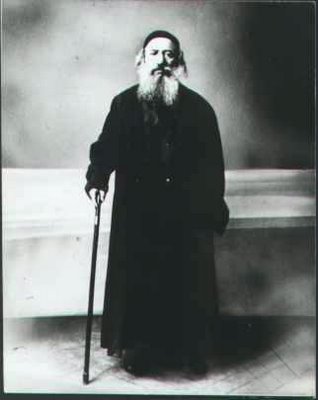
Rav Yisrael Taub zt"l
Rav Yisrael Taub of Modzhitz, mechaber of Divrei Yisrael, was the son of Rav Shmuel Eliyohu Taub of Zhvullin (1888) and the grandson of Rav Yechezkel Taub of Kuzmir (1856), who was one of the talmidim of the Chozeh of Lublin. He was a descendant of the Kuzhmir dynasty. He became the first Rebbe of Modzhitz and was succeeded by his son, Shaul Yedidya Elozor. Legend has it that in 1913 Taub composed a thirty-minute niggun (melody) while having his leg amputated without anesthesia.
Rav Yisrael was the son of Rav Shmuel Eliyohu of Zhvullin, and a descendant of the Kuzhmir dynasty. He was born in Ratzionz in 5609/1849. From a young age he was recognized as extremely talented in Torah with a rare gift for music. In 5648 he succeeded his father (among other successors) and moved to Eyungrud-Modzitz, transforming the city’s character and making it famous in the world of Polish Chassidus. The Chassidim built the Rebbe a beautiful home with a garden surrounding it. Modzitz grew as a center for Chassidus even though the Rebbe only saw Chassidim late at night.
His niggunim spread throughout Poland. Among his most famous musical compositions are the nigun for the homeless, which he composed during the days of World War I in Warsaw and the famed niggun Ezkera, which has thirty-two stanzas and was composed in Berlin 5673 while undergoing surgery on his foot. (The surgical procedure was performed by Professor Israels without anesthesia.) This niggun is sung annually on his Yahrzeit but only a few special individuals know it completely.
He taught himself music theory as well as voice. In his sefer Divrei Yisrael he has two maamorim – Chassidic teachings – on the pasuk “Kechu mizimras ho’oretz – take from the gleanings of the Land,” where he explains how the seven musical notes of the scale correspond to the seven days of Creation and the seven planets (see below under the section for Torah samples).
Close to the war years he moved to Radom; from there he relocated to Warsaw in his old age, where he was niftar. An ohel was built over his kever in Warsaw. His sons were: Rav Shaul Yedidya Elozor of Modzitz, who succeeded him, Rav Yitzchok Tzvi of Modzitz-New York and Rav Yaakov Dovid, who was a parnas of Warsaw.
He authored the sefer Divrei Yisrael on the Torah and Kelalei Oraisa, subjects arranged according to the alef beis.
His musical notations were published in the collection Negina Vachassidus B’vais Kuzhmir Ubnoseha, and Tiferes Yisrael, which was published by his son and grandson.
Stories of Rav Yisrael Taub zt"l

Rav Yisrael’s son, Rav Shaul Yedidya , related:
“When my father [Rav Yisrael] lived in Modzhitz, he had a daily custom to travel with his companions outside the town, where he would take a stroll and breath the fresh air.
“Once, as they traveled through fields and pastures, they suddenly heard the voice of a shepherd tending his flock as he sang his song. My father, the Rebbe, asked them to stop the carriage immediately, so he could listen to the shepherd’s song. When the shepherd concluded his song, the Rebbe motioned that they should continue on their way.
“He then turned to his companions and remarked, ‘Surely you must wonder why I wished to listen to this shepherd’s song. You should know, however, that whoever sings it is as if he is confessing his sins! A person’s song is his confession, because through a person’s song he reveals his inner essence, his identity. Whoever confesses, no matter who that person is, we must stop and listen to hear what he says.’”
(Yisa Berocha Parshas Naso)
Divrei Torah of Rav Yisrael Taub zt"l
music - the avoda of the leviim
Bereishis (43:11) “Kechu mizimras ho’oretz – take from the gleanings of the land.” The Modzitzer Rebbe explains this pasuk by citing the Kedushas Levi’s commentary to the words “The songs of your servant Dovid” (in the berocha Boruch She’omar preceding Pesukei Dezimra) that music is also a form of avoda and this was the avoda of the Levi’im – to sing and play music. These musical scales are named octaves and have levels one above the other. For example, just as there are levels and scales for our love and fear of Hashem, so there are in niggunim. This is the meaning of “the songs of your servant Dovid.” (Kedushas Levi Likkutim s.v. uveshirei)
serve hashem with pride
The Modzitzer Rebbe, in Divrei Yisrael, cites the Toldos Yaakov Yosef (Parshas Eikev), who explains that the pasuk (Divrei Hayomim II 17:6), “His heart was uplifted in the ways of Hashem,” refers to serving Hashem with a feeling of pride and self esteem, that Hashem values and esteems you and that if we have in mind that “the entire world was created for our sake,” (Sanhedrin 37a Rashi ad loc) then this feeling of pride and self esteem will save him from sin.
Therefore, the opening pasuk in Parshas Emor says, “Speak to the Kohanim, the sons of Aharon.” The Modzitzer explains that the pasuk is saying: “Remind them that they are the sons of Aharon. Remind them of their lofty status and importance, because they might forget their own importance, since Tzaddikim tend to be humble, as it says, “[Moshe and Aharon asked,] What are we?” (Shemos 16:7). Since they might forget who they are, we remind them that they have yichus – pedigree – and that they were born holy, not to make them arrogant or give them vanity or haughtiness, but rather that they should remember not to “make themselves impure among their people,” because if they transgress, they will blemish their soul. Thus they need to be protected from such an event.
serve hashem with pride
The Modzitzer Rebbe, in Divrei Yisrael, cites the Toldos Yaakov Yosef (Parshas Eikev), who explains that the pasuk (Divrei Hayomim II 17:6), “His heart was uplifted in the ways of Hashem,” refers to serving Hashem with a feeling of pride and self esteem, that Hashem values and esteems you and that if we have in mind that “the entire world was created for our sake,” (Sanhedrin 37a Rashi ad loc) then this feeling of pride and self esteem will save him from sin.
Therefore, the opening pasuk in Parshas Emor says, “Speak to the Kohanim, the sons of Aharon.” The Modzitzer explains that the pasuk is saying: “Remind them that they are the sons of Aharon. Remind them of their lofty status and importance, because they might forget their own importance, since Tzaddikim tend to be humble, as it says, “[Moshe and Aharon asked,] What are we?” (Shemos 16:7). Since they might forget who they are, we remind them that they have yichus – pedigree – and that they were born holy, not to make them arrogant or give them vanity or haughtiness, but rather that they should remember not to “make themselves impure among their people,” because if they transgress, they will blemish their soul. Thus they need to be protected from such an event.
music - the avoda of the leviim
Bereishis (43:11) “Kechu mizimras ho’oretz – take from the gleanings of the land.” The Modzitzer Rebbe explains this pasuk by citing the Kedushas Levi’s commentary to the words “The songs of your servant Dovid” (in the berocha Boruch She’omar preceding Pesukei Dezimra) that music is also a form of avoda and this was the avoda of the Levi’im – to sing and play music. These musical scales are named octaves and have levels one above the other. For example, just as there are levels and scales for our love and fear of Hashem, so there are in niggunim. This is the meaning of “the songs of your servant Dovid.” (Kedushas Levi Likkutim s.v. uveshirei)
serve hashem with pride
The Modzitzer Rebbe, in Divrei Yisrael, cites the Toldos Yaakov Yosef (Parshas Eikev), who explains that the pasuk (Divrei Hayomim II 17:6), “His heart was uplifted in the ways of Hashem,” refers to serving Hashem with a feeling of pride and self esteem, that Hashem values and esteems you and that if we have in mind that “the entire world was created for our sake,” (Sanhedrin 37a Rashi ad loc) then this feeling of pride and self esteem will save him from sin.
Therefore, the opening pasuk in Parshas Emor says, “Speak to the Kohanim, the sons of Aharon.” The Modzitzer explains that the pasuk is saying: “Remind them that they are the sons of Aharon. Remind them of their lofty status and importance, because they might forget their own importance, since Tzaddikim tend to be humble, as it says, “[Moshe and Aharon asked,] What are we?” (Shemos 16:7). Since they might forget who they are, we remind them that they have yichus – pedigree – and that they were born holy, not to make them arrogant or give them vanity or haughtiness, but rather that they should remember not to “make themselves impure among their people,” because if they transgress, they will blemish their soul. Thus they need to be protected from such an event.
a fools gathering at a foolish place
Mishna Avos 3:3 – Rav Chanina son of Tradyon used to say: Two who sit together and do not exchange words of Torah are a gathering of mocking cynics, as it is stated (Tehillim 1:1): “And among a gathering of cynics he did not sit.”
The Modzitzer Rebbe says in Kelalei Oraisa (os shin): I once heard from the Chassid, the elder Rav Meshulem of Plontsk, how my grandfather, the Kuzhmirer Rebbe, was once visiting the town of Plontsk, and a wealthy gvir, who was a learned lamdan and a Misnagged and knew my grandfather, invited him to stay at his home. The gvir prepared a meal in my grandfather’s honor, and as they sat at the table, the host was in a good mood and invited my grandfather to say a few words.
My holy grandfather grabbed the table by both hands and gave it a shove, pushing it far away, to emphasize and underscore his words: “[Chazal say,] ‘If two are sitting together but there are no words of Torah shared between them, then this is a gathering place of fools.’ It should have said that they themselves are fools. [Why does the Mishna’s criticism seem to focus on the gathering place rather than focusing on the fools themselves?] Rather, the reason for this is because if two Torah scholars sit together and they have no words of Torah to share, it must be due to the impurity of the place where they are sitting, because that table served previously as a gathering for fools [their negative influence affected and infected it].” Afterwards, says the Modzitzer, I found this concept and explanation in the name of Rav Michele of Zlotshuv. (Kelalei Oraisa os shin)
mishna 2:2 “any torah study that has no work and livelihood together with it is destined to cease.”
The Modzitzer Rebbe explains our Mishna as follows: [The acquisition of Torah requires hard work.] Therefore any Torah study that lacks hard work, diligence and effort in its application will eventually cease, as Chazal say (Megilla 6b): “If someone makes the claim that he succeeded in Torah without any effort, do not believe him.” (Kelalei Oraisa os kaf)
remove these concerns like removing shoes from your feet
Mishna Avos 2:10 – “Beware of their fiery coals; their bite is like a fox bite, their sting like a scorpion’s sting, their venom like a serpent’s venom and all their words are fiery coals.” (Avos 2:10)
The Modzhitzer Rebbe, in Divrei Yisrael, tells us about a meeting that took place between his grandfather, Rav Yechezkel of Kuzhmir, and Rav Nosson Duvid of Shidlovitza. At the beginning of the Shidlovitza’s career as Rebbe, he had many detractors who made his life difficult. When he once complained about them to the Kuzhmirer, Rav Yechezekel told him the following peshat in pasuk, based on a novel interpretation of the Mishna in Avos. “Don’t let them bother you, make you angry or upset. When Moshe Rabbeinu became leader of the Jewish people, Hashem gave Moshe the same advice in His very first command. Hashem told Moshe, ‘Remove their concerns from you just as one removes his shoes from his feet. Remove your shoes from your feet.’ (Shemos 3:5)
“The pasuk is understood this way in light of the statement of Chazal, who said, ‘Beware of their fiery coals; their bite is like a fox bite, their sting like a scorpion’s sting, their venom like a serpent’s venom and all their words are fiery coals.’ (Avos 2:10) The acrostic formed by the roshei teivos, the spelling of the first letters of each word of their bite, sting, venom and all their words spells “your shoe” – na’alcha – in Loshon Kodesh – Neshichosom, Akitzosom, Lechishosom, Kol Divreihem kegachalei aish –[נשיכתן עקיצתן לחישתן כל דבריהם כגחלי אש – ר"ת נעלך]. Hashem was saying to Moshe, and I am saying to you, that a leader of the generation must remove all concerns of opposition from any other Jews. Remove these concerns from you as Moshe removed them at Hashem’s advice. Remove all four forms of their oppositions cited above from your concern and do not be angered or concerned over them at all. (Divrei Yisrael Modzhitz Shemos s.v. shal na’alcha me’al raglecha)
mishna avos 4:17 – “just one hour of teshuva in this world is better than all of the next world.”
The Modzitzer Rebbe in Kelalei Oraisa (os yud) cites his grandfather the Kuzhmirer, who explained our Mishna as follows: One hour spent in teshuva in this world filled with inhibitions, difficulties and delays is more precious and beautiful [to Hashem] than the entirety of the coming world, which is a place of rest like a retreat tent, where there are no troubles or difficulties.
torah in the name of the author
Mishna Avos 6:6 – “Whoever quotes something and cites the original author or speaker…”
The Modzitzer Rebbe explains our Mishna as follows: Whoever studies the Torah reciting it vocally in the name of The Author – Hashem – meaning that he studies Torah with the motivation to know Hashem and His Name as One and Only, this brings the Redemption to the world. (Kelalei Oraisa os kaf)
Segulos of Rav Yisrael Taub zt"l
It is a well-known segula for parnossa to daven with a minyan – the Modzitzer Rebbe, the Divrei Yisrael, taught (Parshas Bechukosai) that the curses of the Tochecha are all blessings in disguise; the curse that says ten women will have so little bread that they will bake it all in one oven he explained as: Ten Jewish souls (daughters of the king) who come together to “bake” in one oven – if ten souls come together to warm each other up and enliven and set each other aflame with excitement in communal tefilla as a minyan in shul, they are like bread, which the Gemora says bakes best when the oven is full of bread, and they are like a good stew, whose ingredients cook together and give taste and flavor to one another. Davening in a minyan be’tzibbur is thus a good segula for parnossa, he concludes.