
Rav Moshe Feinstein zt"l
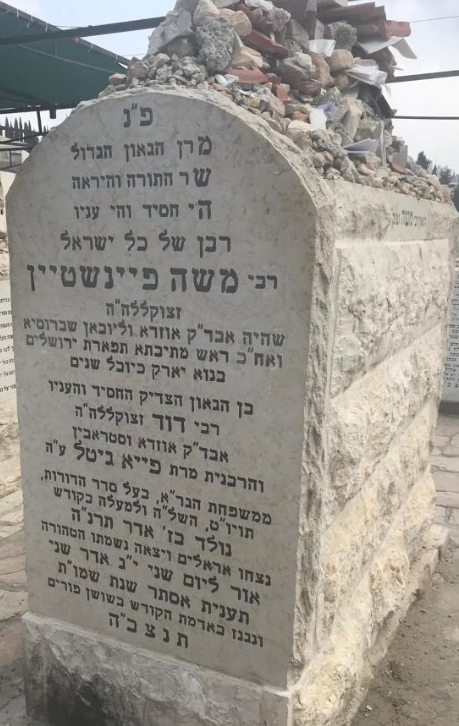
הרב משה בן דוד פיינשטיין זצ"ל
Adar II 13 , 5746
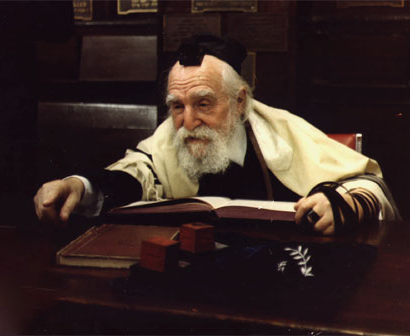
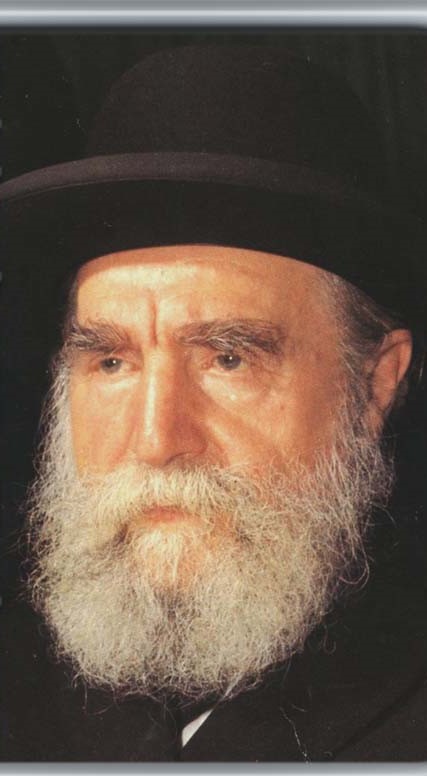
Rav Moshe Feinstein zt"l
Rabbi Moshe Feinstein was born in the year 1895 in Uzda, near Minsk, Belorussia where his father was rabbi. In 1921 he became rabbi of Luban, near Minsk, where he remained until he came to the United States in 1937. In America he became the Rosh Yeshiva (dean) of Mesivta Tiferes Yerushalayim, a yeshiva in New York.
Rabbi Feinstein became the leading halachic (religious law) authority of his time and his rulings were accepted worldwide. Rabbi Feinstein was a dedicated and selfless leader for the Jewish people to whom anyone could approach at any time with any problem.
Rabbi Feinstein’s halachic decisions have been published in a multi-volumed collection titled Igros Moshe (The Letters of Moshe). He also published several volumes of in depth discussions about the Talmud.
Rabbi Moshe Feinstein was one of the last of the great leaders and sages from Europe and was a representative of the greatness the Jewish people had before the destruction of the Jewish communities during World War II. We were greatly privileged to have such a giant here in America. When he passed away in 1986 the Jewish people lost a great and caring leader and one of our last connections to the greatness of European Jewry.
jewishvirtuallibrary.org
Stories of Rav Moshe Feinstein zt"l

On the Pnei Menachem’s first visit to the US, he was to participate in the Aguda Convention, at which the Gaon and Godol, Rav Moshe Feinstein, was to present him as a guest of honor. Rav Moshe, however, was in a quandary as to how to present the Pnei Menachem. A standard introduction, explained Rav Moshe, was out of the question; on the one hand, how can you introduce the son of the Imrei Emes and the brother of the Bais Yisrael of Ger as just any honorable guest? On the other hand, Rav Moshe did not know the Pnei Menachem personally at all. The solution was that although Rav Moshe had a packed schedule, a single hour was set aside for the two Torah giants to meet beforehand. This single solitary meeting slated for a short one-hour slot extended to many hours. When Rav Moshe exited, he told those close to him, “I couldn’t believe my ears! [He knows] the entire Torah, and I mean the entire Torah mamash!” Suffice it to say that at the convention, Rav Moshe heaped praises upon the Pnei Menachem and was able to say to the audience assembled that he testified to these praises from personal experience.
Years later, the Pnei Menachem’s son, Rav Yehuda Arye, married the daughter of the Mishne Halochos, the Ungvar Rav in America, and his father asked him to be tested for semicha from Gedolim and Rabbonim in the US. The first one on the list that the Pnei Menachem gave his son was Rav Moshe.
Rav Yehuda Arye, however, was disappointed to hear from Rav Moshe’s family that due to his advanced age and weak constitution, the Godol HaDor had already ceased testing and giving semicha. When Rav Moshe heard what was happening at the door he agreed with the statement, but also inquired as to the identity of the young man. When he introduced himself, Rav Moshe asked whose son he was. Upon hearing the Pnei Menachem’s name, he responded that his decision had not been made in all circumstances. “For your father, the Gaon, I am making this special exception because I hold he is a Ge’on Olom mamash!” And so, as a rare exception, Rav Moshe tested him and gave him semicha. (HaMevaser HaTorani Adar tov-shin-ayin-alef by Rav Yaakov Heizler)
Rav Elimelech Biderman related:
Rav Mordechai of Zvhill, before he became Rebbe, needed twenty-six thousand dollars for an upcoming chasuna. He went to the office of the Eitz Chaim Yeshiva, where he studied, and asked the director of the Yeshiva to give him the addresses of wealthy donors in America, because he wanted to send them letters, asking for money for the chasuna.
The director did not want to give him the addresses (because he wanted their support for the Yeshiva) so he gave Rav Mordechai Zvhiller some old addresses from people who used to support the Yeshiva, but hadn’t given a donation for a long time.
When Rav Mordechai returned home with the list, his wife rebuked him, “Do you really think that these are going to help you? The director certainly gave you the addresses of people who don’t have money any more.” Rav Mordechai explained to her that he was doing hishtadlus.
“If your goal is hishtadlus, why do you have to send letters to all of them? Just send one letter, and that will be your hishtadlus...” she chided.
Rav Mordechai replied, “You’re right. I’ll send only one letter.”
He sent off one letter and soon received an envelope in return with a check for twenty-six thousand dollars inside. Rav Mordechai went to the director to thank him for the addresses.
The manager was shocked. “You mean your letters were answered?”
“Not the letters. I only sent one letter, and I received twenty-six thousand dollars.” And he told him the name of this ba’al tzedoka.
The manager called up this ba’al tzedoka and asked, “I see that you have money, because you just gave one of our talmidim twenty-six thousand dollars for hachnossas kalla, so why did you stop sending money to the Yeshiva?”
The man replied, “I don’t have money any more. The money was from my daughter, who is a kalla. After her engagement, we discovered that she has an illness. We went to Rav Moshe Feinstein, and asked him whether we must tell the chosson and the mechutonim about it. Rav Moshe inquired as to the nature of the illness, and then ruled that we don’t need to say anything. ‘However,’ Rav Moshe advised, ‘if your daughter has some money of her own, it is a good idea for her to give it for hachnossas kalla. In the merit that she helps another kalla go to the chuppa, she will also merit going to her chuppa.’ Just then, we received Rav Mordechai’s letter, and his request for hachnossas kalla. My daughter works, so she had some money saved up. She emptied her account, and immediately sent it to Rav Mordechai, for his daughter’s wedding.” Rav Mordechai had bitochon, and received all the money he needed with one letter.
This story is an example of hashgocha protis. Immediately after Rav Moshe advised them to donate money for hachnossas kalla, Rav Mordechai’s letter arrived in the mail.
(Wellsprings, Parshas Teruma, by Boruch Twerski)
A strong tree has healthy roots. So too were the roots of R' Moshe Feinstein, strong and special from the start. His father, R' Dovid Feinstein, zt"l, was a grandchild of the Be'er Hagolah and of the brother of the Gra, R' Avrohom. His mother was Feige Gittel, daughter of the Gaon, R' Yechiel zt"l, rov of Kopolia.
He was born on 7th Adar, 5655 (1895), a date which in his own words gave him the feeling that he was obligated to follow in the ways of Moshe Rabbeinu in Torah and in middos.
R' Dovid invested much time, money and effort into the education of his son Moshe, asking the melamed who usually learned with a group of ten talmidim to make Moshe's a group of five and he, R' Dovid, would subsidize the rest of the money from his own pocket. Even before he started to learn in the local cheder, R' Moshe learned the entire Chumash with his father and by the time he was bar mitzvah he was fluent in more than two sedorim of Shas.
He joined the yeshiva of R' Isser Zalman Meltzer in Slutzk at the age of twelve, where he also learned under the tutelage of HaRav Pesach Pruskin, zt"l. When the latter opened his own yeshiva in Shklov, R' Moshe went with him and recounted that at the grand opening ceremony of the new yeshiva, R' Isser Zalman himself was present.
At the age of sixteen, R' Moshe completed Shas and Shulchan Oruch. During this period he was called to serve in the army. R' Moshe traveled with his father to the Chofetz Chaim in Homil to request his blessing. "Heaven had originally decreed that you join the army," said the Chofetz Chaim. "But since you took upon yourself wholeheartedly the ol Torah, the ol Malchus has been removed from you." R' Moshe was never conscripted.
In the year 5676 (1916) he was appointed rov in Uzdah in order to avoid army service and, after two years when the laws were changed he returned to his father in Strobin.
From 5681 (1921) to 5696 (1936) he was rov in Lyuban, after which he decided that this was not the right place to bring up his children and educate them in the Torah's ways. He traveled to Riga and there he obtained visas to go to America.
An impressive delegation met R' Moshe as the ship docked at the port at Ellis Island. He was immediately offered numerous positions as maggid shiur in various existing yeshivos, but refused all the offers until, in 5697 (1937), he became a lecturer in Yeshivas Tiferes Yerushalayim, where after a year he became head of the yeshiva. From this position he disseminated Torah for the rest of his life and his shiurim are printed in his sefer Dibros Moshe.
Aside from the yeshiva, R' Moshe did not take on any official rabbinical position. Nevertheless, he became a center point, a point to which people turned from all directions from all parts of the world to hear the word of Hashem. Thousands of teshuvos in halochos were issued by him, many of these being printed in the eight volumes of Igros Moshe. There wasn't one matter in the world of Torah and halochoh that wasn't brought to him for his opinion.
The gedolei haTorah were all in awe of him, as seen in an example: HaRav Yonoson Shteif of Budapest used to put on his hat out of respect for R' Moshe whenever he spoke to him on the telephone!
Towards the end of his life, when the doctors wanted to insert a pacemaker in his heart, R' Moshe only agreed after he had made sure there was no halachic problem involved, that the insertion does not inflict the type of blemish in his body that would render him unfit to be a member of Sanhedrin should Moshiach come.
On the night of Taanis Esther, 5746, R' Moshe was niftar. The levaya on Taanis Esther morning in New York City was like none that New York had never seen; about one hundred and fifty thousand people accompanied R' Moshe on this step of his final journey. Even the American flag on the East Side was flown at half-mast as the non-Jews' sign of mourning that the leader of the Jews had died.
His oron was brought to Eretz Yisroel and on Shushan Purim in Yerushalayim, hundreds of thousands of Israeli Jews from all walks of life accompanied the levaya to Har Hamenuchos where he is buried close to the Gaon of Tchebin, the Belzer Rov, in the portion near his Rebbe, R' Isser Zalman Meltzer, zt"l.
********
"R' Moshe." Just that, without any extra titles or descriptions. So was R' Moshe known by all Jews: Ashkenazim and Sephardim, Chassidim and Misnagdim, Rabbonim, Roshei Yeshivos and Admorim, Rabbis and laymen; all knew R' Moshe and all saw in him their rabbi and leader - whether in a complicated halachic query such as permitting an agunoh to remarry, or a private instruction for a yeshiva bochur or an avreich - to all the address on the East Side was the place to which to turn.
It is impossible on a single page to describe even a fraction of his greatness in Torah and halocho. However, we cannot with this dismiss the whole subject. Let us at least take a glimpse into the sparks of his greatness in middos and try to emulate his wonderful and refined ways.
The following fact once slipped out when R' Moshe was trying to impress on his family the right approach to Torah.
As a child of eight he was playing chess with a friend, when he suddenly realized that he was concentrating deeply, so engrossed in his game that it was no longer a form of relaxation but an effort. If it requires effort, isn't it better to use these powers of concentration for Torah learning? From then on, he never played chess again.
He once added that since he was of short build, he was afraid to play with friends his age for they were taller and stronger than he was. "I saw this as Hashgocho protis for due to this, I spent more time delving into Torah."
It is no wonder, therefore, that he had finished Noshim and Nezikim by the time he was eleven years old.
Once, his uncle HaRav Eliyohu Pruzhiner, zt"l, came to visit their house and when the eleven year old Moshe entered the room, his uncle arose to his full height, saying, "For a boy who knows two sedorim, one must stand up."
His father, R' Dovid immediately sent the boy to bring something for the guest to eat. "When I left the room," R' Moshe would recount, "I caught my father admonishing my uncle: Do you want to ruin my son? To turn him into a baal gaavah, chas vesholom?"
His words had a profound effect on the young boy who internalized their lesson of humility forever.
In his later years too, when his name was mentioned with awe and respect by all, he remained as unassuming as Moshe Rabbeinu himself, his humility even preventing him from visiting Eretz Yisroel. When he came to the Holy Land in 5724 (1964), thousands flocked to his door, individuals with private sheilos, rabbonim with halachic queries that were rocking the rabbinic world, the brokenhearted to pour our their problems and ask for practical advice - twenty-four hours a day they came in a steady stream.
Upon returning to New York, R' Moshe was heard to say, "To receive all the people who wanted to see me was impossible, yet who am I to turn away a Jew? I can no longer go on a short-term visit to Eretz Yisroel!" He was even absent at the wedding of his grandchild that took place in Yerushalayim for this reason.
His family related a remarkable incident that took place after R' Moshe paskened a famous sheilo as permitted. There were rabbonim who disagreed with his psak as is often since we are in golus. "We have no novi . . ."
A follower of one of these, a man of bad middos stood up publicly against R' Moshe's psak and even degraded R' Moshe himself. R' Moshe, true to the Torah's command, "You shall not fear any man," did not sway from his daas Torah, and held his own.
Not long after, this man was caught by the American authorities for a minor crime. His court case was imminent and he knew that he could receive a very harsh sentence if the court was against him. He turned to R' Moshe, not to apologize and beg forgiveness, for perhaps this happened because he had humiliated a godol hador, but to request that the rabbi write a letter in his favor to the judge, as even the non-Jews respected the rabbi's word.
Immediately, Reb Moshe took out a paper and pen and wrote a warm letter which, after reading it, one would think was written about a close friend, and handed it to his adversary saving him from a harsh verdict.
His astonished family explained their wonder: how could he so wholeheartedly help someone who had besmirched his name only a short while earlier? The wonder of wonders was that Reb Moshe was not working on his middos in writing this letter; he did it naturally and in total innocence did not understand his family's amazement. "If I am in a position to help this man, how can I refuse to extend a helping hand to a fellow Jew in need?
His wonderful middos did not allow him to even slightly harm the feelings of another, even at his personal cost. His sister, the Rebbetzin Chanah, related that when Reb Moshe was rov in Lyuban, before he was married, a woman was appointed to cook for him. The food she cooked was literally inedible, but to Reb Moshe, embarrassing a Jewish woman was even more inconceivable and he always finished his meals to the last crumb.
Thinking that the rov enjoyed her food so much, the cook served him even larger portions and these too were finished each time. "One day I went to visit my brother and joined him for lunch. I just about tasted the food and almost threw up the bit that I had swallowed, so nauseating was the taste. `How could you eat such disgusting food?' I asked my brother. His answer was simple. `I force myself in order to avoid embarrassing the cook.'
Reb Moshe once told his sister that she did him a great favor that day by stuffing all the food into her bag so at least one day he didn't have to eat it.
On another occasion a talmid of Reb Moshe took him home in his car. He opened the door of the passenger seat and Reb Moshe got out, whereupon the talmid slammed the door on his hand. The pain was unbearable, but Reb Moshe contained himself with superhuman control in order not to alert the talmid, who would surely be mortified by his mistake.
Indeed, how appropriate are the words uttered by Reb Moshe himself, not long before he was niftar: "As far as I know, to the furthest extent of my memory, I never harmed anyone, nor did I ever hurt a person's feelings."
This short, concise admission coming from the holy mouth of Reb Moshe himself is sufficient testimony and the greatest mussar book for us. http://www.chareidi.org/archives5761/tezave/features.htm