Rav Yaakov Abuchatzeira zt"l
הרב יעקב בן מסעוד אבוחצירא זצ"ל
Teves 20 , 5640

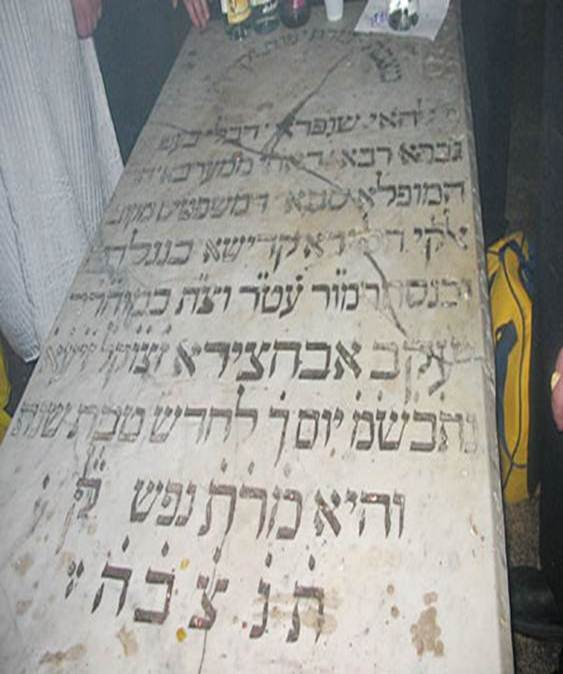
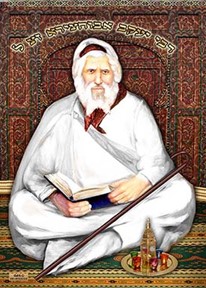
Rav Yaakov Abuchatzeira zt"l
Rav Yaakov was born in the year תקס''ו in Tafilalt, Morocco.
Abuchatzeira Yichus
His father was tenth-generation descendant of Rav Shmuel Elbaz the founder of the Abuchatzeira dynasty. The family name changed from Elbaz to Abuchatzeira because of the nickname Rav Shmuel was given.
(Note: In the following account, there are several family traditions that explain what the “mat” is referring to and perhaps all of them are true.)
The Abir Yaakov’s grandson the famed Rav Yisrael Abuchatzeira of Netivot (known as the Baba Sali) used to tell how once Rav Shmuel lacked the necessary funds to undertake an important journey. So instead, he sat down to study Torah on a straw mat (as was customary in those lands, in those days.) As he took his place on the straw mat (called a machtzeles) and became absorbed in intense Torah study, a miraculous wind came and blew him to his intended destination (like a flying carpet). As a reminder of this wonder, they applied the nickname, “Father” or “Master of the Machtzeles” – Abu Chatzeira.
Another family tradition (cited by Chida in Shem HaGedolim Shin) is that Chatzeira means “Chatzer – backyard”, and it became his nickname due to the time he spent studying Torah in hisbodedus in his backyard.
Rav Masud heard a heavenly voice (bas kol) proclaiming that he would bring a great light into the world and then his son Rav Yaakov was born.
He established his yeshivah Abir Yaakov there and was forever known as the Abir Yaakov.
SEDER HAYOM
His son, Rav Aharon, tells us of his father’s wondrous seder hayom – his daily schedule. It consisted of nightly recitation from memory of Chai Perakim (18 Chapters) of the Mishnah as well as a review of the Shulchan Aruch and Rambam and the poskim. He would then research their sources in the Gemara. At midnight, he would take a short nap before getting up to continue his avodah.
He recited tikkun chatzos and afterwards began the study of Kabbalah. Rav Chaim Vital’s Etz Chaim and the Arizal’s Eight Gates opened before him, as the light of the holy Zohar illuminated him as he studied until dawn.
Before sunrise, he would don tallis and tefillin and hurry off to shul to be one of the first ten people in the minyan for shacharis. He davened in his yeshivah and continued to sit and study after his tefillos. Rather than return home for meals, he ate in yeshiva. He also donated tzedakah to the poor who came seeking his financial support. (Introduction to Pituchei Chosam)
Rav Yaakov Abuchatzeira passed away on a journey to fulfill his dream of coming to Eretz Yisroel. He became sick and died on 20 Teves תר''מ in Damanhur, near Alexandria in Egypt.
The Abir Yakov’s children were: Rav Masud, father of the Baba Sali, and Rav Aharon who published the manuscripts of his father’s seforim.
Stories of Rav Yaakov Abuchatzeira zt"l

His love for his holy writings was great indeed, so that he even took them along with him when he went on a trip or a long journey. During one such journey, after he arrived in the city, he was received with honors by the local rabbanim. Sometime during the visit, it was discovered that someone had broken into the room where he was staying and had stolen his treasured manuscripts! After a preliminary search turned up nothing, the local rabbanim tried to comfort him. The Abir Yaakov calmly responded that he was not worried; if from Heaven it had been decreed that his precious writings should somehow vanish, surely it was a Divine sign that they were not desired or wanted. “Better that they had never been written at all”, he declared emphatically.
In the midst of this display of complete trust in Hashem, thieves burst into the room. Oblivious to the respected rabbanim and local authorities in the room, the well-known robbers ran straight to the holy Abir Yaakov. They fell sobbing and pleading at his feet, “Holy Tzadik, we beg your forgiveness! Please, please we admit we stole your holy writings and we are here to return them, just please forgive us!”
To the amazement of all those assembled, they recounted what led them, once bold, proud robbers to grovel on the floor before the venerable sage. What transpired was nothing short of miraculous:
After they got hold of the chest full of treasure, they made their escape. As they approached the usually tranquil waters or the river to ford to the other side, something bazaar occurred. The waters began to foam and churn and rose up to prevent their crossing. It seemed they would be swept away by the torrent. They turned back and as quickly as the tempest had begun, the waters quieted. Taking advantage of the respite, they attempted to cross once again. However, no sooner did their feet touch the water, when they were once again caught in a tempest which threatened to drown them. They realized that these repeated events where a sign that the Hand of Heaven was at work. They not only backed off, but resolved to return the stolen items realizing that the holy writings knew how to protect themselves.
Divrei Torah of Rav Yaakov Abuchatzeira zt"l
his berachos: like a snake; like a lion cub
In Yaakov Avinu’s beracha to Dan in Parshas Vayechi (Bereishis 49:16-18), he states: Dan will avenge his people, the shevatim of Yisroel will be united as one. Dan will be a serpent on the highway, a viper by the path, that bites a horse’s heels so that its rider falls backwards. For your salvation I await O Hashem!
Rashi explains that Yaakov alludes in these pesukim to Shimshon Hagibor, the descendant of Dan who fought the Philistines and brought unity to the Jewish people. Shimshon attacked with guerilla warfare and then afterwards, slithered stealthily like a snake back to its lair. He had his final victory when he pulled down the two pillars of the Philistines’ idolatrous temple, killing three thousand. (Shoftim 16:29). His final prayer to Hashem at that time, after his eyes were put out and he was chained (ibid 16:28), is alluded to in the blessings in Bereishis 49:18.
Moshe Rabbeinu’s beracha in parshas V’zos Habrachah (Devarim 33:22) states: Dan is like a lion cub, leaping forth from the Bashan.
preparation for shabbos merits three levels of soul on shabbos
Our sages said (Avodah Zara 2a) “Whoever toiled to prepare on Erev Shabbos will have what to eat on Shabbos.”
The Abir Yaakov says: In this statement Chazal hinted to us that whoever properly prepares himself during the six days of the week by studying Torah l’Shma (sincerely, for the sake of Hashem), davens properly, and is careful in fulfilling all the mitzvos, and does this all with proper love, fear, awe, and joy, then he merits on Shabbos Kodesh an additional three levels of soul - the Nefesh, Ruach, and Neshamah.
Whoever fails to toil in spiritual pursuits all week, should not expect to enter Shabbos Kodesh with his soul aflame.
This is proven by the source of the commandment, “To remember Shabbos”. The juxtaposition of two pasukim (Shemos 20:8-10) shows how the sanctity of Shabbos depends on our preparations the week before:
“Remember the Shabbos day to sanctify it as holy.” This, as the next pasuk reveals, is contingent on a condition: “For six days shall you toil, and do all your work; the seventh day shall be a Shabbos for Hashem your G-d.'' In order for the holiness of Shabbos to happen, a Jew must work hard (do his avodah) all six weekdays.
(Maaglei Tzedek Tav #400)
abir yaakov on avos
Mishnah Avos 1:13 “Whoever does not add will be subtracted,”
The Abir Yaakov explains, based on this Mishnah which says, “Whoever doesn’t add something new each day in his war against the yetzer hara , allows the evil one to defeat him and destroy him.”:
This is because the evil yetzer hara renews his strength and on a daily basis and comes up with new tricks and new strategies to overwhelm us with. If we ourselves do not meet the challenge equally with new strength each day and oppose him with fresh resolve, surely the evil one will defeat us and destroy us.
Mishnah Avos 2:9 “Rabbi Yochanan asked his disciples go out and see what is the best way of life a person should attach himself to and what is the worst. Rabbi Elazar ben Arach answered: a good heart and an evil heart [respectively]. I see Rabbi Elazar ben Arach’s words because his includes yours”
The most important body part (in this example) is the heart. And primarily the best way to safeguard and refine the heart is by breaking our desires and conquering our passions.
This is hinted at very outset of the Torah, with the word “Bereishis” (Genesis). The word itself is linked to teshuvah because its gematria is the same as shaber taavah – break down your desires.
Conquer and master them since this is the best and highest form of teshuvah (Ginzei HaMelech Tikkun Teshuvah 21)
Mishnah Avos 4:1 “Who is a courageous hero? Whoever overcomes his evil urge.”
The Abir Yaakov taught that there is no stronger and more courageous hero than a person who overcomes his yetzer hara and breaks his desires.
The reason is that when it comes to powerful physical opponents a person fights against, it is physical prowess and muscle that is all you need since you are coming up against a human being just like you.
But whoever breaks his desires and fights with his evil urge is battling against a mighty spiritual opponent with far superior powers. That is why someone who overcomes the yetzer hara is a true hero. (Ginzei HaMelech Tikkun Teshuvah 21)
Mishnah Avos 4:1 “Who is a courageous hero? Whoever overcomes his evil urge.”
The Abir Yaakov taught that when we go out to war with the yetzer hara, we need weapons. The ammunition in our spiritual arsenal are all hinted at by the roshei teyvos of, “Go Out [to war],” תצא --Teitzai which is spelled Tav, Tzadi, Alef and they include:
This stands for: Tefillin Tzitzis and Os. We use the mitzvos of tefillin and tzitzis as weapons in our war against the evil one along with “os” hinting at two signs of the covenant 1. the os bris kodesh and 2. the sign of Shabbos; Shabbos is called an os beini ubeinaychem.
תצא --Teitzai stands for: Tefillah, Tzedakah, and Ohr referring to the spiritual light of Torah study as in Mishlei 6:23 Torah Ohr.
תצא --Teitzai also stands for: Taanis, Tzedakah, and Ohr this is similar to the idea of Tzom, Kol, Mamon – fasting, davening, and giving charity to cancel bad decrees. If you take these mitzvos in hand-- adding them as weapons to your cache-- their tikkunim will aid you in winning the war against the evil urge and Hashem will then give him into your hand to defeat him. (Pituchei Chosam Ki Seitzeh)
Segulos of Rav Yaakov Abuchatzeira zt"l
There is a great segulah that Hashem hid within Torah study. We know that intense exertion in Torah study weakens the body and can break a person as toiling in Torah study uproots him from the physical world.
At the same time, spiritual suffering and privation that accompanies Torah study and mitzvah observance takes the place of physical suffering, sickness, or illness, Heaven forbid. As a person can only suffer an allotted amount, Ovdei Hashem fill their quota—so to speak—through straining themselves in their avodah.
Chazal say (Sanhedrin 99b) “Rabbi Elazar says everyone was created to toil as it says in Iyov 5:7, ‘A person was born to toil’; and if we are unsure if this toil is achieved by speech of our mouth or by the toil of our hands, we can resolve it from a line in Mishlei 16:26, “His mouth was saddled” From here, we see that we mean the toil of our mouth.”
When it says that our mouths should toil, are we talking about using our mouths for Torah, or is the pasuk referring to mundane talk as well? This is resolved by what it says in Yehoshua 1:8, “The sefer Torah should not depart from your mouth”. We were created to toil in Torah.
This segulah is hinted to in the pasuk (Shemos 15:26) “All the sickness that I put on Egypt I won’t put on you.” Machalah מחלה (sickness) whose gematria with the “kollel" (the inclusive form) of the word itself equals 89 which is the same value for the word, guf – גוף (the body) which is 89. Hashem won’t bring about any physical sickness of the body since we will exempt ourselves by fulfilling our obligations through pain of toil in Torah study. (Pituchei Chosam BeShalach)