
Tanna Yonasan ben Uziel zt"l
הרב יונתן בן עוזיאל זצ"ל
Sivan 26 , 0
Tanna Yonasan ben Uziel zt"l
The great and famous sage Hillel had eighty most distinguished disciples; thirty of them were said to be worthy to enjoy the Divine Presence as Moshe did; another thirty were said to be great enough to have stopped the sun in its path as Yehoshua did; the remaining twenty were "in the middle." The greatest of all of Hillel's disciples was Yonasan ben Uzziel; the smallest among them was Rabban Yochanan ben Zakkai, who was familiar with all the hidden secrets of the holy Torah.
Thus our Sages described the greatness of Hillel and his disciples. And from the greatness of Hillel's smallest disciple Rabban Yochanan ben Zakkai, we can imagine the greatness of Hillel's greatest disciple Rabbi Yonasan ben Uzziel!
The Sages related that when Rabbi Yonasan ben Uzziel was busy studying the holy Torah, a bird flying over him at that moment would be burned!
The great sage Shammai, who was the Av Beis Din had a very high opinion of Rabbi Yonasan ben Uzziel. The Talmud mentions a case, where Shammai came to discuss a point of law with him. It so happened that a rich Jew had willed all his possessions to Rabbi Yonasan ben Uzziel as his own children unfortunately did not live up to the way of the Torah. What did Rabbi Yonasan ben Uzziel do when he inherited such a large fortune? He retained one third; donated one third to the Beis Hamikdosh, and the other third to the heirs.
The old sage Shammai came to Rabbi Yonasan ben Uzziel to question his right to return part of the inheritance to the heirs, against the wishes of their father. Rabbi Yonasan ben Uzziel did not agree to the objections of Shammai. He argued that if he was the rightful owner of the property to donate part of it to the Beis Hamikdosh, he had the same right to return part of it to the heirs, for he could do with the inheritance as he pleased. Shammai was forced to admit that Rabbi Yonasan ben Uzziel was right.
Rabbi Yonasan ben Uzziel became especially famous through his interpretation of the Torah, called Targum Yonasan, that he left us.
Our Sages relate that when Rabbi Yonasan ben Uzziel wrote his commentary on the books of the Prophets, the Holy Land trembled and a heavenly voice called out: "Who has dared to reveal My secrets to mortal men?" Rabbi Yonasan ben Uzziel then arose and declared: "I am the one responsible for revealing Your holy secrets to mankind. But not to do myself honor, nor for the glory of my ancestors did I do this, but solely so that the Jews may understand what the Prophets have told them."
When he intended writing an interpretation of the Kesuvim, he was forbidden to do so, because they reveal secrets which must not be revealed till Moshiach comes.
https://www.chabad.org/library/article_cdo/aid/112289/jewish/Rabbi-Jonathan-ben-Uzziel.htm
Stories of Tanna Yonasan ben Uziel zt"l

For a solid week rain cascaded down from the heavens with scarcely a moment of relief. It was easy to imagine how an unfortunate tourist might wonder why Israelis complained incessantly of seasonal drought. It was harder to imagine what Israeli drivers might be wondering as they slowed to gawk at two hooded figures sloshing one after the other along the roadside in the deluge.
The explanation was quite simple. After a year of being in shidduchim without a single likely prospect, I had accosted my Rosh Yeshiva in a moment of frustration and demanded a segula guaranteed to hasten the process of finding a wife.
The Rosh Yeshiva replied without a second thought. “Go to Amuka,” he said. “Go as soon as possible.”
As Chanuka approached, my roommate Yechezkel and I prepared to travel to Amuka during our Yeshiva’s two-day recess. We agreed to begin our expedition by immersing ourselves in the famous mikve of the Arizal, to daven at the sunrise minyan of the Breslover Chassidim, and to proceed from there into the mountains of Tzefas on foot, speaking only words of Torah all along the way.
And so it was that in the predawn darkness we descended unsteadily but unreservedly down the steps of worn and slippery Yerushalayim stone awash in rainwater that came nearly to our knees. We trudged down the rocky path and turned into the cave that houses the ice-cold, spring-fed pool carved into the bedrock of the mountain. As we entered, our hearts soared to find a single candle placed there by some Tzaddik, no doubt, who had come already to immerse in the humble stone bath and left illumination for those who would follow.
Perhaps it was the rain-freshened mountain air, perhaps the echo of those spiritual giants who walked the earth here for so many generations. Or, most likely, some combination of the two, that permeated the city Tzefas with a solemn joy that emanated from the stone streets, the arched stairways and the words of our tefillos that morning as we davened with mounting exuberance.
Ducking under every available overhang, Yechezkel and I returned to our hostel, ate a quick breakfast, then set out once more against the rain, which seemed possessed of a conscious will to drive us back. Yet onward we marched toward the edge of town, as indifferent to the weather as to the incredulous stares of drivers from the windows of their passing cars.
A little more than half a mile along the highway, a rough asphalt road turned up into the hills and, as we began our ascent on the steep incline that rose up before us, something remarkable happened. Suddenly but undramatically, the torrent became a downpour, then a shower, then a sprinkle, then scarcely more than a mist that danced around our heads.
The wellsprings of the firmament seemed to have finally exhausted themselves. In scarcely a minute’s time the storm simply dried up, as if, having rallied all the forces at his command but failing to turn us back, the Soton finally capitulated. Exchanging eerily auspicious glances, Yechezkel and I threw off the hoods of our ponchos. Only minutes later we shed them completely and, bundling them into our daypacks, we attacked the mountain with renewed vigor.
The sky remained overcast and our clothes stuck to our skin, but our buoyed spirits lifted our feet and carried us as if on the wings of eagles. While we walked, we reviewed the sugya we had been learning in Yeshiva, exchanged insights into the weekly Parsha, debating fine points of hashkofa, and rebuking one another at the slightest deviation from topics of kedusha into matters of the mundane.
We hiked two or three miles before turning off down a rocky dirt road, where we began a descent even sharper than our previous climb. By now even the mist had vanished, and the air thickened with the scent of pine and sharpened with the fragrance of anticipation. The road wound its way down before eventually flattening out, and we pressed on eagerly, taking no notice of time or distance. A crudely painted sign offered ambiguous directions, and we wavered momentarily before scrambling down the path to the right.
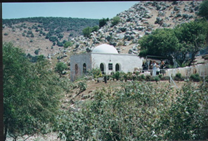
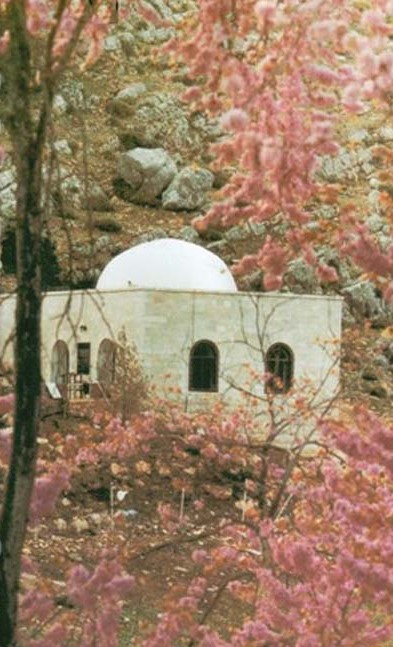
Within minutes we broke through the woods into a wide, uneven wadi from whose rocky ground sprouted a concrete ohel, about twenty feet across, with a low, iron fence enclosing an area set under thick pillars that supported a broad roof. A few cement steps led up onto a cement platform dominated by a tapestry-covered encasement that resembled a crypt and contained nothing. We had learned prior to coming that this whole elaborate edifice had been erected only a few years earlier, after many pilgrims ended their journey in frustration, unable to locate the humble marker that had identified the Tzaddik’s grave for centuries.
The area beneath the roof was partitioned, with one side raised to create an Ezras Noshim, and only minutes after our arrival, a dusty silver van drove up and emptied half a dozen enthusiastic seminary girls. Yechezkel and I sighed as this sudden flock of visitors fluttered into both sides of the monument, and we stepped back out under the open sky to bide our time.
The driver’s side of the van snapped open, and out climbed a short, frenetic Chassid. “Fifteen minutes, girls,” he shouted in clear but accented English. “Fifteen minutes and we go.” The girls seemed to pay him no mind.
He lit a cigarette and strolled over to where Yechezkel and I were waiting for the storm to pass. “Sholom aleichem,” he said.
“Aleichem shalom,” we responded together.
“How did you get here?” he asked, looking around.
“We walked,” Yechezkel answered.
“Gevaltig!” he cried. “If you walk, it is guaranteed to work. Girls, ten more minutes.”
The girls had settled down to recite Tehillim, as Yechezkel and I had begun to do on our arrival. I couldn’t help but look them over, imagining that I might be married to one of them in a year’s time. Then, as my gaze wandered, I noticed that Yechezkel himself had returned to his own prayerful meditation. Right, I thought, back to business.
Minutes later the girls were gone, but neither Yechezkel nor I felt any sense of hurry. Only when the sun began to dip into the afternoon sky did we concede that maybe it was time to return. Uncertain that we could make it back in time to catch a minyan for Mincha, we decided to daven then and there. Together, we began reciting Ashrei, and then rose simultaneously; and just as we took three steps forward, the clouds broke open for the first time and sharp rays of sunlight set the wooded hills ablaze.
Does the segula really work? I can only speak from my own experience. Yechezkel met his wife two weeks later. He was married two weeks before the Yahrzeit of Yonoson ben Uziel, which falls on the 26th of Sivan.
And me? After hiking back to Tzefas, Yechezkel and I caught a bus to Yerushalayim that afternoon. I met my wife the next night. We were married the first week in Adar, less than two months after my visit to Amuka.
(Published in Hamodia, 06/18/2009)