
Rav Yehuda Lowy zt"l
הרב יהודה בן בצלאל לאווי זצ"ל
Elul 18 , 5369

Rav Yehuda Lowy zt"l
The Maharal was born in Pozna, Poland in the year 5272 (1511) to a distinguished family of talmidei chachamim originating from Vermiza (Worms). He was the youngest of four sons (see below).
His father was Rav Betzalel (of Worms) ben Rav Chaim ben Rav Betzalel, descendants of Rav Yehuda Levai HaZakein, the elder of Prague, who hailed from a family of good pedigree. Their lineage traced back to Bustenai ben Chaninai of Bavel and to Dovid HaMelech.
THE BRACHAH FOR HIS BIRTH
The Megillas Yuchsin (p.19) relates that Rav Betzalel of Worms, the father of the Maharal, had two brothers, Rav Yaakov and Rav Tzvi Helman, who were sent to study under the Maharshal, Rav Shlomo Luria (1510-1573). When Rav Betzalel complained to his father, Rav Chaim, why he alone was not also sent off to study in Poland his father responded that for his shimush – the service and the care he took of him – he would be blessed with four luminaries: The Maharal of Prague; Rav Chaim, Av Beis Din Friedberg and author of Sefer HaChaim and Iggeres HaTiyul (6 Sivan); Rav Sinai, Av Beis Din Nikolsburg and chief rabbi of Mehren (5 Elul); and Rav Shimshon, Av Beis Din Kremnitz.
RABBINICAL POSTS AND THE FOUNDING OF THE KLOIZ IN PRAGUE
The Megillas Yuchsin (p.21, in the footnotes from Tzemach Dovid by his talmid Rav Dovid Ganz) relates that the Maharal was Rav and Av Beis Din of Mehren (Moravia) for approximately twenty years. Following his time there, he founded a yeshivah in Prague, along with his famed kloiz, for a period of “eleven years and four years.” There is speculation as to what “and four years” is referring to. It could be an allusion to his departure from Prague, as he returned to Poznan (Posen, Poland) to assume the post of Av Beis Din and Rosh Yeshivah on 4 Iyar 5352 (1592) and ultimately returned to Prague, where he passed away at a ripe old age of over seventy years.
From his published derashos we know that the Maharal delivered the derashos “Derush L’Shabbos Shuvah” in Prague in 5344, and “Al HaTorah V’Hamitzvos” in Pozna in Sivan, 5352.
DERECH HA’LIMUD
The Maharal was a strong proponent of the derech ha’limud as it was in earlier times of Chazal, and went to great lengths to reinstate this path of learning, especially the study of mishnayos and chazarah, the practice of constant reviewing and revising.
He had a major influence on many talmidim and disciples. Prominent among them, Rav Yom Tov Lipman Heller authored his magnum opus, the commentary Tosafos Yom Tov on Mishnayos while under the tutelage of his mentor and master the Maharal to study the Mishnah. As Rav Heller testifies in the introduction:
“The Maharal toiled and taught Torah, and especially Gemara, in yeshivah to the masses as is well publicized. Afterwards, he demanded of us to seize the study of Mishnah until we established groups to study daily chapters of mishnayos and review them over and over again. This was a Divine revelation to introduce this like a law that cannot be repealed. Not only here in Prague, where the Maharal’s influence and opinion is law, but holy communities and kehillos far and wide accepted upon themselves [this method of study] to teach Bnei Yisrael. . . Greater is the power of our great master and teacher [the Maharal] than that of the holy master and teacher [Rav Yehuda HaNasi, author of the Mishnah] . . . because of all this [that each generation understands less without commentary]. For this very reason, when we accepted upon ourselves to fulfill the will and word of our master, Tiferes Yisrael, our mentor and teacher Rav Loewe, to teach and study the Mishnah in Klal Yisrael, the manner and way of study was not the same as in previous generations, without any explanations or reasons given for these laws. Rather, the Mishnah was learned together with a commentary and explanation . . . This is what I meant when I stated earlier that the power and strength of our master and teacher’s [the Maharal’s] words are stronger than [Rav Yehuda HaNasi, author of the Mishnah] those of the holy rebbe – Rabbeinu HaKadosh. This is because the study of Mishnah according to the way of our master and teacher [the Maharal] is done with a commentary and explanations, and this is now considered as if you are engaged in studying the Gemara together with the Mishnah . . . and I attached myself to one of these study groups. . .”
Afterwards, Rav Yom Tov Lipman describes in great detail all the difficulties he had when studying the Mishnah that led him to author the Tosafos Yom Tov, all thanks to the influence of his rebbe and mentor, the Maharal (from the Introduction to Tosafos Yom Tov on the Mishnah).
Similarly, Rav Shlomo Ephraim Luntschitz (1550-1619) writes: “I returned [to the old ways] and saw the great benefit from studying mishnayos, which the gaon Rav Loewe, of our kehilla of Prague, established and founded in all of the shuls and batei knesset to study one chapter each day with chavrusas after davening” (Amudei Sheish, Mosad Amud HaTorah).
The Maharal bewailed and bemoaned again and again what he felt was the major failure of his generation in Torah study: the lack of study of Mishnah and the failure to do chazarah and review.
Two examples of his lament are translated below:
STUDYING MISHNAH AND REVIEWING YOUR STUDIES
“We need to analyze the way of learning in this generation . . . and the truth is that – and believe me that I do not say these things because I hold myself to be worthy of rebuking others . . . I too am guilty of the same faults, as I started out studying just like them and that is why I realized my great shortcomings with which I find fault with myself – none of us reviews their learning in order to fulfill his studies, and they fail to review neither the mikrah, nor the Mishnah, nor the Talmud. . . we fail to worry about the statement of Chazal (Sanhedrin 99a) regarding the pasuk (Bamidbar 15:31): “He shamed and disparaged the word of G-d.” Rabbi Nosson said this refers to whoever fails to pay attention to the Mishnah . . . Rabbi Yehoshua ben Karcha said this refers to whoever fails to review his studies; he is compared to someone who sows seed and fails to reap . . . The reason why one who fails to review his studies is compared to someone who sows and plants seed and fails to reap is because when a seed is planted in the ground, it is nullified and absorbed therein. Similarly, the words of Torah that we receive are absorbed in the body and are therefore not spiritual and intellectually divested from the material, because man possesses a body and receives and absorbs it. When he reviews his studies, has completely divested the gross physical material form from his learning. This can be compared to someone who reaps the grain cutting it from the ground; this process is separating the wheat from the ground (Derech HaChaim, Avos 6:6).
THE MAHARAL’S PROMISE
“Whosoever separates himself from this false path [of pilpul] and turns himself and others together with him towards the true, straightforward path, regarding him it was said (Yirmiyahu 15:19): “If you bring an honorable person from a glutton, you will be like My own mouth,” and the Torah shall shield and protect him in this world and the next.” (Derech HaChaim Avos 6:6)
BATTLE AGAINST YAYIN NESECH
During the Maharal’s tenure as Rav in Mehrin (Moravia), he fought strongly against one of the major issues of his day: the consumption of non-kosher wine, known as yayin nesech. In his sefer Gevuros Hashem, as well as in his drashah on Torah and mitzvos, he cautions against this practice again and again.
From Hilchos Yayin Nesech V’Issuro, published at the end of Gevuros Hashem:
“Even though the prohibition [against drinking non-kosher wine known as stam yenam] is rabbinic in origin, the rabbis were extremely strict regarding this; more strict even than other Torah prohibitions, since they forbade us to even derive any benefit from such wine, a stricture that demonstrates the severity and gravity of the prohibition. Yet some people are so brazen that they even willfully transgress by making Kiddush and Havdalah using such forbidden wine. Others add even worse criminal behavior by drinking such wine and using it for the Four Cups on Pesach at the Passover Seder! . . . The main reason the rabbis decreed a prohibition on yayin nesech (Shabbos 17b) is to prevent intermarriage and assimilation . . . this is the elevated stature and purpose of being a Jewish nation separated from the gentiles and not to be like them . . . This was primarily realized by our redemption from Egypt, and he who takes gentile wine and uses it for the four cups at the Seder is actively erasing the difference between Yisrael and the gentiles, because the four cups correspond to the four expressions of redemption.”
MI SHEBERACH
Among the enactments against stam yenam and yayin nesech, the Maharal instituted the recitation of the Mi Sheberach prayers for those who did not drink the non-kosher wines. He also instituted a Mi Sheberach prayer for those who safeguard their mouths and refrain from talking in shul as well as a Yehi Ratzon prayer against informers. The Tosafos Yom Tov was a disciple and talmid of the Maharal, and many clearly see his rebbe’s influence in the Tosafos Yom Tov’s famed Mi Sheberach prayer, also for those who refrain from talking in shul.
COMMUNAL WORK AND HIS MEETING WITH THE EMPEROR
From more than one source we know that the Maharal met with Roman Emperor Rudolph II, but the reason for the meeting and the matters under discussion remain a mystery to this day. Some speculate that the Emperor was fascinated with Kabbalah and that they discussed Jewish mysticism and philosophy.
The Megillas Yuchsin relates (ibid) that he met with Emperor Rudolph on Sunday, 3 Adar, he was well received and that they discussed secret matters. This story is also related by the Chida in Shem HaGedolim: “I received a tradition from an Ashkenazi rabbi that the Maharal did awesome things based on what was revealed to him from heaven. Thus it came about that he spoke with the Emperor privately for about half an hour. He showed great respect towards the Maharal, as it says in Tzemach Dovid.”
HIS SEFARIM
The Maharal was a prolific writer, author and publisher for his time. He was perhaps the first in Ashkenazi lands to publish a super/meta-commentary on Rashi’s commentary to the Torah, named Gur Aryeh.
Gur Aryeh (www.HebrewBooks.org/42841 thru 42848 in 8 volumes) was groundbreaking, and was followed by the Maharal’s other famous works on Jewish philosophy:
Gevuros Hashem on Pesach (www.HebrewBooks.org/44296),
Tiferes Yisrael on Matan Torah and Shavuos (www.HebrewBooks.org/42865 -42867 in 3 volumes),
Netzach Yisrael on Tisha B’Av (www.HebrewBooks.org/44279 / www.HebrewBooks.org/42854 -42855 2 volumes).
According to his introduction to Gevuros Hashem, the Maharal planned to author three more volumes: HaGedula on Creation, Hod on Sukkos, and Shamayim V’Aretz on Rosh Hashanah and Yom Kippur, but it is unclear if he actually completed these works, changed his mind, simply never published the manuscripts or that they were lost.
The Maharal also published:
Ohr Chadash on Purim (www.HebrewBooks.org/44288) and
Ner Mitzvah (www.HebrewBooks.org/14191) on Chanukah, and
a series of Drashos (www.HebrewBooks.org/44708 , www.HebrewBooks.org/31781 , www.HebrewBooks.org/31791 , www.HebrewBooks.org/3868 , www.HebrewBooks.org/14198 )
and Chiddushim on Aggados HaShas (www.HebrewBooks.org/14194 www.HebrewBooks.org/14192 , www.HebrewBooks.org/14199 , www.HebrewBooks.org/14201 in 4 volumes)
Derech Chaim on Avos (www.HebrewBooks.org/42835 -42839 in 5 volumes),
Be’er HaGola (www.HebrewBooks.org/11506). In Chapter 6, the Maharal severely criticizes the approach of Azariah Dei Rossi (Min HaAdumim) in his work Me’or Einayim. The Maharal writes that he initially rejoiced to receive a new sefer that contained chiddushim like a groom rejoices over his bride. But once he he read it, “Woe to the eyes that saw such things, and woe to the ears that heard such things, cursed be the day that such things were said by a person who failed to understand the words of Chazal on even smaller matters; all the more so large matters, especially deep matters. How could he not fear to speak against Chazal? He spoke about them as if they were people of this generation, as if they were his own fellows. Such things have never been said until this generation; has such a thing even been said before? . . . Not only does he quote from the works of idolaters rejecting Chazal, but he printed his words to publicize them! His book should be burned like the works of apostates and sorcerers; his work is worse than theirs since he printed this book as it were a sefer. We don’t complain about him directly since he is obviously accustomed to reading non-Jewish books and ideas and they influenced him to make such mistakes. Our complaint rather is to the lack of protest against printing such works. Therefore, the proper course of action for people with yiras Shamayim in their midst is to bewail and bemoan the besmirching of the honor and glory of our Torah and Chazal, our sages. Pour out your heart and soul over this. And although I shouldn’t pay attention to this, because foolish, ignorant people might believe his words, I will reply and answer to correct his mistakes . . . Therefore, this book is considered foreign and it is forbidden to read it. Anyone who is a follower of Toras Moshe and believes in the oral and written law should consider this book like chametz on Pesach, forbidden to be seen or possessed. One should never read it or look in it to study, and not even just to peruse . . . Hashem knows the truth that I did not write this to shame or disparage anyone; I did so solely for the sake of avenging the honor of the Torah. For the words of the living G-d are like fiery flames, and this person misunderstands them as if they were empty and lacking value. We should wonder that a participant in the covenant of Avraham Avinu who calls himself a Jew should speak in such a manner . . . Hashem save us from people who honor and glorify foreign and strange ways. Amen, Selah.”
Nesivos Olam Mussar and Machshavah in the Aggados Chazal, arranged based on Mishlei (www.HebrewBooks.org/11804 / www.HebrewBooks.org/14202 www.HebrewBooks.org/14209 – 2 volumes)
and Shu”t (www.HebrewBooks.org/14196 ) and
Chiddushim on Shas (www.HebrewBooks.org/14485 )
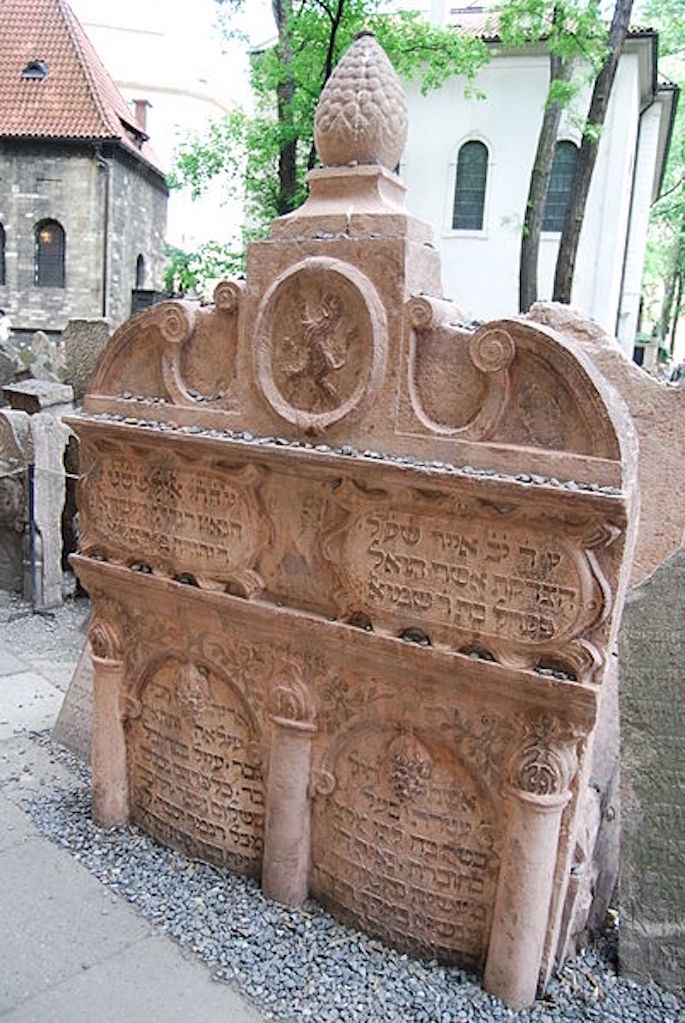
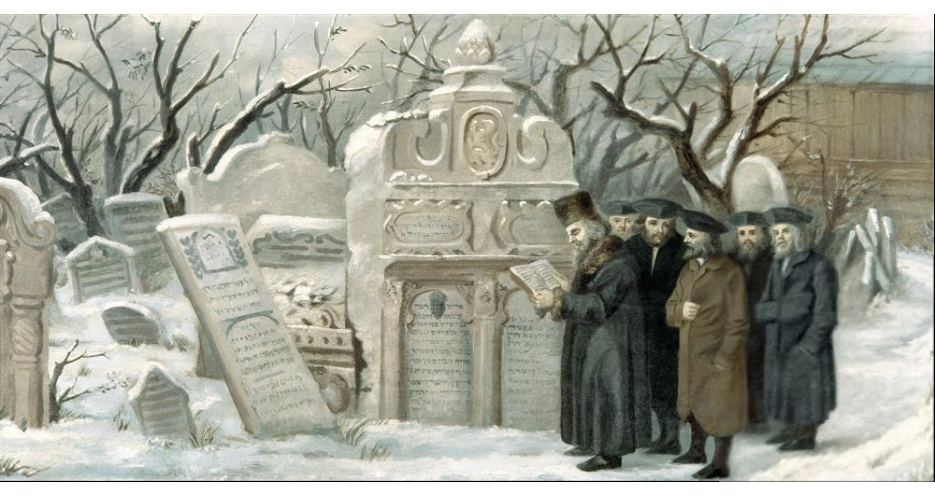
The Maharal passed away on Chai Elul 5369 (1609) and was laid to rest in the old cemetery in Prague alongside his wife, Pearl.
He left behind one son, Betzalel, a famed son-in-law, Rav Yitzchak Katz, and many talmidim, among them Rav Yom Tov Lipman Heller (6 Elul), author of the Tosafos Yom Tov, who was so influenced by his rebbe’s derech in learning of the Mishnah that he authored his famous commentary, and Rav Dovid Ganz, author of Tzemach Dovid (8 Elul).
HIS LEGACY
Perhaps no other Ashkenazi rav from his generation had so profound an influence on Jewish philosophy, thought, mussar and chassidus as the Maharal through the vast number of sefarim he authored.
Among the Chassidic masters, it was Rav Yisrael Haufstein, the Koznitzer Maggid, who encouraged the study and reprinting of the Maharal’s sefarim. According to Chabad tradition, the Alter Rebbe, Rav Shneur Zalman of Liadi, author of Tanya and founder of Chabad, was not only descended from the Maharal but was so influenced by him that the Tanya is largely based on his teachings. The Maharal’s sefarim were also studied and treasured in Peshischa and Kotzk.
Mussar giants such as the founder Rav Yisrael Salanter, his talmid Rav Simcha Zissel of Kelm, and Rav Yerucham Levovitz of Mir cited and used the Maharal’s teachings in their mussar shmuessen. Other modern-day gedolim such as Rav Kook and Rav Yitzchak Hutner, author of Pachad Yitzchak, also used the Maharal’s teachings to teach Jewish philosophy.
Stories of Rav Yehuda Lowy zt"l

I heard the following story from my forefathers. The Maharal married at age 32. He was engaged to the daughter of Rav Shmuel ben Rav Yaakov, a great and wealthy community leader, nicknamed Reich Shmelke (Wealthy Shmelke). He sent the Maharal to study in Premisla at the yeshivah of the Maharshal.
This Reich Shmelke had a son named Yehoshua Shmelke’s, who was the forefather of Rav Shmelke of Ostrog and Rav Shmelke Segal Horowitz, Av Beis Din Trani (ancestor of Rav Shmelke Nikolsburger and his brother Rav Pinchas, author of Hafla’ah), the son of Rav Yehoshua HaAruch Segal (nicknamed HaAruch – der hoicher because he grew taller every Shabbos and diminished Motzaei Shabbos).
Meanwhile, four tragedies befell the Maharal’s father-in-law to be in Prague, leaving him penniless. He then wrote to his future son-in-law that he was no longer able to keep his promises for support. “I therefore release you from this shidduch and you are free to take another proposal.” The Maharal responded, “I wish to take your daughter for my shidduch and I will wait for Hashem’s salvation. I will not be unfaithful.”
Meanwhile, the kallah opened a small store selling baked goods in order to have some means of support and sustenance for her aging parents in such a dire emergency situation.
One day, as the kallah sat selling her baked goods, a soldier on horseback rode up and speared a loaf of bread on the sharp point of his sword and prepared to gallop off with his prize. Terribly distraught, she grabbed hold of the horse’s reins to restrain the soldier, crying and pleading with him, “Please my good soldier, I beg you, I am a poor girl and my parents are elderly and destitute. The sale of this bread is our only source of income. Please do not steal the only means of sustenance we have!” The soldier replied, “I have not eaten for three days and I am starving. Here, take this coat as collateral, and if I do not return with two coins as payment for the loaf within twenty-four hours you can keep the coat instead. The kallah agreed, and when the soldier didn’t return, they found that the coat was lined with gold coins! They wrote back to the chasan, the Maharal, that he was welcome to come back and proceed with the chasunah because, due to this miraculous occurrence, they were wealthy once again. The kallah was then 28, and the Maharal was 32. Her name was Pearl, a flawless jewel (she is indeed buried next to the Maharal in the old Jewish cemetery in Prague; they share the same matzeiva.) (Megillas Yuchsin, Gevuras Ari pp 20-21)
My rebbe from Peshischa said that everyone needs to have two rebbes, one from this world and one from supernal worlds up above – Olam Ha’elyon. I understood that he was referring to the Maharal because he was telling us just then how he had been to his kever in Prague. He said that he had studied the Maharal’s sefarim before davening and that his tefillah that day was especially fluent and fluid. I heard that when he was at the Maharal’s kever in Prague, he asked for three things and promised that if they were fulfilled he would publicize the great value of the Maharal’s sefarim (Ramasayim Tzofim on Tana Devei Eliyahu Chap 18, cited in Gevuras Ari p10, footnote #24).
Divrei Torah of Rav Yehuda Lowy zt"l
lev tov - a good heart
The Maharal’s unique insights and novel chiddushim in Jewish thought and philosophy are often interwoven among explanations of the pesukim in Tanach and the statements and teachings of Chazal.
Often, the same topics and themes are touched upon in several works. The Maharal himself cross references his own sefarim, citing and referring to other places where he has touched upon the topic at hand before or spoken about in greater length and detail. As it is beyond the scope of our work here to properly cite and cover even a portion of the Maharal’s vast encyclopedic treasure trove of sefarim, we give you just a taste of what this is like.
Please enjoy the following excursion among three of the Maharal’s works: Nesivos Olam (arrangement based on Mishlei), Derech HaChaim on Pirkei Avos, and Gur Aryeh on Chumash with Rashi’s commentary.
LEV TOV – A GOOD HEART
It says in Mishlei (22:11), “He who loves the purity of heart; his lips are gracious, the King [Hashem] is his friend.”
Whoever has a good heart is beloved above and below . . . I have already elaborated on this [in Derech HaChaim on Pirkei Avos 2:13-14]: “I prefer the idea of Elazar ben Arach, for his idea includes all of yours.” He says there that whoever has a good heart includes all manner of wholeness and completeness..."
Whoever possesses the attribute of a good heart is worthy of the Divine Spirit of ruach hakodesh, as it says (Midrash Tanchuma, Shemos 4:14): “When he [Aharon] sees you [Moshe], he will rejoice in his heart.” Rabbi Shimon Bar Yochai says that whoever’s heart is happy and gladdened at his brother’s greatness is worthy of donning the Urim V’Tumim (which bestow ruach hakodesh). It is only proper that ruach hakodesh is bestowed upon those who are wholehearted, because the heart sees using ruach hakodesh. None other than Aharon HaKohen merited to have the Urim V’Tumim and ruach hakodesh because he was wholehearted and possessed a good heart – lev tov. . .
This attribute of lev tov refers to a person who desires the best for his fellow and friend; even if he sees in his friend something that appears to be evil, he judges him favorably – dan lekaf zechus . . .
This is similar to what we wrote [Derech HaChaim on Pirkei Avos], that an evil heart contains all evil things, and the result of this attribute is hatred of other creatures. A good-hearted person loves all creatures, desires their good and judges them favorably, while an evil-hearted person hates all creatures as we explained earlier [in Derech HaChaim] regarding the mishnah (Avos 2:16): “An evil eye, the evil inclination and hatred of all creatures drive a person from this world.” (Nesivos Olam: Nesiv Lev Tov)
As it says in Pirkei Avos (2:13-14): “I prefer the idea of Elazar ben Arach to yours, for his idea includes all of yours.” Rav Elazar ben Arach said [that the best path for a person to attach himself to is] a good heart, because when a person possesses a good heart, all good things are contained within it, and he acts with loving kindness towards others . . . People who look towards the future worry about what it will bring and if the outcome will cause them a loss. This doubt prevents them from doing good, whereas a goodhearted person does not hold back from doing chessed even if he will lose out and suffer some loss . . . This is the essence of a person who possesses a good heart: he does good for others even when he loses out . . . He is whole and complete both spiritually and physically. The heart is the source and root of a living being; its location in the center of the body is proof of this. Whenever an object is located in the center, it is always the root for everything else. Therefore, the heart’s location at the center of the body signifies that it is the root and source of the person’s totality . . . When the heart is good all is good (Derech HaChaim).
The mishnah says, “An evil eye, the evil inclination and hatred of all creatures drive out a person from this world,” (Avos 2:16). This is only true if his heart is so evil that he hates other creatures . . . These three things are said to drive a person out from this world because when Hashem created His world, He wrote Ki Tov – it was good – for each and every thing that He created. These three things are the opposite of what Hashem created in His world, and therefore these three things drive a person out from this world. Just as the good found in all creatures is what gives existence to the world, so do these three things drive us out from the world. We have already explained this idea in Gur Aryeh on Parshas Vayeishev (Derech HaChaim).
The pasuk says (Bereishis 37:2): “And Yosef would bring evil reports of them to his father.” Rashi comments there that “every evil that he saw and observed in his brothers – the sons of Leah – he would tell his father.” There are three things in man that are explicitly named evil as mentioned above: “the evil inclination . . . the evil eye . . . and an evil heart.” . . . Because Yosef was a completely righteous tzaddik, he was the only one singled out from among the tribes to be called Yosef HaTzaddik. Because it says, “Say to the tzaddik ki tov,” and a true tzaddik is completely good, Yosef distanced himself from all things evil. His brothers were not on the same level of righteousness as he, and so he suspected them of evil doing . . . because the “evil inclination” for immoral behavior is the strongest urge and passion of them all . . . They showed an “evil eye” when they teased the children of the maidservants (Bilhah and Zilpah) because they wanted to feel superior to them . . . The third aspect, an “evil heart,” . . . was inferred when they were suspected of consuming ever min ha’chai – a limb torn from a live animal – because of the cruelty inherent in such an act.
Regarding these three things, Chazal tell us (Avos 2:16): “Rabbi Yehoshua says an evil eye, the evil inclination and hatred of all creatures drive out a person from this world.” These three are named evil because of the hatred towards others they comprise. He who hates other creatures is called evil-hearted, because hatred is based in the heart. It drives a person from this world because, when Hashem created the world, He declared each stage was good, and when something tends towards evil it is inclined towards leaving this world. . . Therefore an evil eye, an evil inclination and an evil heart drive a person out from this world. The existence of the world is good and its absence is evil, therefore whatever has evil tendencies will eventually vanish (Gur Aryeh Vayeishev).
lev tov - a good heart
The Maharal’s unique insights and novel chiddushim in Jewish thought and philosophy are often interwoven among explanations of the pesukim in Tanach and the statements and teachings of Chazal.
Often, the same topics and themes are touched upon in several works. The Maharal himself cross references his own sefarim, citing and referring to other places where he has touched upon the topic at hand before or spoken about in greater length and detail. As it is beyond the scope of our work here to properly cite and cover even a portion of the Maharal’s vast encyclopedic treasure trove of sefarim, we give you just a taste of what this is like.
Please enjoy the following excursion among three of the Maharal’s works: Nesivos Olam (arrangement based on Mishlei), Derech HaChaim on Pirkei Avos, and Gur Aryeh on Chumash with Rashi’s commentary.
LEV TOV – A GOOD HEART
It says in Mishlei (22:11), “He who loves the purity of heart; his lips are gracious, the King [Hashem] is his friend.”
Whoever has a good heart is beloved above and below . . . I have already elaborated on this [in Derech HaChaim on Pirkei Avos 2:13-14]: “I prefer the idea of Elazar ben Arach, for his idea includes all of yours.” He says there that whoever has a good heart includes all manner of wholeness and completeness..."
Whoever possesses the attribute of a good heart is worthy of the Divine Spirit of ruach hakodesh, as it says (Midrash Tanchuma, Shemos 4:14): “When he [Aharon] sees you [Moshe], he will rejoice in his heart.” Rabbi Shimon Bar Yochai says that whoever’s heart is happy and gladdened at his brother’s greatness is worthy of donning the Urim V’Tumim (which bestow ruach hakodesh). It is only proper that ruach hakodesh is bestowed upon those who are wholehearted, because the heart sees using ruach hakodesh. None other than Aharon HaKohen merited to have the Urim V’Tumim and ruach hakodesh because he was wholehearted and possessed a good heart – lev tov. . .
This attribute of lev tov refers to a person who desires the best for his fellow and friend; even if he sees in his friend something that appears to be evil, he judges him favorably – dan lekaf zechus . . .
This is similar to what we wrote [Derech HaChaim on Pirkei Avos], that an evil heart contains all evil things, and the result of this attribute is hatred of other creatures. A good-hearted person loves all creatures, desires their good and judges them favorably, while an evil-hearted person hates all creatures as we explained earlier [in Derech HaChaim] regarding the mishnah (Avos 2:16): “An evil eye, the evil inclination and hatred of all creatures drive a person from this world.” (Nesivos Olam: Nesiv Lev Tov)
As it says in Pirkei Avos (2:13-14): “I prefer the idea of Elazar ben Arach to yours, for his idea includes all of yours.” Rav Elazar ben Arach said [that the best path for a person to attach himself to is] a good heart, because when a person possesses a good heart, all good things are contained within it, and he acts with loving kindness towards others . . . People who look towards the future worry about what it will bring and if the outcome will cause them a loss. This doubt prevents them from doing good, whereas a goodhearted person does not hold back from doing chessed even if he will lose out and suffer some loss . . . This is the essence of a person who possesses a good heart: he does good for others even when he loses out . . . He is whole and complete both spiritually and physically. The heart is the source and root of a living being; its location in the center of the body is proof of this. Whenever an object is located in the center, it is always the root for everything else. Therefore, the heart’s location at the center of the body signifies that it is the root and source of the person’s totality . . . When the heart is good all is good (Derech HaChaim).
The mishnah says, “An evil eye, the evil inclination and hatred of all creatures drive out a person from this world,” (Avos 2:16). This is only true if his heart is so evil that he hates other creatures . . . These three things are said to drive a person out from this world because when Hashem created His world, He wrote Ki Tov – it was good – for each and every thing that He created. These three things are the opposite of what Hashem created in His world, and therefore these three things drive a person out from this world. Just as the good found in all creatures is what gives existence to the world, so do these three things drive us out from the world. We have already explained this idea in Gur Aryeh on Parshas Vayeishev (Derech HaChaim).
The pasuk says (Bereishis 37:2): “And Yosef would bring evil reports of them to his father.” Rashi comments there that “every evil that he saw and observed in his brothers – the sons of Leah – he would tell his father.” There are three things in man that are explicitly named evil as mentioned above: “the evil inclination . . . the evil eye . . . and an evil heart.” . . . Because Yosef was a completely righteous tzaddik, he was the only one singled out from among the tribes to be called Yosef HaTzaddik. Because it says, “Say to the tzaddik ki tov,” and a true tzaddik is completely good, Yosef distanced himself from all things evil. His brothers were not on the same level of righteousness as he, and so he suspected them of evil doing . . . because the “evil inclination” for immoral behavior is the strongest urge and passion of them all . . . They showed an “evil eye” when they teased the children of the maidservants (Bilhah and Zilpah) because they wanted to feel superior to them . . . The third aspect, an “evil heart,” . . . was inferred when they were suspected of consuming ever min ha’chai – a limb torn from a live animal – because of the cruelty inherent in such an act.
Regarding these three things, Chazal tell us (Avos 2:16): “Rabbi Yehoshua says an evil eye, the evil inclination and hatred of all creatures drive out a person from this world.” These three are named evil because of the hatred towards others they comprise. He who hates other creatures is called evil-hearted, because hatred is based in the heart. It drives a person from this world because, when Hashem created the world, He declared each stage was good, and when something tends towards evil it is inclined towards leaving this world. . . Therefore an evil eye, an evil inclination and an evil heart drive a person out from this world. The existence of the world is good and its absence is evil, therefore whatever has evil tendencies will eventually vanish (Gur Aryeh Vayeishev).
Segulos of Rav Yehuda Lowy zt"l
During the infamous pogroms of Ta”ch V’Ta”t (years 5408 and 5409 – 1648-1649) the Tosafos Yom Tov fasted and beseeched that from on High it be revealed to him why such terrible calamities had befallen the Jewish people. It was revealed to him from on High that there was lightheaded, idle chatter in shul. People spoke in shul and in the middle of davening, which caused a blemish in the letter “vav” and the word for speech, dibur, was transformed into dever, a plague! When he learned of this, he composed a special prayer (others say the Maharal composed it but the Tosafos Yom Tov instituted and enacted its recitation in his kehillos. See the original nusach below) to help increase the awareness of the power of silence in shul, the destructive nature of idle chatter, and talking in shul and during davening. It is printed in many siddurim alongside the Mi Sheberach we recite on Shabbos after the reading of the Torah.