
Rav Aharon of Zhitomir zt"l
הרב אהרן בן מרדכי מזיטאמיר זצ"ל
Tishrei 26 , 5577
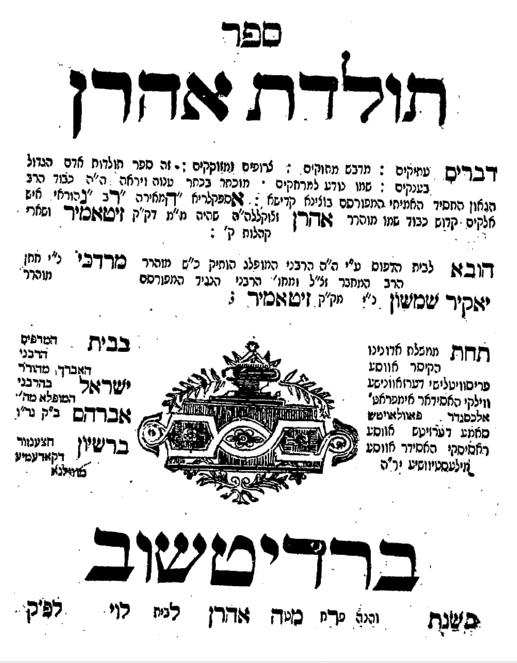
Rav Aharon of Zhitomir zt"l
Rav Aharon of Zhitomir, son of Rav Mordechai, was recognized at a young age as a Talmid Chochom. He supported himself by working, rather than by assuming a Rabbinical position. He gave fiery deroshos to be mechazek limud haTorah.
In the sha’ar of his sefer, Toldos Aharon, he is identified as one of the leading talmidim of Rav Levi Yitzchok of Berditchev. After the petira of Rav Zev Wolf of Zhitomir, the Ohr HaMeir, Rav Levi Yitzchok appointed Rav Aharon as his successor. Rav Levi Yitzchok warned the community of Zhitomir to heed his every word.
The Ohev Yisrael of Apta, Rav Yisrael of Pikov, son of Rav Levi Yitzchok of Berditchev, and Rav Mordechai of Chernobyl all wrote warm haskomos to Toldos Aharon, attesting to the great tzidkus and high madreigos of its mechaber. Rav Aharon was considered a k’dosh elyon.
He was the Maggid in Zhitomir for three years, and then moved to Hungary, where he was active in spreading Toras HaChassidus, especially in the cities of Krali and Ashver where he lived. His deroshos brought people to teshuva. Some listeners became his Chassidim.
Rav Aharon was niftar on the 26th of Tishrei, a day after the Yahrzeit of his Rebbe, Rav Levi Yitzchok of Berditchev. He was buried in Zhitomir.
When his talmidim saw that his end was near, they began to cry.
“Why are you crying?” Rav Aharon asked them. “The end of every person is death.”
“How can we not cry when our Rebbe is leaving us?” they answered. “We will be left a flock without a shepherd. The other Tzaddikim of the generation are more hidden in their Avodas Hashem, unlike our Rebbe, to whose derech in Avodas Hashem we have become accustomed.”
“Know,” said Rav Aharon, “that before Moshiach comes there will be Tzaddikim who will be greater than me, and with what they do, they will be meyached more yichudim than we accomplished, even with our learning and davening!”
One of his closest talmidim, Rav Levi of Zhitomir, wrote down his Divrei Torah after every Shabbos and Yom Tov. Rav Aharon himself edited these notes. Toldos Aharon was first printed in Berditchev, shortly after his petira in 5577, by his son-in-law, Rav Mordechai, and Rav Mordechai’s father, the noggid, Rav Yakir Shimshon of Zhitomir. Other Divrei Torah of Rav Aharon are printed in Pisgomin Kaddishin.
www.hamodia.com/features/day-history-26-tishreioctober-20/
Stories of Rav Aharon of Zhitomir zt"l

Rav Avrohom Dov of Avritch, mechaber of Bas Ayin and a talmid of Rav Levi Yitzchok of Berditchev, was visiting Zhitomir. He went to see the Toldos Aharon, Rav Aharon Zhitomir, also a talmid of Rav Levi Yitzchok. The Avritcher found Rav Aharon lying sick in bed. Rav Aharon was very glad to see Rav Avrohom Dov. “I will only be cured when I drink water that came from Eretz Yisrael,” he explained. “I know that you are planning to travel there. In fact, your thoughts are already there, and as we both know, wherever a person’s thoughts are, that is where the person is. Please, Rav Avrohom, take a mouthful of water and place it in a vessel. It will be just like water that came from Eretz Yisrael. I will drink it and be healed.”
And so it was.
The Avritcher wondered, though, how Rav Aharon could possibly know of his deep longing to move to the Holy Land. He had not told his plans to a soul. It was just an idea in his mind, and yet Rav Aharon knew all about it!
When Rav Mordechai of Slonim related this tale, he added that the Avritcher discusses this concept in his sefer Bas Ayin. He quotes Rashi’s comment in Vayishlach that the messengers that Yaakov sent to Esav were in fact malochim, and Rav Aharon writes: “We must seek to understand how malochim from the Holy Land [what does it mean they came from the Holy Land? Don’t malochim dwell in a spiritual realm above?] could come to Yaakov when he had not yet entered Eretz Yisrael. He hadn’t even reached Sukkos yet! The Ramban asks this very question in his commentary and answers that since he was traveling to Eretz Yisrael, it was as if he had already arrived there.”
(Based on Ma’amar Mordechai 9 and Kisvei Rav Yoshe 4, p. 181. It’s important to note that in our printed version of the Ramban’s commentary, he does not pose this question in Vayishlach, but rather in Vayeitzei.)
The answer that the Bas Ayin gives doesn’t appear in the Ramban’s commentary at all. HaRav Yisrael Meir Mendelowitz, however, in his notes to Bas Ayin (Brooklyn, New York: 2006) adds that perhaps the answer can be found in the Ramban’s commentary to Eiruvin 17, where he discusses the concept that everywhere a man’s thoughts are, that is where he is. See also Meor Einayim (Yismach Lev, Kesubos), which discusses this at length. See also Shabbos 102a and Eiruvin 99a.
Rav Yitzchok Neshchizer related one Shabbos during the month of Menachem Av how the holy Rav Araleh (Aharon) of Zhitomir was originally a talmid of the Vilna Gaon. However, that path was unacceptable to his heart. He heard that in Zelichov there was a certain Rav Levi Yitzchok who ran a Yeshiva there. (The Berditchever was still Rav in Zelichov at the time).
Rav Araleh visited his Yeshiva, and there the Berditchever saw him from far away, five seats away from him, and did not even turn toward him at all. Even though all of Rav Araleh’s questions were good and right on target, Rav Levi Yitzchok initially paid him no heed and he did not answer him. He said that as long as he had in him even a vestige of haughtiness or arrogance, he would not draw him close.
Afterward, when the Berditchever felt that he had refined himself enough, he drew him close and sat Rav Aharon next to him. They studied together the Gemora that relates that if one finds a bill of debt that proves liability, why should he not return it? The Berditchever explained this to Rav Aharon as: “If you find your own liability, why should you not return to Hashem and repent fully?!”
(Zichron Tov – MeAvodas HaTzaddikim #4, Page 12).
The holy Rav Levi Yitzchok of Berditchev once traveled with his talmid, Rav Aharon of Zhitomir, mechaber of Toldos Aharon, to the city of Lizhensk. There they stayed together with Rebbe Reb Elimelech in his home. Rebbe Reb Elimelech questioned the Berditchever, saying to him, “Why are you stealing away all of my own talmidim?” (This was because many great Torah scholars left Rebbe Reb Elimelech to study under the Berditchever.)
The Berditchever answered Rebbe Reb Elimelech with humility, “Vaymens bin ich den? Ich bin zich ayer talmid oich! - And just whose talmid do you think I am? I am also your talmid! Thus, all my talmidim are therefore your very own talmid’s talmidim!” With this humble answer, he was able to placate and satisfy Rebbe Reb Elimelech. Afterward, the Berditchever continued on his way to attend to some matters while his talmid, Rav Aharon of Zhitomir, remained behind and continued studying in Rebbe Reb Elimelech’s Bais Medrash.
Rebbe Reb Elimelech did not realize this, and when one night he walked in and found Rav Aharon sitting there learning, he was surprised and asked Rav Aharon, “Why did you not continue traveling with your Rebbe?” Rav Aharon answered Rebbe Reb Elimelech, “Mein Rebbe ken ich. Bin ich gebliben ba aych zu kenen! – My Rebbe I already know. I remained behind to get to know you as well!” Hearing this, Rebbe Reb Elimelech got all worked up. He seized Rav Aharon and began to shake him by the lapels of his clothing and declared, “Dein Rebbe kenstu? Afilu zein zhupstze kenstu nisht, bifrat im alein! – You think you really know your Rebbe? Why, you don’t even know his lapels, let alone really know him and how great he is!”
(Avodas Levi, page 98)